All species › Swifts › Hummingbirds › Green-crowned Brilliant
Green-crowned Brilliant | Heliodoxa jacula
Groenkruinbriljantkolibrie | Brillante coroniverde | Brilhante-de-coroa-verde
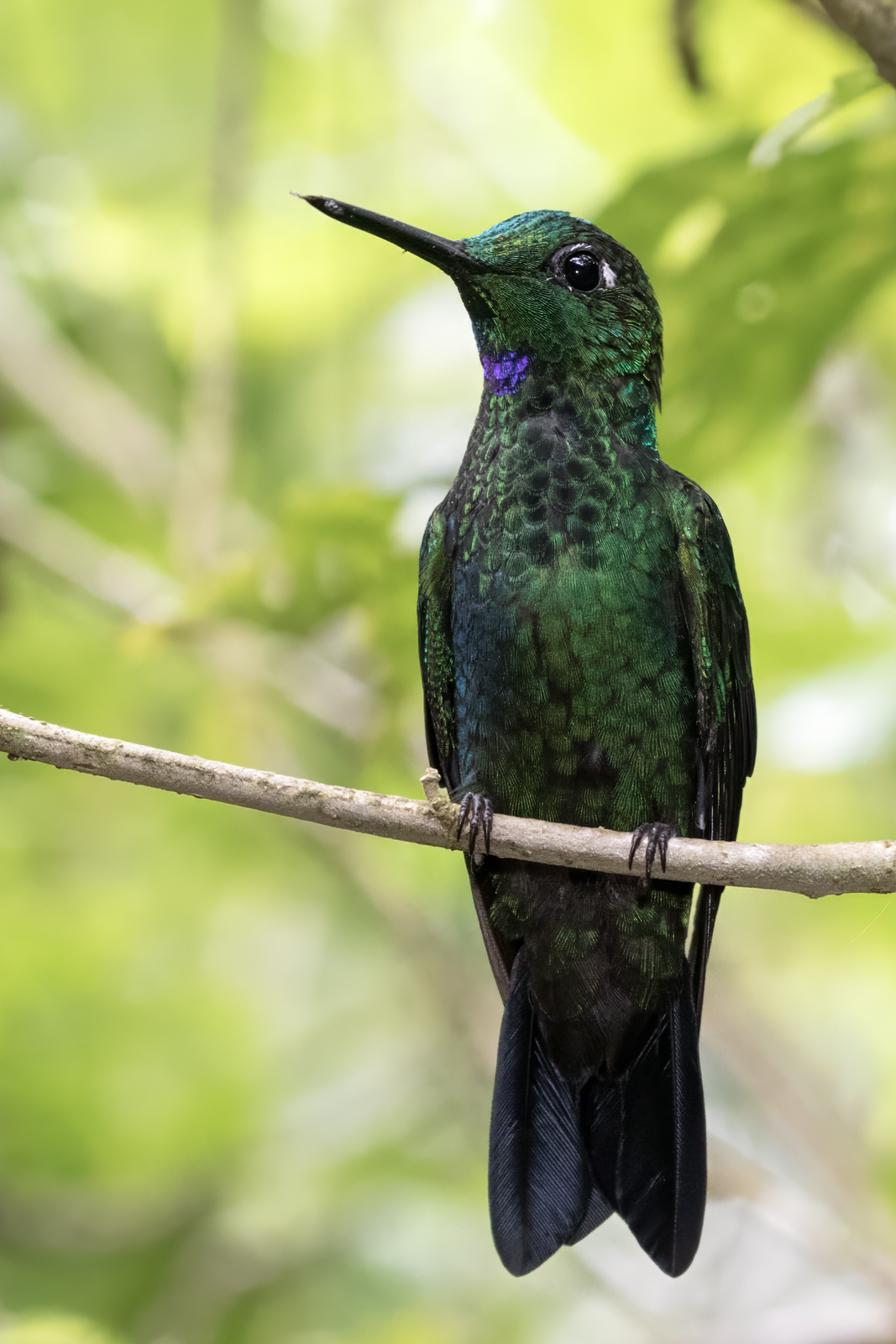
The Green-crowned Brilliant is a large, green brilliant of humid montane forest from Panama to western Ecuador. The male is almost entirely glittering green, with a small violet-blue throat patch and a forked blue-black tail. The species defends flowering plants and regularly comes to feeders.
Voice
A loud, squeaky kyew or tyew; chasing birds give sputtering notes and squeaks.
Recording: José María Loaiza B. — CC BY-NC-SA 4.0 · xeno-canto
Identification
12–13 cm, with a straight black bill and a white spot behind the eye. The male has a glittering green to blue-green head and breast, with a small, glittering violet-blue patch on the throat; the upperparts and belly are bronzy green, the vent and thighs white. The tail is blue-black and clearly forked. The female has white underparts densely spotted green, a short white malar stripe and a less deeply forked black tail with white tips to the outer feathers.
Confusion species
Empress Brilliant Heliodoxa imperatrix is larger, with a much longer, deeply forked bronzy black tail and a golden green belly, and lacks the white vent. Fawn-breasted Brilliant Heliodoxa rubinoides has buff underparts. Crowned Woodnymph Thalurania colombica is smaller, and the male has a violet crown and belly. Violet-fronted Brilliant Heliodoxa leadbeateri has a violet-blue forehead in the male and lives mainly on the east side of the Andes.
Habitat
The interior, edges and clearings of humid montane forest and lower cloud forest, also mature secondary forest and gardens, in Colombia between about 300 and 1700 m and in Ecuador mostly between 500 and 1550 m. It feeds in the lower and middle strata at flowers, defends flowering plants against other hummingbirds and catches small insects.
Where the bird is most at home, classified by the vegetation units of the Andes and the west coast.


Range and movements
In Colombia in all three Andean ranges, mainly the western and central ranges and the Pacific slope. In Ecuador on the western slope of the Andes, south to at least El Oro. Absent from Peru, Bolivia and the Galápagos. Outside the guide area in Costa Rica and Panama.
- Resident
- dark = core range, pale = thinly spread
How and when to look
At lodge feeders on the western slope in north-western Ecuador, for example around Mindo, and in western Colombia. Males often hold the same flowering plants.
Conservation status
Least Concern. The species is locally common and tolerates secondary forest, but deforestation of the slopes affects its habitat.
Scientific name
Heliodoxa jacula | Gould, 1850
Gould described the species in 1850 and placed it straight away in the genus where it still stands. He introduced the genus Heliodoxa in that same work. The genus name combines Greek hēlios, 'sun', with doxa, 'glory' or 'splendour'. The species name comes from Latin iaculus, 'thrown, darting' (compare Late Latin iaculum, 'arrow'). The specimen the first description was based on came from Bogotá, Colombia.