All species › Passerines › Mockingbirds and thrashers › Espanola Mockingbird
Espanola Mockingbird | Mimus macdonaldi
Españolaspotlijster | Cucuve de Española | Sabiá-de-española
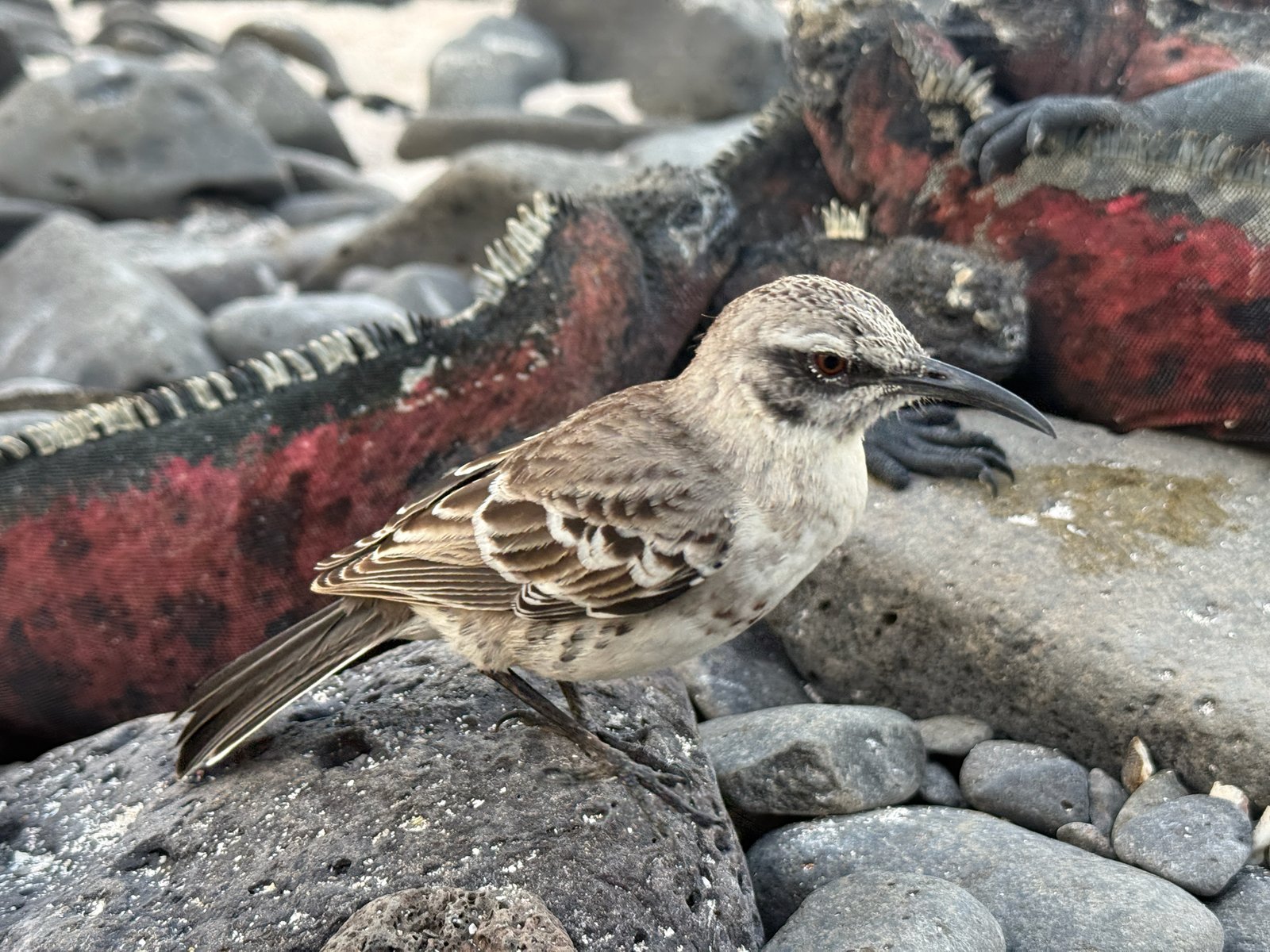
The Espanola Mockingbird is the largest of the four mockingbirds of the Galápagos and occurs only on Española and a few islets off it. It has the longest and most decurved bill of the group and walks more than it flies. On this dry island without fresh water it obtains moisture from eggs, fruit and carrion, and it inspects visitors and their water bottles at close range.
Voice
The song is a series of whistled, hoarse and scratchy notes, often given from the ground, a rock or a shrub. The call is a harsh, hoarse rasp; groups are very noisy when alarmed.
Recording: Paul Driver — CC BY-NC-SA 4.0 · xeno-canto
Identification
28 cm, a large, long-tailed mockingbird with long legs and a long, clearly decurved black bill. The upperparts are grey-brown with dark streaking, the underparts dingy white with brown spots or streaks on the breast sides and flanks. A dark patch behind the eye forms a mask, less sharply defined than in Galapagos Mockingbird. The wings are dark with narrow pale wing bars, and the tail is dark with pale edges. The sexes are alike; juveniles are browner and more heavily streaked.
Confusion species
No other mockingbird lives on Española. Galapagos Mockingbird Mimus parvulus, on most other islands, is smaller, with a shorter, less decurved bill and a sharper dark mask. San Cristobal Mockingbird Mimus melanotis on neighbouring San Cristóbal is smaller, with a shorter bill and a dark ear patch. Floreana Mockingbird Mimus trifasciatus is slightly smaller and has dark patches on the breast sides.
Habitat
Dry coastal and lowland vegetation with shrubs, cacti and lava rocks, also in and around the seabird colonies of Española. It forages mainly by walking on the ground, taking insects, spiders, fruit, seeds, seabird eggs and carrion, also at sea lion colonies. It lives in groups that defend a territory together; group members help raise the young. The nest is a cup of twigs in a shrub or cactus.
Where the bird is most at home, classified by the vegetation units of the Andes and the west coast.


Range and movements
Endemic to the Galápagos: only on Española and a few islets off it, such as Gardner. Absent from the other islands, where other mockingbirds live, and from mainland Colombia, Ecuador, Peru and Bolivia.
- Resident
How and when to look
On the visitor trail at Punta Suárez and on the beach at Bahía Gardner on Española; the birds often walk right up to visitors and their bags.
Conservation status
Vulnerable. Its entire range is limited to one small island and a few islets, and numbers fluctuate strongly with drought and El Niño years. Introduced diseases and animals are a potential threat; since the removal of goats from Española the vegetation has been recovering.
Scientific name
Mimus macdonaldi | (Ridgway, 1890)
Ridgway described the species in 1890 as Nesomimus macdonaldi; because it was later moved to another genus, the author and year stand in brackets. The genus Mimus was introduced in 1826 by Boie. The genus name is Latin mimus, 'mimic', after the imitation of other sounds. The species name honours Marshall McDonald (1835–1895), United States Commissioner of Fisheries. The specimen the first description was based on came from Isla Española, Galápagos.