All species › Passerines › Mockingbirds and thrashers › San Cristobal Mockingbird
San Cristobal Mockingbird | Mimus melanotis
Sancristóbalspotlijster | Cucuve de San Cristóbal | Sabiá-de-san-cristóbal
The San Cristobal Mockingbird occurs only on San Cristóbal, the easternmost large island of the Galápagos. It was on this island that Darwin collected his first mockingbird of the archipelago in 1835; he later realised that each island had its own form. The species is less numerous than Galapagos Mockingbird and is under pressure from introduced animals.
Voice
The song is a varied series of whistled, scratchy and chattering notes, often given from a shrub or rock. The call is a harsh, hoarse rasp.
Recording: Patricio Mena Valenzuela — CC BY-NC-SA 4.0 · xeno-canto
Identification
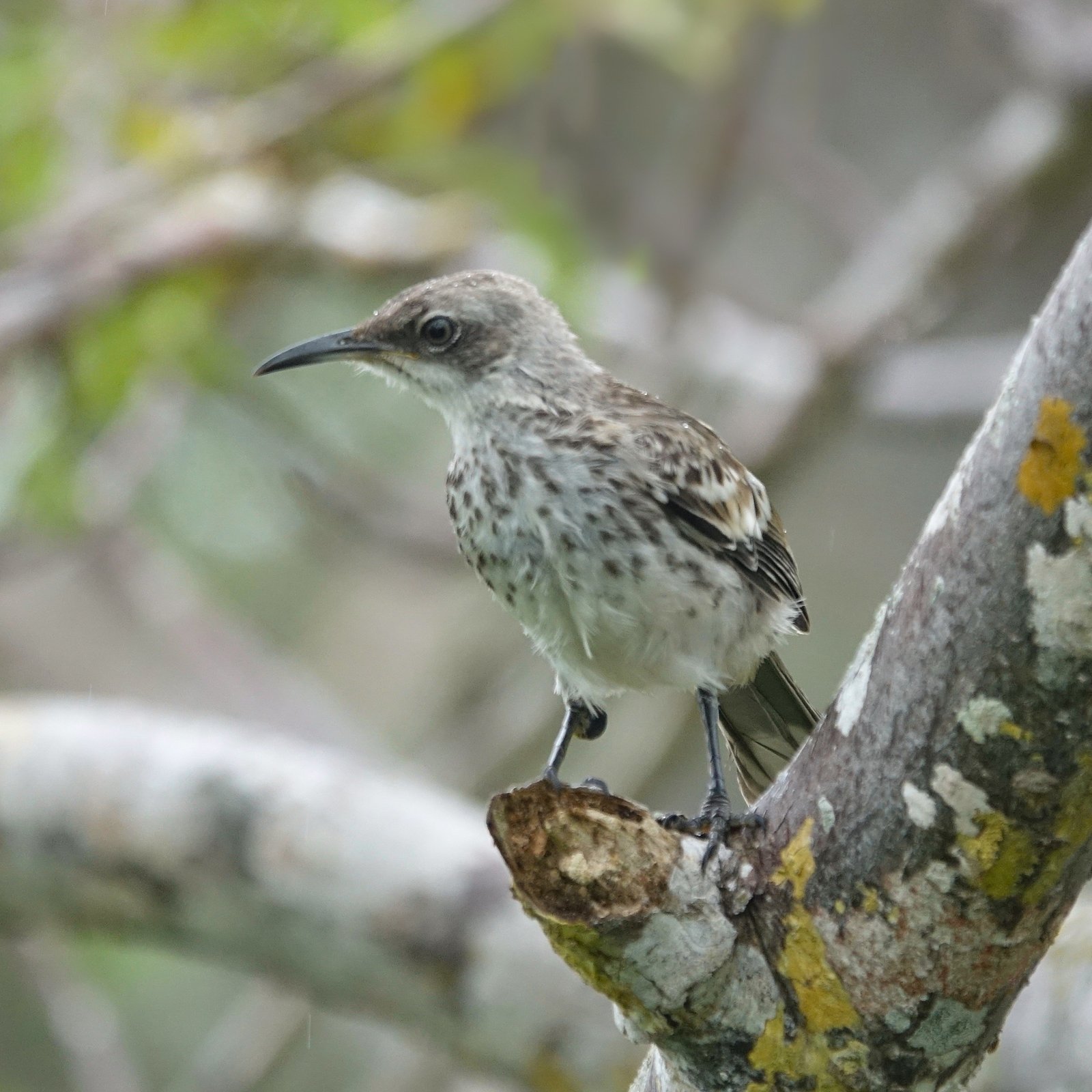
25 cm, a slender mockingbird with a long tail, long legs and a slightly decurved black bill. The upperparts are browner than in Galapagos Mockingbird, with dark streaking. The underparts are dingy white, with small dark spots on the breast sides. The name melanotis means 'black ear' and refers to the dark ear patch behind the eye. The wings are dark with narrow pale wing bars. The sexes are alike; juveniles are browner and more streaked.
Confusion species
No other mockingbird lives on San Cristóbal. Galapagos Mockingbird Mimus parvulus of most other islands is greyer, with a more sharply defined mask and a paler breast. Espanola Mockingbird Mimus macdonaldi on neighbouring Española is larger, with a longer, more decurved bill.
Habitat
Mainly the arid lowland zone with shrubs, cacti and lava fields, but also higher up in the transition zone and the wetter parts of the island, and in and around Puerto Baquerizo Moreno. It eats insects, spiders, fruit, nectar and small vertebrates. It lives in groups with a shared territory. The nest is a cup of twigs in a shrub or small tree.
Where the bird is most at home, classified by the vegetation units of the Andes and the west coast.


Range and movements
Endemic to the Galápagos: only on San Cristóbal. Absent from the other islands, where other mockingbirds live, and from mainland Colombia, Ecuador, Peru and Bolivia.
- Resident
How and when to look
In and around Puerto Baquerizo Moreno, for example along the trail from the interpretation centre to Cerro Tijeretas, and in the arid zone along the coast.
Conservation status
Near Threatened. Its range is limited to a single island, where introduced rats and cats, the parasitic fly Philornis downsi and the conversion of native vegetation to farmland put pressure on numbers.
Scientific name
Mimus melanotis | (Gould, 1837)
Gould described the species in 1837 as Orpheus melanotis; because it was later moved to another genus, the author and year stand in brackets. The genus Mimus was introduced in 1826 by Boie. The genus name is Latin mimus, 'mimic', after the imitation of other sounds. The species name comes from Greek melas, 'black', and ous, ōtos, 'ear': black-eared. The specimen the first description was based on came from Galápagos.