All species › Passerines › Mockingbirds and thrashers › Long-tailed Mockingbird
Long-tailed Mockingbird | Mimus longicaudatus
Langstaartspotlijster | Sinsonte colilargo | Sabiá-de-cauda-longa
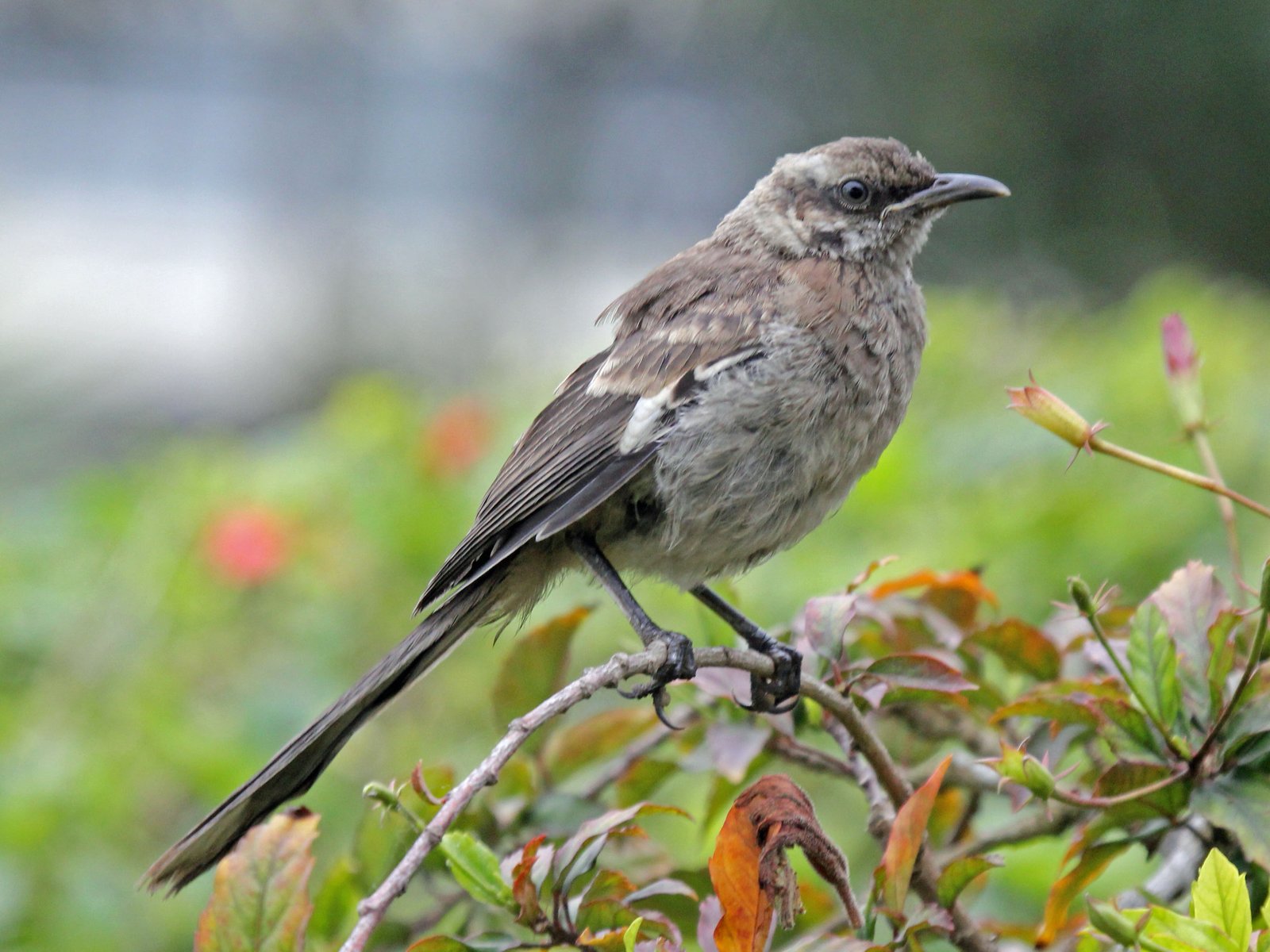
The Long-tailed Mockingbird is the large mockingbird of the dry Pacific coast of Ecuador and Peru. It has a very long, white-tipped tail, shows white wing patches in flight and sings loudly and in great variety. In the coastal desert and the dry valleys it is one of the most widespread birds, also in gardens and parks of cities such as Lima.
Voice
A loud, varied song of repeated whistled and scratchy phrases, often given from a shrub top, post or roof. The call is a harsh, hoarse chack.
Recording: Juan Freile — CC BY-NC-SA 4.0 · xeno-canto
Identification
29–31 cm, large and slender, with long legs, a long, slightly decurved black bill and a very long, graduated tail. The upperparts are grey-brown with dark streaking. The head has a pale supercilium, a dark eye-stripe and a dark malar stripe bordering the white throat. The underparts are dingy white to pale buff, with some streaking on the flanks. The wings are dark with two white wing bars and a white patch at the base of the primaries, visible mainly in flight. The tail is dark with broad white tips to the outer feathers. The sexes are alike; juveniles are browner, with spots on the breast.
Confusion species
Along the Pacific coast of the mainland this is the only mockingbird. Tropical Mockingbird Mimus gilvus of Colombia is smaller and greyer, with a shorter tail and no malar stripe, and does not occur in the same area. Brown-backed Mockingbird Mimus dorsalis has a warmer brown back and lives in the dry Andean valleys of Bolivia. Galapagos Mockingbird Mimus parvulus and its relatives on the Galápagos are smaller and shorter-tailed.
Habitat
Dry scrub, coastal desert with scattered trees and shrubs, Tumbesian dry forest, riparian growth in the coastal valleys, fields, orchards, gardens and parks, from sea level to roughly 2500 m. It forages much on the ground for insects and other invertebrates and also eats fruit. The nest is a cup of twigs in a shrub or tree.
Where the bird is most at home, classified by the vegetation units of the Andes and the west coast.


Range and movements
Ecuador: in the dry west and south-west, from Manabí and the Santa Elena peninsula to El Oro and Loja. Peru: along the Pacific coast and on the western slope of the Andes to the south of the country, and in the dry Marañón valley. Absent from Colombia, Bolivia and the Galápagos. Hardly occurs outside the guide area.
- Resident
- dark = core range, pale = thinly spread
How and when to look
In almost every dry coastal valley in Peru and south-western Ecuador; in Lima it lives in parks and gardens. Look for the long tail and white wing patches as the bird flies from shrub to shrub.
Conservation status
Least Concern. The species is common and makes much use of gardens, orchards and irrigated farmland in the dry coastal regions.
Scientific name
Mimus longicaudatus | Tschudi, 1844
Tschudi described the species in 1844 and placed it straight away in the genus where it still stands. The genus Mimus was introduced in 1826 by Boie. The genus name is Latin mimus, 'mimic', after the imitation of other sounds. The species name comes from Latin longus, 'long', and caudatus, 'tailed': long-tailed. The specimen the first description was based on came from Lima, Peru.