All species › Passerines › Mockingbirds and thrashers › Tropical Mockingbird
Tropical Mockingbird | Mimus gilvus
Tropische spotlijster | Centzontle tropical | Sabiá-da-praia
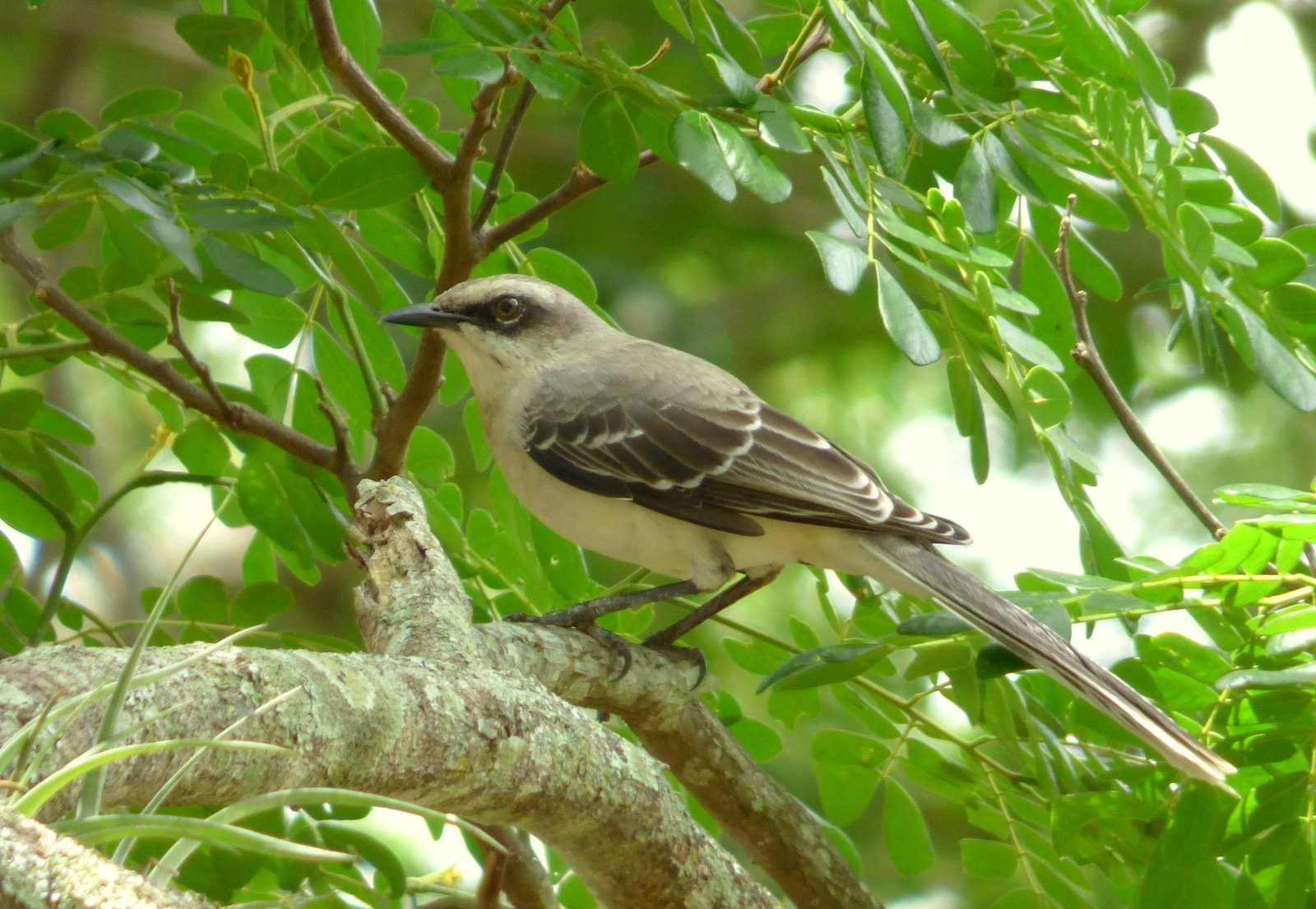
The Tropical Mockingbird is a grey-and-white mockingbird of open, dry and inhabited country in northern South America and Central America. In the guide area it occurs only in Colombia, where it inhabits open country in the lowlands and Andean valleys and appears to be gaining ground with deforestation. It often sings from roofs, wires and shrub tops, also in the middle of villages and towns.
Voice
A loud, varied song of whistled and scratchy phrases, often repeated a few times. The call is a harsh, hoarse chack.
Recording: Denis Dujardin — CC BY-NC-SA 4.0 · xeno-canto
Identification
23–25 cm, slender, with a long tail and a thin, slightly decurved black bill. The upperparts are grey, the underparts dingy white, almost unstreaked. The head has a white supercilium and a dark eye-stripe; the eye is yellowish. The wings are blackish with two narrow white wing bars and white feather edges. The tail is blackish with broad white tips to the outer feathers. The sexes are alike; juveniles are browner, with spots on the breast and a dark eye.
Confusion species
In Colombia this is the only mockingbird. Long-tailed Mockingbird Mimus longicaudatus of the Pacific coast of Ecuador and Peru is larger, browner and longer-tailed, with a dark malar stripe. Chalk-browed Mockingbird Mimus saturninus of the Bolivian lowlands is browner, with a streaked back and a broad white supercilium. Neither occurs together with Tropical Mockingbird.
Habitat
Open country with scattered shrubs and trees, dry savanna, pastures, fields, gardens, parks and villages, from sea level to roughly 2700 m in the Andes, for example on the Bogotá plateau. It forages on the ground and in shrubs for insects, other invertebrates and fruit. The nest is a cup of twigs in a shrub or tree.
Where the bird is most at home, classified by the vegetation units of the Andes and the west coast.


Range and movements
Colombia: widespread in the Caribbean lowlands, in the Magdalena and Cauca valleys, on the plateau of the Eastern Andes and in the Llanos, and also on San Andrés and Providencia; largely absent from the Amazon region and the Pacific coast. Absent from Ecuador, Peru, Bolivia and the Galápagos. Outside the guide area from southern Mexico to Central America, and in Venezuela, the Guianas, along the east coast of Brazil and in the Lesser Antilles.
- Resident
- dark = core range, pale = thinly spread
How and when to look
In almost every village and park in the Caribbean lowlands and Andean valleys of Colombia, including Bogotá; the birds often sing from an antenna, roof or shrub top.
Conservation status
Least Concern. The species is common and makes much use of cleared land, pastures and built-up areas.
Scientific name
Mimus gilvus | (Vieillot, 1808)
Vieillot described the species in 1808 as Turdus gilvus; because it was later moved to another genus, the author and year stand in brackets. The genus Mimus was introduced in 1826 by Boie. The genus name is Latin mimus, 'mimic', after the imitation of other sounds. The species name is Latin gilvus, 'pale yellow, dull'. The specimen the first description was based on came from French Guiana.