All species › Passerines › Mockingbirds and thrashers › Grey Catbird
Grey Catbird | Dumetella carolinensis
Katvogel | Pájaro gato gris | Pássaro-gato-cinzento
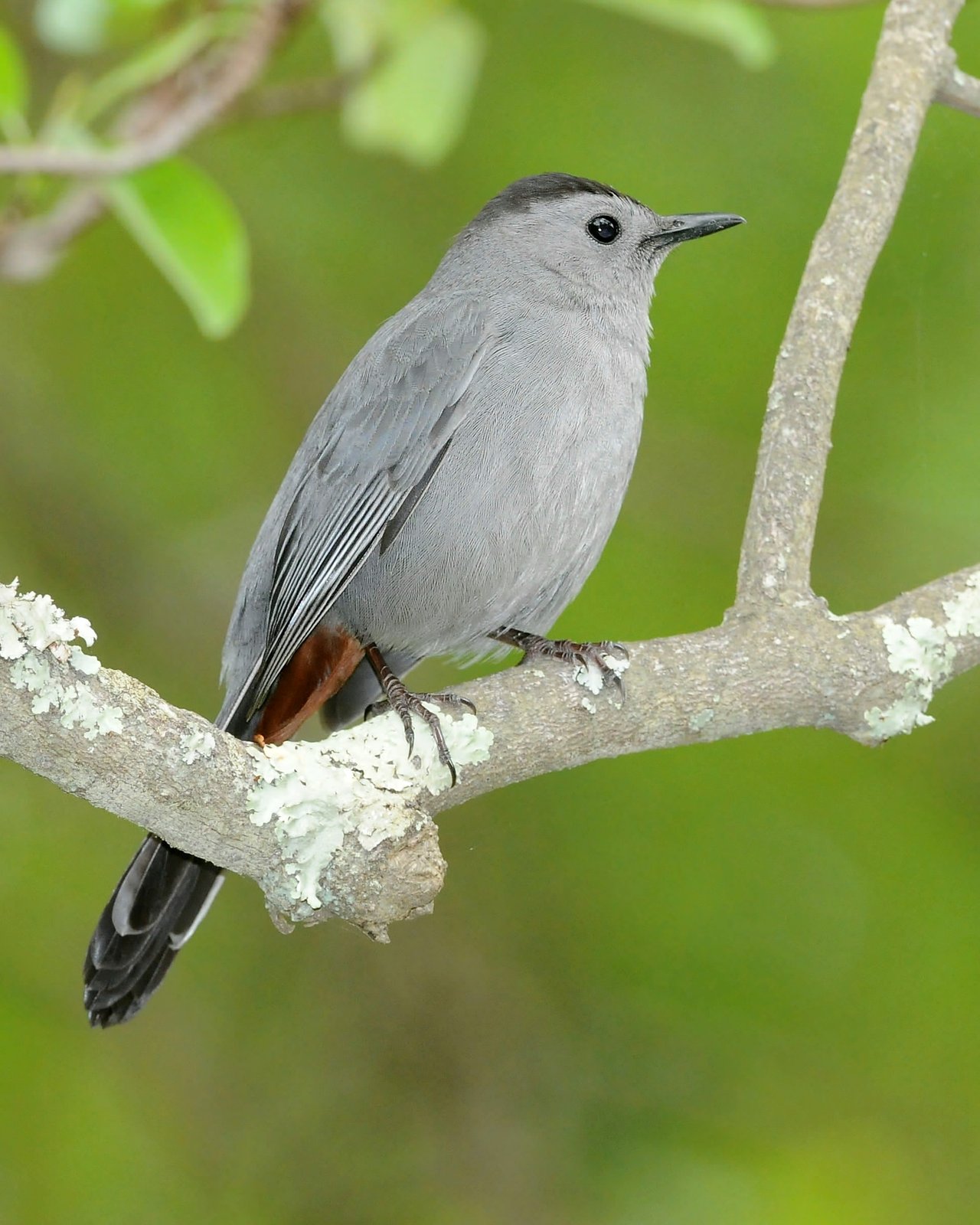
The Grey Catbird is a slate-grey mimid of thickets in eastern and central North America, named after its mewing call. It winters mainly in the south-eastern United States, Mexico, Central America and the Caribbean. In the guide area it is a vagrant, seen with some regularity in winter only on the Colombian islands of San Andrés and Providencia.
Voice
The call is a nasal, mewing meeow, recalling a cat; also a quick, dry kwut. The song, rarely heard in winter quarters, is a long, irregular series of scratchy, squeaky and whistled phrases, often with imitations, the phrases usually not repeated.
Recording: Scott Olmstead — CC BY-NC-SA 4.0 · xeno-canto
Identification
21–23 cm, a slender, plain slate-grey bird with a long, rounded tail and a thin black bill. The crown is black and the tail blackish. The undertail coverts are rufous, often visible only when the bird cocks its tail. Eyes dark, legs dark. The sexes are alike; juveniles are duller, with paler undertail coverts.
Confusion species
Hardly confusable. Tropical Mockingbird Mimus gilvus is pale grey, with whitish underparts, a dark eyestripe and white tips to the tail. Grey thrushes (Turdus) lack the black cap and rufous undertail coverts and usually have a yellow or orange bill.
Habitat
In winter quarters in dense thickets, forest edges, secondary forest, gardens, mangrove edges and plantations, usually low in the vegetation and often on the ground. It eats insects and other invertebrates and in winter many berries and fruits. It breeds in North America in dense shrubs, with a cup-shaped nest.
Where the bird is most at home, classified by the vegetation units of the Andes and the west coast.


Range and movements
Colombia: on San Andrés and Providencia a scarce but recurring winter visitor from about October to April; very rare on the mainland, with a few records along the Caribbean coast in the north. No or hardly any records from Ecuador, Peru and Bolivia; absent from the Galápagos. Breeds in southern Canada and the eastern and central United States; winters from the south-eastern United States to Panama and in the Caribbean.
How and when to look
On San Andrés, search dense shrubs and gardens; the bird often first gives itself away by its mewing call from cover. A record on the mainland is exceptional; document it with photographs and sound recordings.
Conservation status
Least Concern. Common and widespread in North America; in the guide area a scarce winter visitor on the islands and a vagrant on the mainland.
Scientific name
Dumetella carolinensis | (Linnaeus, 1766)
Linnaeus described the species in 1766 as [Muscicapa] carolinensis; because it was later moved to another genus, the author and year stand in brackets. The genus Dumetella was introduced in 1837 by Wood. The genus name is formed from Latin dumus, 'thorny thicket', and means roughly 'small thicket-dweller'. The species name is New Latin for 'from Carolina'. The specimen the first description was based on came from Virginia, United States.