All species › Passerines › Dippers › White-capped Dipper
White-capped Dipper | Cinclus leucocephalus
Witkopwaterspreeuw | Mirlo acuático coroniblanco | Melro-d'água-de-coroa-branca
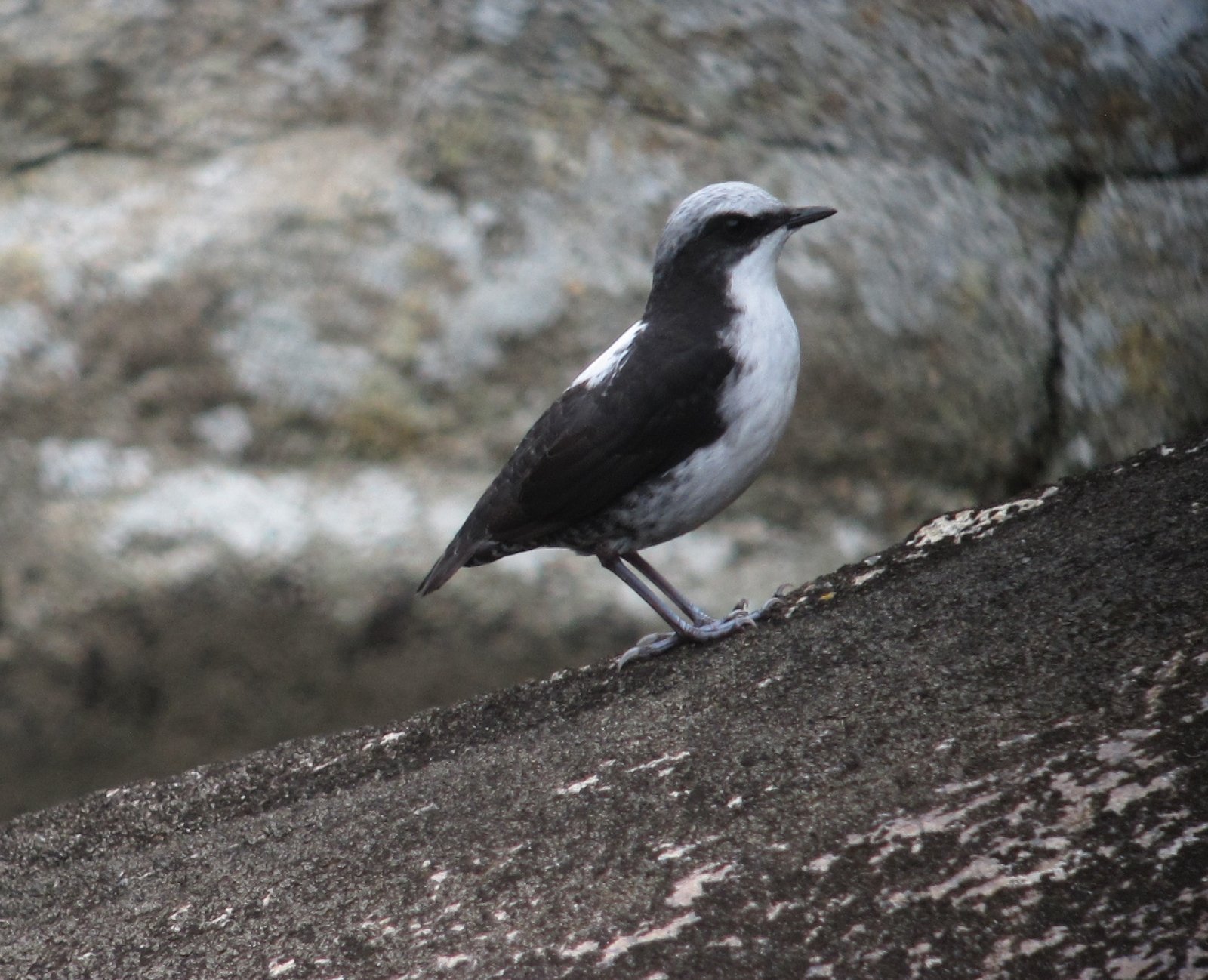
The White-capped Dipper is the dipper of the fast-flowing mountain streams of the Andes, from Venezuela to Bolivia. It perches on rocks in mid-stream, bobs its body and flies low and fast over the water from rock to rock. Unlike the dippers of the northern hemisphere it rarely submerges completely; it forages mainly in the splash zone along the rocks.
Voice
A high, sharp, buzzy call, often given in flight, which carries above the roar of the water. The song is a soft, rattling trill.
Recording: Yair Guillermo Molina Martínez. — CC BY-NC-SA 4.0 · xeno-canto
Identification
15 cm, plump and short-tailed, with strong legs and a short, straight bill. Dark grey-brown to blackish, with a white crown and nape and a white throat. The extent of white varies by region: in Colombia and Ecuador the breast and belly are also largely white and birds often show a white back patch; in Peru and Bolivia only the throat and breast are white and the belly is dark; in the Sierra Nevada de Santa Marta there is less white on the underparts. The sexes are alike; juveniles are greyer, with a less clean white head and pale scaling below.
Confusion species
In the guide area this is the only dipper, except in southern Bolivia, where Rufous-throated Dipper Cinclus schulzii lives: it is grey, with a rufous-orange throat and no white cap. Black Phoebe Sayornis nigricans also perches on rocks along mountain streams, but is a slender tyrant flycatcher with a longer tail, a black head and a white belly. Torrent Tyrannulet Serpophaga cinerea is smaller and pale grey, with a black head.
Habitat
Fast-flowing, rocky streams and rivers in montane forest and open country, roughly between 1000 and 3500 m, locally lower or higher up to the treeline. It searches for insect larvae and other aquatic animals on rocks, in the splash zone and in shallow running water. The nest is a ball of moss with a side entrance, in a rock crevice, under an overhang, behind a small waterfall or under a bridge.
Where the bird is most at home, classified by the vegetation units of the Andes and the west coast.


Range and movements
Colombia: in all three Andean ranges, in the Sierra Nevada de Santa Marta and in the Serranía de Perijá. Ecuador: on both slopes of the Andes. Peru: mainly along the eastern slope of the Andes, locally also on the northern part of the western slope. Bolivia: on the eastern slope of the Andes. Absent from the Galápagos. Outside the guide area in western Venezuela.
- Resident
- dark = core range, pale = thinly spread
How and when to look
At bridges over mountain streams and along roads that follow a river; the bird perches on rocks in mid-stream and gives itself away by its high call in flight.
Conservation status
Least Concern. The species depends on clean, fast-flowing water and disappears locally through hydroelectric schemes, water abstraction and pollution.
Scientific name
Cinclus leucocephalus | Tschudi, 1844
Tschudi described the species in 1844 and placed it straight away in the genus where it still stands. The genus Cinclus was introduced in 1797 by Borkhausen. The genus name comes from Ancient Greek kinklos, a name for small tail-wagging birds living near water. The species name comes from Greek leukos, 'white', and kephalē, 'head', for the white head. The specimen the first description was based on came from Junín, Peru.