All species › Passerines › Dippers › Rufous-throated Dipper
Rufous-throated Dipper | Cinclus schulzii
Roodkeelwaterspreeuw | Mirlo acuático gorjirrufo | Melro-d'água-de-garganta-ruiva
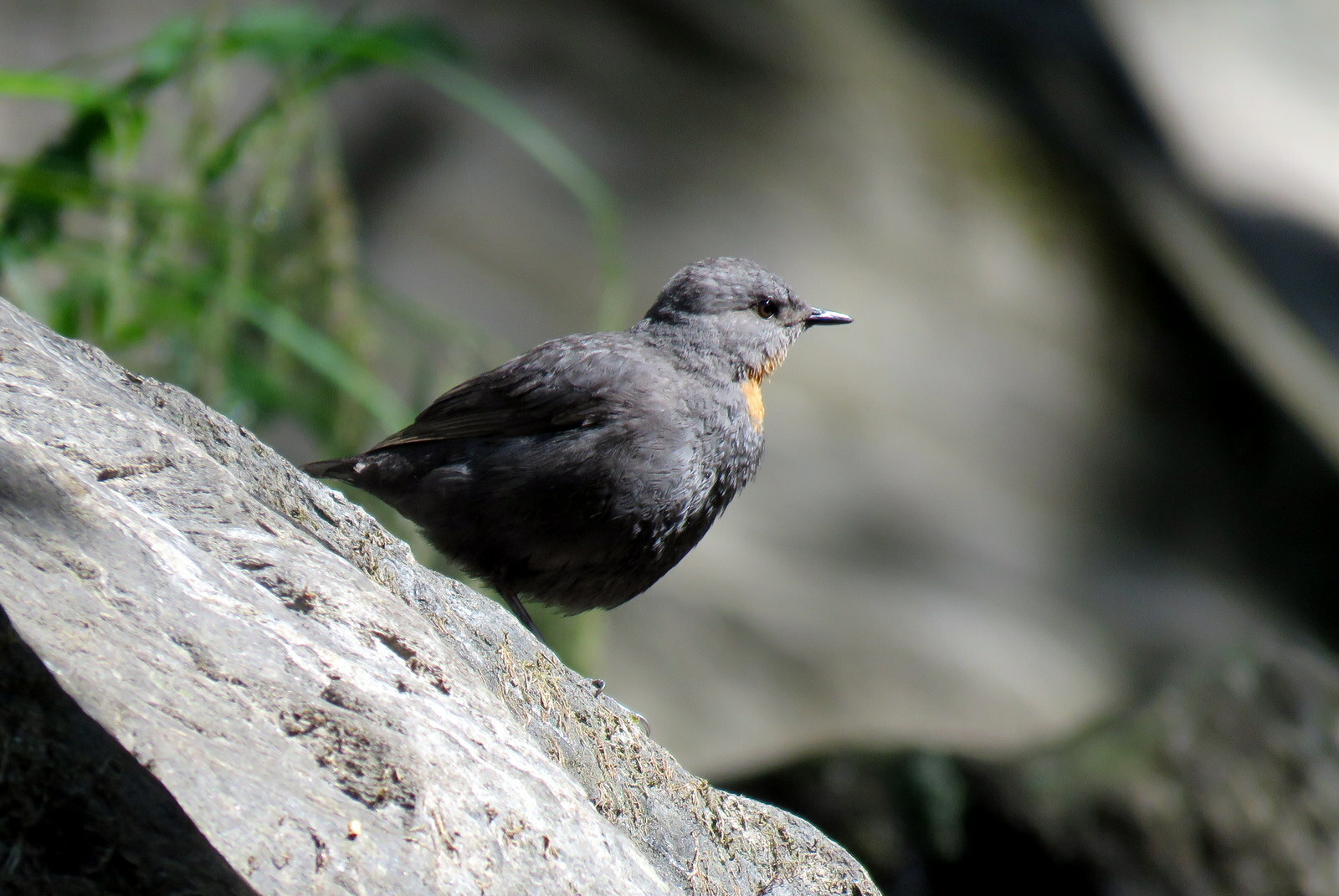
The Rufous-throated Dipper is a small, grey dipper with a rufous-orange throat, found only in a narrow belt of montane forest in southern Bolivia and north-western Argentina. It lives along fast-flowing streams in alder forest and the upper part of the Yungas. It is the southernmost dipper in the world, with a small range.
Voice
A high, sharp call, often given in flight, which is readily lost in the roar of the water. The song is a soft, high trill.
Recording: Sjoerd Mayer — CC BY-NC-SA 3.0 · xeno-canto
Identification
15 cm, plump and short-tailed, with strong legs and a short, straight bill. Almost entirely grey, the head and upperparts slightly darker. The throat and upper breast are rufous-orange to cinnamon. In flight and when wing-flicking a small white patch shows at the base of the primaries. The sexes are alike; juveniles are paler, with a pale, less rufous throat.
Confusion species
White-capped Dipper Cinclus leucocephalus, further north in Bolivia, is dark brownish black, with a white crown and white throat, and lacks the rufous throat. Torrent Tyrannulet Serpophaga cinerea also perches on rocks in mountain streams, but is a slender, pale grey tyrant flycatcher with a black head and a longer tail.
Habitat
Fast-flowing, rocky streams and small rivers in montane forest, mainly in alder forest (Alnus acuminata) and the upper part of the Yungas, roughly between 1500 and 2500 m; sometimes lower outside the breeding season. It searches for insect larvae and other aquatic animals on rocks, in the splash zone and in shallow water. The nest is a ball of moss in a rock crevice or under an overhang by the water.
Where the bird is most at home, classified by the vegetation units of the Andes and the west coast.


Range and movements
Bolivia: only in the south, on the eastern slope of the Andes, mainly in the department of Tarija. Absent from Colombia, Ecuador, Peru and the Galápagos. Outside the guide area in north-western Argentina, from Jujuy and Salta south to Tucumán and Catamarca.
- Resident
- dark = core range, pale = thinly spread
How and when to look
Search mountain streams in the alder forest on the eastern slope in Tarija; the birds perch on rocks in the water and fly off low over the stream.
Conservation status
Vulnerable. The population is small and the range limited; dams, water abstraction, deforestation, pollution and possibly introduced trout, which eat the same aquatic animals, are threats.
Scientific name
Cinclus schulzii | Cabanis, 1882
Cabanis described the species in 1882 and placed it straight away in the genus where it still stands. The genus Cinclus was introduced in 1797 by Borkhausen. The genus name comes from Ancient Greek kinklos, a name for small tail-wagging birds living near water. The species name honours the German zoologist Friedrich W. Schulz, who collected the type specimen. The specimen the first description was based on came from Cerro Bayo, Tucumán, Argentina.