All species › Passerines › Thrushes and allies › Varied Solitaire
Varied Solitaire | Myadestes coloratus
Bonte solitaire | Solitario variado | Solitário-variado
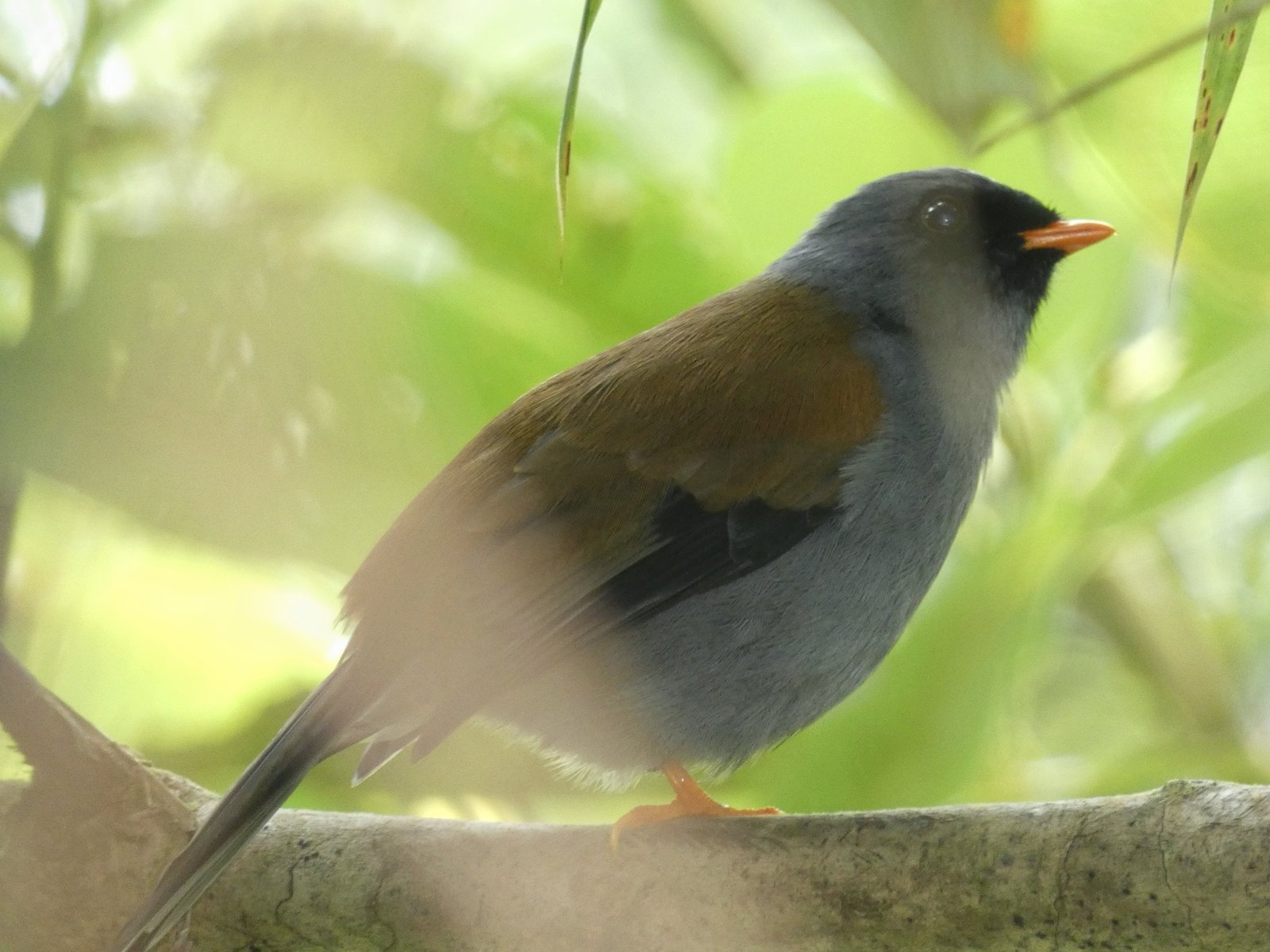
The Varied Solitaire is a small, grey and brown solitaire of the isolated mountains on the border of Panama and Colombia. Its entire range covers only a few highland areas in eastern Panama and adjacent north-western Colombia. Its slow, whistled song carries from the canopy of the cloud forest.
Voice
The song is a slow series of drawn-out single whistles and flute-like phrases, with pauses of 3 to 6 seconds between them and sometimes a few harsh notes.
Recording: Iván Lau — CC BY-NC-SA 4.0 · xeno-canto
Identification
17 cm, with a short bill, a rounded head and a fairly long tail. The forehead, face and chin are blackish. The rest of the head, the neck and the underparts are slate-grey. The back and wing coverts are warm brown, the flight feathers blackish. The bill and legs are yellow to orange-yellow. The sexes are alike. Young birds are olive-brown with pale buff spots and streaks on the upperparts and white spots on the brownish underparts.
Confusion species
Andean Solitaire Myadestes ralloides does not occur in the same mountains; it lacks the black face and has a black upper mandible and pale outer tail feathers. Slaty-backed Nightingale-Thrush Catharus fuscater also has an orange bill and orange legs, but is dark slate-grey above, has a pale iris and a shorter tail, and spends more time on the ground.
Habitat
Montane rainforest and cloud forest, mainly at about 800 to 1600 m, locally up to 2200 m. It often sits quietly in the middle and upper levels of the forest and feeds mainly on fruit. Almost nothing is known about the nest; the breeding season includes at least April to June.
Where the bird is most at home, classified by the vegetation units of the Andes and the west coast.


Range and movements
In the guide area only in the far north-west of Colombia, in the mountains along the Panama border (Serranía del Darién), where it is local and scarce. Absent from Ecuador, Peru, Bolivia and the Galápagos. Outside the guide area in the mountains of eastern Panama.
- Resident
- dark = core range, pale = thinly spread
How and when to look
The Colombian side of the range is remote and seldom visited. In the border mountains the slow song gives away its position; the birds then often stay on the same branch for a long time.
Conservation status
Near Threatened. The world population is estimated at 20,000 to 50,000 mature individuals and is declining. The species depends heavily on cloud forest and is therefore vulnerable to deforestation, although part of its habitat lies in protected areas in Panama.
Scientific name
Myadestes coloratus | Nelson, 1912
Nelson described the species in 1912 and placed it straight away in the genus where it still stands. The genus Myadestes was introduced in 1838 by Swainson. The genus name combines Greek muia, 'fly', with edestēs, 'eater': 'fly-eater'. The species name comes from Latin coloratus, 'coloured', for its more varied plumage than related solitaires. The specimen the first description was based on came from Cerro Pirre, Darién, Panama.