All species › Passerines › Thrushes and allies › Andean Solitaire
Andean Solitaire | Myadestes ralloides
Andessolitaire | Solitario andino | Solitário-andino
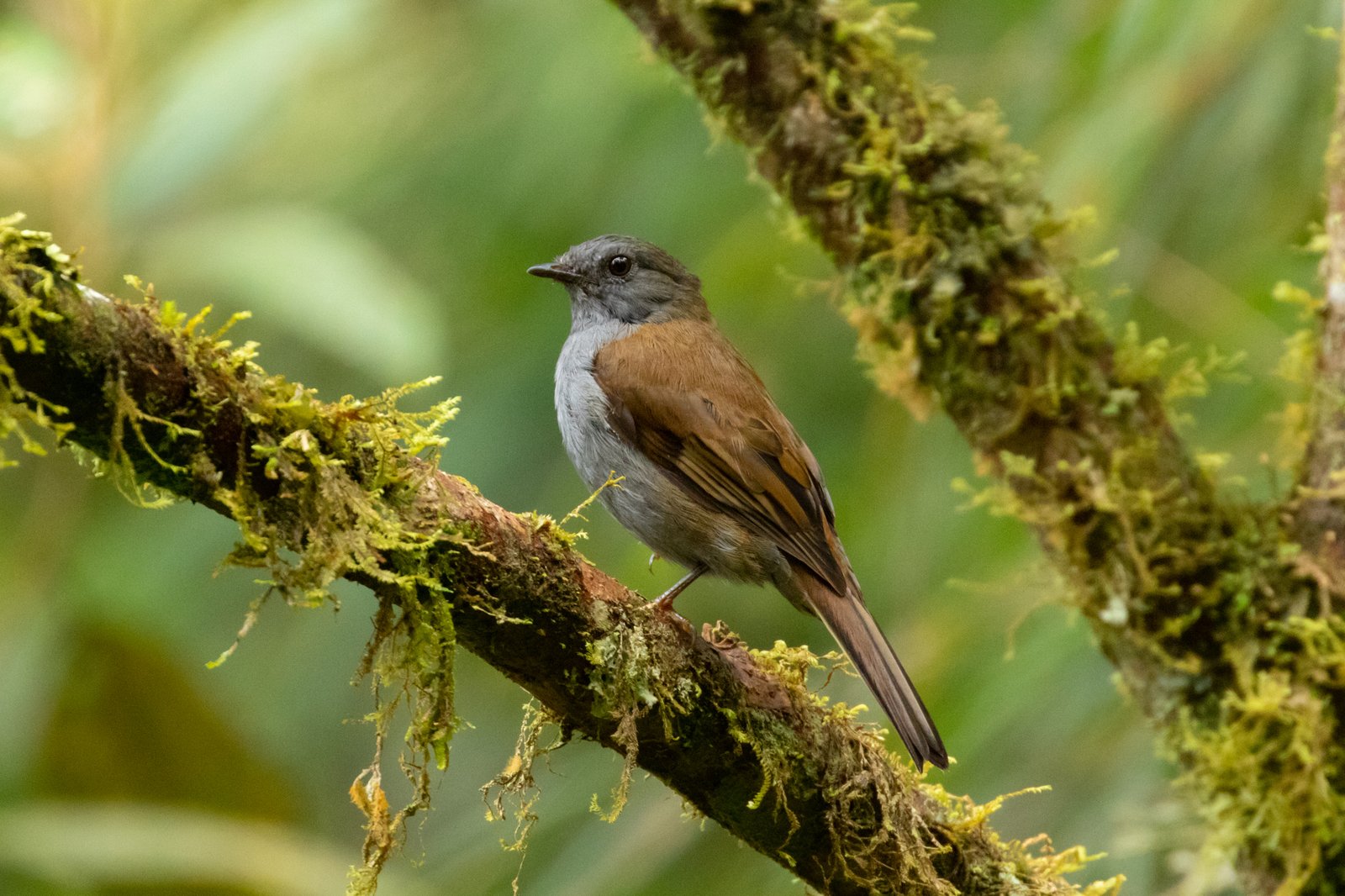
The Andean Solitaire is a grey and rufous-brown solitaire of humid montane forest along the whole length of the Andes. It often perches motionless for long periods on a branch in the mid-storey and then attracts little attention. Its ethereal, whistled song, interspersed with creaky and metallic notes, is part of the cloud forest on both the eastern and the western slope.
Voice
The song is a slow, ethereal series of high, liquid whistles, mixed with creaky, metallic and twittering notes, often kept up for a long time. The call is a soft, nasal weep.
Recording: Alain Verneau — CC BY-NC-SA 4.0 · xeno-canto
Identification
17–18 cm, with a short, broad bill and a fairly long tail. The head and underparts are grey, the back, wings and tail warm rufous-brown to olive-brown; in northern birds the head is more brownish grey. The upper mandible is black, the lower mandible yellow; the legs are yellowish. The outer tail feathers are pale grey at the tip, and in flight a pale band shows on the underwing. The sexes are alike. Young birds are brown with buff spots.
Confusion species
Rufous-brown Solitaire Cichlopsis leucogenys is larger and uniformly rufous-brown, with a rusty throat and paler underparts; it lives lower down. Slaty-backed Nightingale-Thrush Catharus fuscater is dark slate-grey with an entirely orange bill and orange legs, a pale iris and a shorter tail; it lives on or just above the ground. Varied Solitaire Myadestes coloratus has a black face and a yellow bill, but lives only in the mountains on the Panama–Colombia border.
Habitat
Humid montane forest, cloud forest and forest edges, also older secondary forest, mostly at about 900 to 2700 m. It perches upright and still in the mid-storey and feeds mainly on berries and other fruit, and also on insects caught in short sallies. The nest is a cup of moss in a hollow or niche in a mossy bank or tree trunk.
Where the bird is most at home, classified by the vegetation units of the Andes and the west coast.


Range and movements
In Colombia in all three cordilleras and in the Serranía de Perijá; in Ecuador on both slopes of the Andes; in Peru mainly along the eastern slope, in the north also on the western slope; in Bolivia along the eastern slope of the Andes south to Cochabamba and Santa Cruz. Absent from the Galápagos. Outside the guide area in the mountains of Venezuela.
- Resident
- dark = core range, pale = thinly spread
How and when to look
Listen in the early morning along roads and trails through cloud forest; the song carries far. A singing bird often sits on a bare, horizontal branch in the mid-storey and can then be watched for a long time.
Conservation status
Least Concern. Fairly common in continuous montane forest; disappears where the forest is cleared completely.
Scientific name
Myadestes ralloides | (d'Orbigny, ACVMD, 1840)
D'Orbigny, ACVMD described the species in 1840 as Muscipeta ralloides; because it was later moved to another genus, the author and year stand in brackets. The genus Myadestes was introduced in 1838 by Swainson. The genus name combines Greek muia, 'fly', with edestēs, 'eater': 'fly-eater'. The species name combines Rallus, 'rail', with Greek -oidēs, 'resembling': 'rail-like', probably for the plumage colour. The specimen the first description was based on came from Chulumani, Yungas, La Paz, Bolivia.