All species › Passerines › Thrushes and allies › Rufous-brown Solitaire
Rufous-brown Solitaire | Cichlopsis leucogenys
Roodbruine solitaire | Solitario rufimoreno | Sabiá-castanho
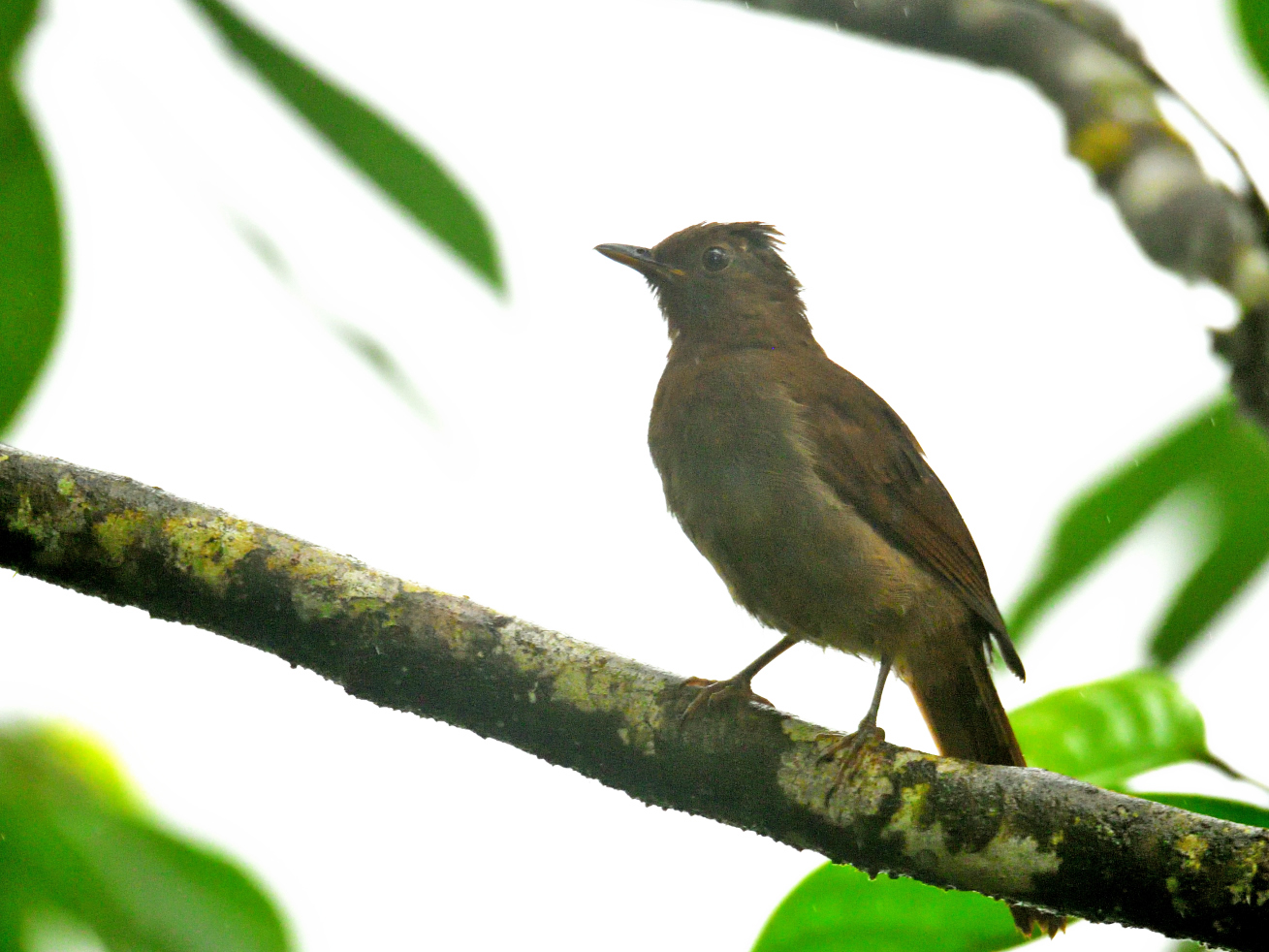
The Rufous-brown Solitaire is a sturdy, warm brown solitaire of humid, mossy foothill and montane forest. It is spread over four widely separated areas of South America, two of them in the guide area: the Chocó of Colombia and Ecuador, and the eastern slope of the Andes in central Peru. Its fast, varied song carries from the canopy.
Voice
The song is a long, fast, varied series of clear whistles and phrases, mixed with chattering and twittering notes; it differs somewhat between regions.
Recording: Aran Rodrigues Cardoso — CC BY-NC-SA 4.0 · xeno-canto
Identification
20–21 cm, with a short, stout, slightly hooked bill. The upperparts are uniform rufous-brown to olive-brown. The throat and undertail coverts are rufous: dark chestnut in Chocó birds, rufous-tinged ochre in Peruvian birds, which also have dark lores and a faint pale supercilium and eye-ring. The rest of the underparts are paler greyish brown with a rufous wash on the belly. The upper mandible is blackish, the lower mandible yellow to orange-yellow; the legs are yellowish. The sexes are alike. Young birds have faint buff spots on the upperparts and breast.
Confusion species
Andean Solitaire Myadestes ralloides is smaller, with a grey head and grey underparts without a rufous throat, and usually lives higher. Pale-vented Thrush Turdus obsoletus is larger, plainer brown, with a white vent and an all-dark bill, and forages more on the ground.
Habitat
Humid to very wet, mossy foothill and lower montane forest, also older secondary forest; in Colombia mainly below 1000 m, in Ecuador at about 400 to 1200 m and in Peru at around 900–1100 m. It feeds mainly on fruit, including figs and melastomes, plucked from branches or taken in short sallies; sometimes with mixed flocks. The only nest described was an open cup of moss and rootlets in a tree fork.
Where the bird is most at home, classified by the vegetation units of the Andes and the west coast.


Range and movements
In Colombia on the western slope of the Western Andes, from Valle del Cauca southwards. In Ecuador in the far north-west, in Esmeraldas and Pichincha. In Peru on the eastern slope of the Andes in Huánuco, Pasco and Junín, known from only a few sites. Absent from Bolivia and the Galápagos. Outside the guide area on the tepuis of Venezuela, Guyana and Suriname and in the Atlantic Forest of eastern Brazil.
- Resident
- dark = core range, pale = thinly spread
How and when to look
In the Chocó, listen along trails through humid, mossy forest at low elevation; the bird often sings for a long time from a hidden perch high in a tree. Fruiting trees attract it.
Conservation status
Not Evaluated. Some classifications split the four areas into four separate species, and only those have been assessed by the IUCN: the Chocó and Peruvian forms each as Near Threatened. Clearing of forest for pasture and farming is the main threat.
Scientific name
Cichlopsis leucogenys | Cabanis, 1851
Cabanis described the species in 1851 and placed it straight away in the genus where it still stands. He introduced the genus Cichlopsis in that same work. The genus name combines Greek kikhlē, 'thrush', with opsis, 'appearance': 'thrush-like'. The species name combines Greek leukos, 'white', with genus, 'cheek': 'white-cheeked'. The specimen the first description was based on came from Brazil.