All species › Passerines › Thrushes and allies › White-eared Solitaire
White-eared Solitaire | Entomodestes leucotis
Witoorsolitaire | Solitario orejiblanco | Solitário-de-orelha-branca
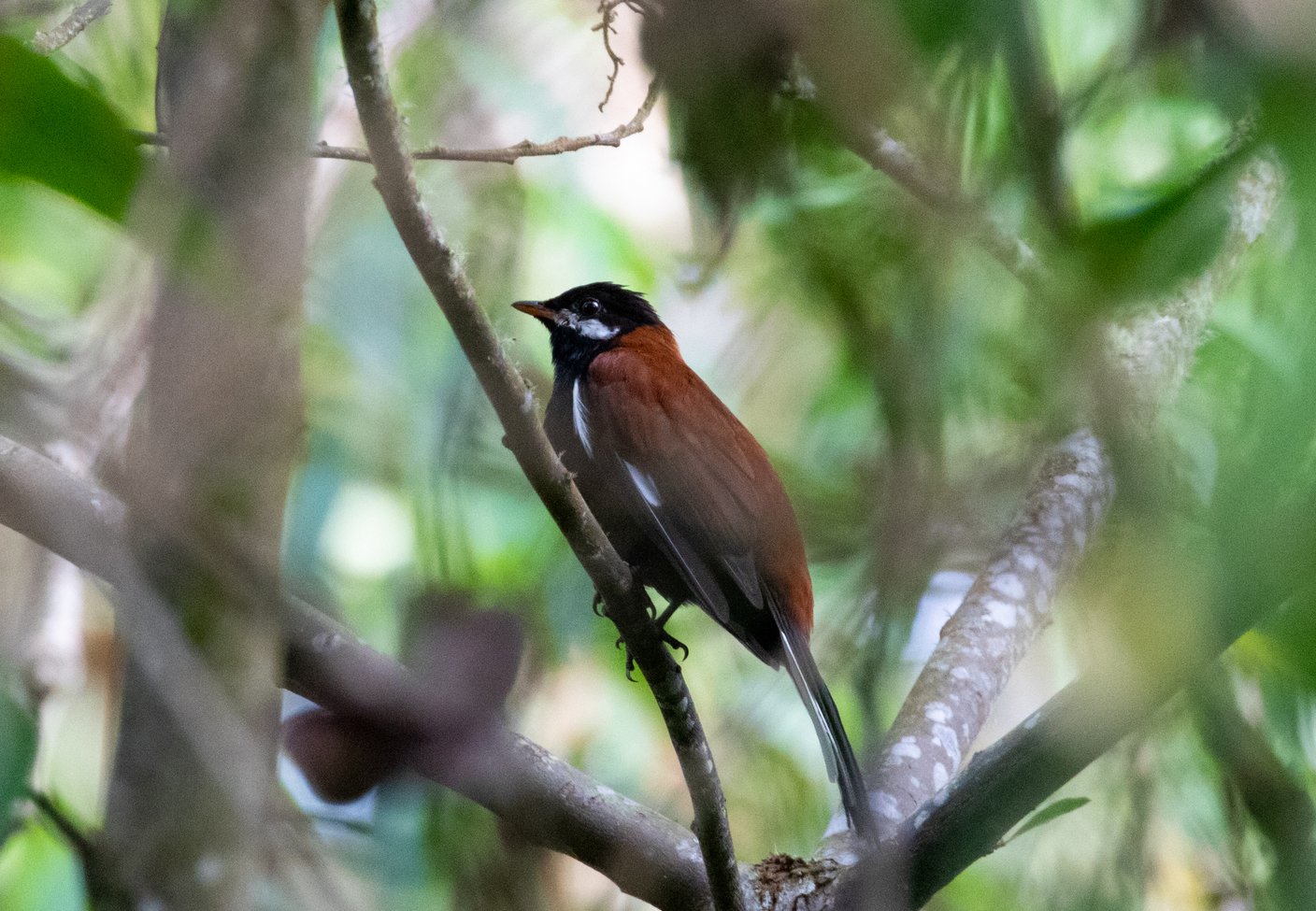
The White-eared Solitaire is a large, black and chestnut solitaire of montane forest on the eastern slope of the Andes in Peru and Bolivia. The broad white patch on the cheek is visible from far away. Its song consists of a single long, ringing note, repeated at long intervals.
Voice
The song is a single long, ringing note, repeated about every 10 to 20 seconds. In the north it sounds fuller and somewhat creaky, from Cusco southwards flatter, buzzier and nasal. Calls include a soft dzz, a high, ringing tseee and a low growl as an alarm.
Recording: Niels Krabbe — CC BY-NC-SA 3.0 · xeno-canto
Identification
22–24 cm, with a fairly long tail. The head, throat and underparts are black, with a large white patch from the bill base across the ear coverts. The nape, back and wing coverts are rich chestnut, the flight feathers blackish. In flight a broad white band shows on the underwing; the outer tail feathers have white tips. The iris is reddish brown, the upper mandible black and the lower mandible yellow; the legs are blackish. The female has a browner crown and some brown on the underparts. Young birds are duller, with a rufous crown and browner underparts.
Confusion species
Black Solitaire Entomodestes coracinus also has a white cheek patch, but is entirely black without a chestnut back and lives far to the north, in the Chocó of Colombia and Ecuador. The male Glossy-black Thrush Turdus serranus is entirely black, with an orange bill, eye-ring and legs, and has no white on the head.
Habitat
Interior and edges of humid montane forest and cloud forest, mostly at 1500 to 2800 m, in Peru from about 1200 m. It forages mainly in the mid-storey for fruit, insects and seeds, and sometimes joins mixed flocks. Little is known about breeding; the breeding season includes at least October and November.
Where the bird is most at home, classified by the vegetation units of the Andes and the west coast.


Range and movements
In Peru on the eastern slope of the Andes from Amazonas in the north southwards. In Bolivia on the eastern slope of the Andes in La Paz and Cochabamba to central Santa Cruz. Absent from Colombia, Ecuador and the Galápagos. Does not occur outside the guide area.
- Resident
- dark = core range, pale = thinly spread
How and when to look
Listen along roads through eastern-slope cloud forest, such as the Manu road in Cusco and the Villa Rica–Oxapampa road in Pasco, for the long, ringing note. The bird often sits high on an open branch and can then be recognised from a distance by its white cheek.
Conservation status
Least Concern. Fairly common in continuous montane forest on the eastern slope.
Scientific name
Entomodestes leucotis | (Tschudi, 1844)
Tschudi described the species in 1844 as Ptilogonys leucotis; because it was later moved to another genus, the author and year stand in brackets. The genus Entomodestes was introduced in 1883 by Stejneger. The genus name combines Greek entomon, 'insect', with edestēs, 'eater': 'insect-eater'. The species name combines Greek leukos, 'white', with ous (ōtos), 'ear': 'white-eared'. The specimen the first description was based on came from Peru.