All species › Passerines › Thrushes and allies › Black Solitaire
Black Solitaire | Entomodestes coracinus
Zwarte solitaire | Solitario negro | Solitário-negro
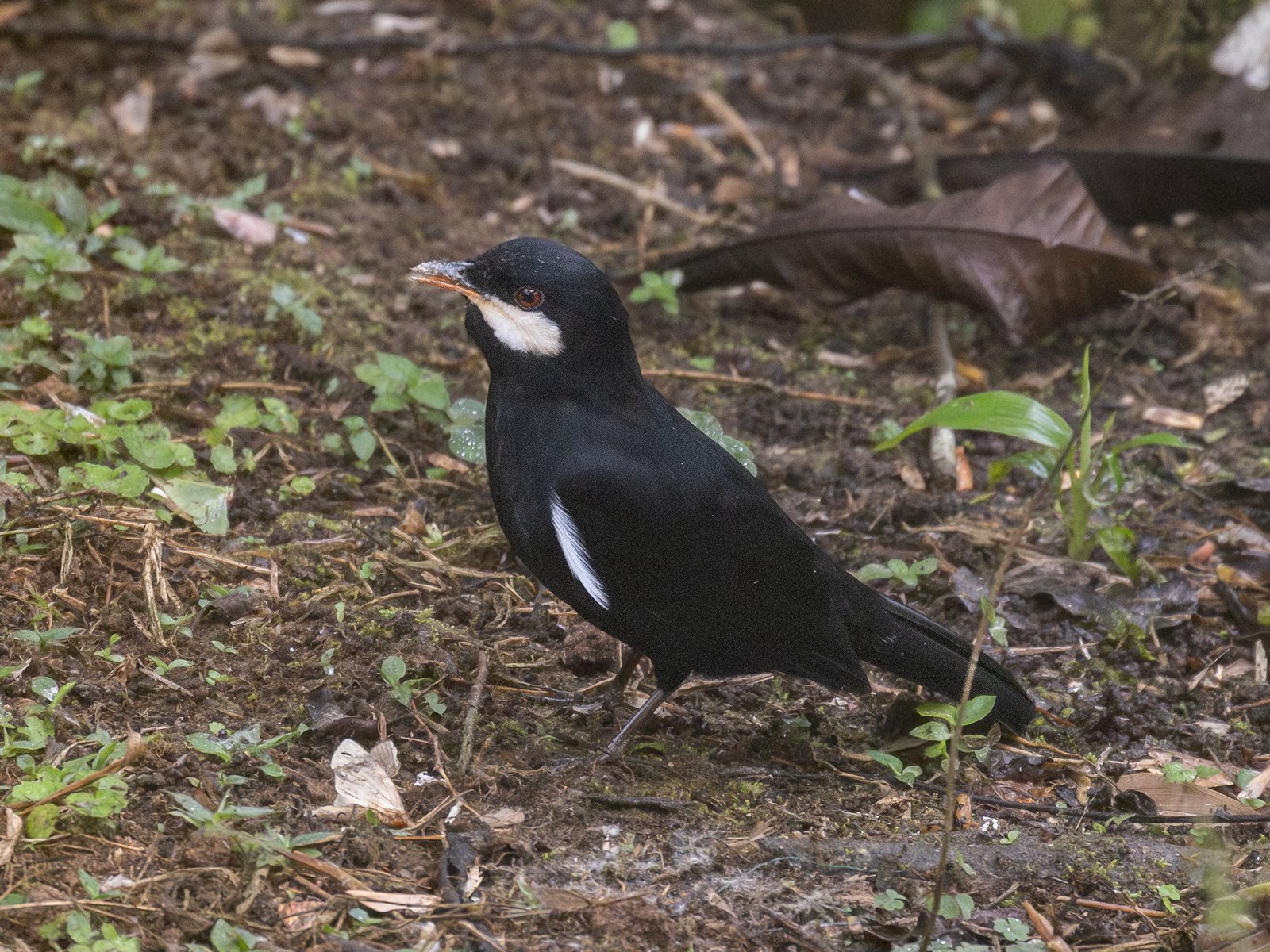
The Black Solitaire is a glossy black solitaire with a silvery white cheek, restricted to the wet forests of the Chocó in western Colombia and north-western Ecuador. It sings little, but its long, nasal whistle carries far through the mossy forest. Its occurrence is irregular: at the same site it may be present one year and absent the next.
Voice
Sings little. The song is a long, drawn-out whistle with a resonant, somewhat nasal quality, which carries far despite its soft start. The call is a much softer, shorter whistle.
Recording: Jonas Nilsson — CC BY-NC-SA 4.0 · xeno-canto
Identification
22–23 cm, with a fairly long tail. Almost entirely glossy black, with a silvery white cheek from the bill base to the ear coverts. The underwing coverts are white, which shows mainly in flight, and the outer tail feathers are white on the lower half. The iris is red, the upper mandible black and the lower mandible yellowish orange; the legs are dark greyish brown. The sexes are alike. Young birds are mostly dull brown and show less white.
Confusion species
White-eared Solitaire Entomodestes leucotis has a similar white cheek patch, but a chestnut nape and back; it lives far to the south, on the eastern slope of the Andes in Peru and Bolivia. The male Glossy-black Thrush Turdus serranus is also glossy black, but has an all-orange bill, an orange eye-ring and orange legs and no white cheek.
Habitat
Interior and edges of wet tropical and lower montane forest, especially heavily mossy forest, sometimes also secondary forest; in Colombia at about 400 to 2300 m, in Ecuador mostly at 1100 to 1600 m. It moves irregularly up and down the slope. It feeds on fruit at all levels of the forest, alone or in pairs, sometimes with other fruit-eaters in the same tree. The nest is a cup of moss lined with rootlets, in dense vegetation such as bromeliads or vine tangles.
Where the bird is most at home, classified by the vegetation units of the Andes and the west coast.


Range and movements
In Colombia on the Pacific slope of the Western Andes, from Chocó southwards. In Ecuador in the north-west, south to Pichincha. Everywhere local and patchy. Absent from Peru, Bolivia and the Galápagos. Does not occur outside the guide area.
- Resident
- dark = core range, pale = thinly spread
How and when to look
Search fruiting trees in mossy forest on the western slope of the Western Andes, for example along the Montezuma road in Tatamá National Park in Risaralda. As the bird sings little, patience at a fruiting tree works better than searching by ear.
Conservation status
Least Concern. The range is small and the population is thought to be declining through deforestation, but no immediate threats are known.
Scientific name
Entomodestes coracinus | (Berlepsch, 1897)
Berlepsch described the species in 1897 as Myiadestes coracinus; because it was later moved to another genus, the author and year stand in brackets. The genus Entomodestes was introduced in 1883 by Stejneger. The genus name combines Greek entomon, 'insect', with edestēs, 'eater': 'insect-eater'. The species name comes from Latin coracinus, 'raven-black', from Greek korax, 'raven'. The specimen the first description was based on came from San Pablo, Nariño, Colombia.