All species › Passerines › Thrushes and allies › Orange-billed Nightingale-Thrush
Orange-billed Nightingale-Thrush | Catharus aurantiirostris
Geelbekdwerglijster | Zorzal pico naranja | Sabiá-de-bico-laranja
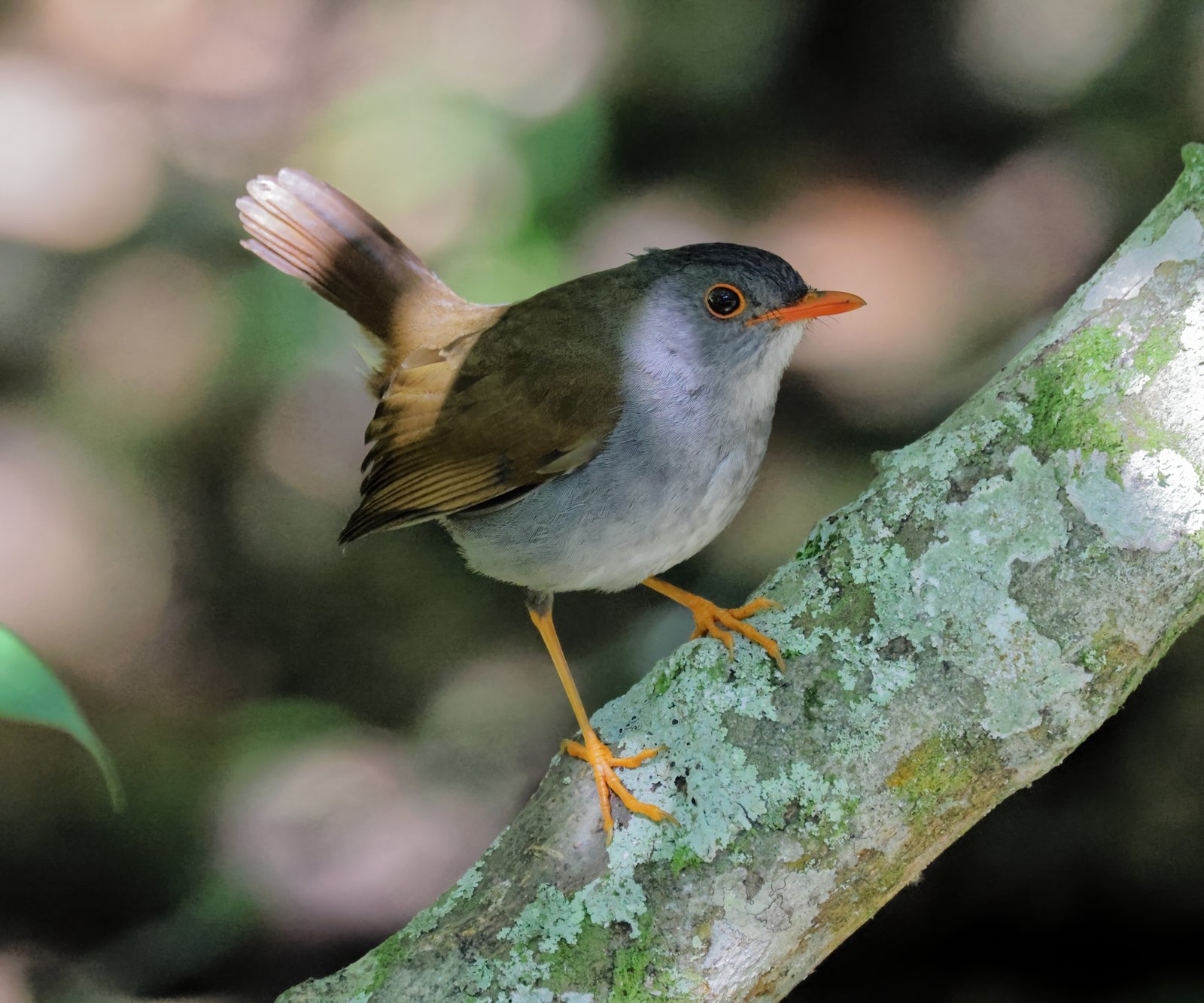
The Orange-billed Nightingale-Thrush is a small, brown and grey nightingale-thrush with an orange bill and an orange eye-ring, widespread from Mexico to Venezuela. In the guide area it occurs only in Colombia. Unlike most nightingale-thrushes it lives mainly in thickets, forest edges and coffee plantations rather than in the forest interior.
Voice
The song is a short, shrill, somewhat scratchy and disjointed phrase of squeaky and twittering notes, often repeated for a long time from cover. The call is a nasal, plaintive meow or waaa.
Recording: Manuel Grosselet — CC BY-NC-SA 4.0 · xeno-canto
Identification
16–17 cm, slim, with fairly long legs. The upperparts are plain olive-brown to rufous-brown, the head sometimes somewhat greyer. The underparts are grey, paler on the throat and belly, without spots. The bill, narrow eye-ring and legs are orange; the iris is dark. The sexes are alike. Young birds are browner, with pale spots on the upperparts, a spotted breast and a darker bill.
Confusion species
Slaty-backed Nightingale-Thrush Catharus fuscater also has an orange bill and orange legs, but is dark slate-grey above and has a pale iris; it lives in the interior of humid montane forest. Yellow-throated Nightingale-Thrush Catharus dryas has a black head and yellowish-orange underparts with dark spots. Swainson's Thrush Catharus ustulatus and Grey-cheeked Thrush Catharus minimus, winter visitors from North America, have a dark bill, pinkish legs and a spotted breast.
Habitat
Thickets, forest edges, open woodland, secondary forest and shady coffee and other plantations, both humid and fairly dry, at about 600 to 2500 m. It forages on the ground and in low vegetation for insects, spiders and small fruit. The nest is a cup of moss and plant material low in a shrub.
Where the bird is most at home, classified by the vegetation units of the Andes and the west coast.


Range and movements
In Colombia in the Sierra Nevada de Santa Marta, the Serranía de Perijá and locally in the Andes, mainly on the slopes of the Magdalena and Cauca valleys. Absent from Ecuador, Peru, Bolivia and the Galápagos. Outside the guide area from northern Mexico through Central America to Venezuela and Trinidad.
- Resident
- dark = core range, pale = thinly spread
How and when to look
Search in the early morning along shrubby forest edges, hedgerows and coffee plantations at middle elevations. The bird often stays in cover, but regularly comes out onto trails and open patches on the ground.
Conservation status
Least Concern. Common, and tolerates disturbed and semi-open landscapes well, including shade coffee.
Scientific name
Catharus aurantiirostris | (Hartlaub, 1850)
Hartlaub described the species in 1850 as Turdus aurantiirostris; because it was later moved to another genus, the author and year stand in brackets. The genus Catharus was introduced in 1850 by Bonaparte. The genus name comes from Greek katharos, 'pure, clean', referring to the plumage of the Orange-billed Nightingale-Thrush (C. aurantiirostris). The species name combines Latin aurantius, 'orange', with rostrum, 'bill': 'orange-billed'. The specimen the first description was based on came from Caracas, Venezuela.