All species › Passerines › Mockingbirds and thrashers › Floreana Mockingbird
Floreana Mockingbird | Mimus trifasciatus
Floreanaspotlijster | Cucuve de Floreana | Sabiá-de-floreana
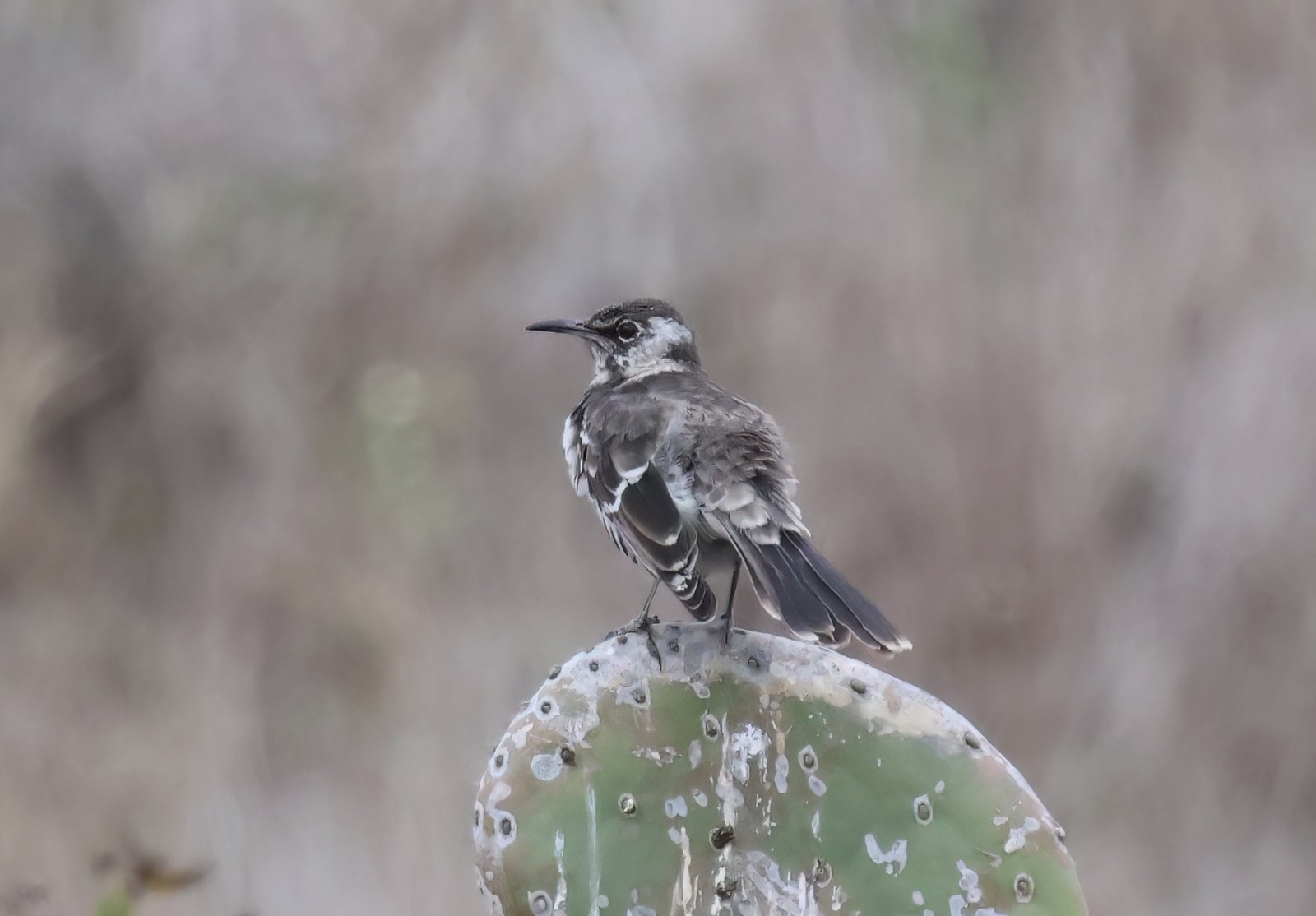
The Floreana Mockingbird is one of the four mockingbirds of the Galápagos and one of the rarest birds of the islands. Darwin collected specimens on Floreana in 1835, and the difference from the mockingbirds of other islands played a part in his thinking on the origin of species. It disappeared from Floreana itself in the late nineteenth century and survives only on the islets of Champion and Gardner-by-Floreana.
Voice
The song is a varied series of whistled, scratchy and chattering phrases, similar to that of the other Galápagos mockingbirds. The call is a hoarse, rasping scold.
No recording with a suitable Creative Commons licence is available for this species yet.
Identification
25–27 cm, a fairly large, sturdy mockingbird with long legs and a long, slightly decurved black bill. The upperparts are dark grey-brown with dark streaking. The underparts are whitish, with dark brown patches on the sides of the breast, often forming a broken breast band, and streaked flanks. A dark patch around and behind the eye. The wings are dark with narrow pale wing bars; the tail is dark with pale tips. The sexes are alike; juveniles are browner and more heavily spotted.
Confusion species
Only one mockingbird lives on each island of the Galápagos. Galapagos Mockingbird Mimus parvulus is smaller and paler, with fewer dark patches on the breast sides, but does not occur on Champion or Gardner-by-Floreana. San Cristobal Mockingbird Mimus melanotis and Espanola Mockingbird Mimus macdonaldi live only on their own islands.
Habitat
The arid lowland zone of two small islets, with shrubs and above all the tree cactus Opuntia megasperma, which provides nest sites, nectar, pollen and fruit. It also eats insects, spiders, seabird eggs and carrion. It lives in groups that defend a territory together; group members help raise the young.
Where the bird is most at home, classified by the vegetation units of the Andes and the west coast.


Range and movements
Endemic to the Galápagos. Occurs only on Champion and Gardner-by-Floreana, two small islets off the coast of Floreana. Extinct on Floreana itself since the late nineteenth century; after the eradication of introduced rats and cats on Floreana, the return of the species there is being prepared. Absent from the other islands and from mainland Colombia, Ecuador, Peru and Bolivia.
- Resident
How and when to look
Champion and Gardner-by-Floreana are closed to visitors. From a boat along the coast of Champion, at the snorkelling site there, the birds can sometimes be seen in the cacti.
Conservation status
Endangered. The world population numbers at most a few hundred birds on two islets and fluctuates strongly with drought and El Niño. Threats are the loss of Opuntia, the parasitic fly Philornis downsi, disease and the risk of rats reaching the islets.
Scientific name
Mimus trifasciatus | (Gould, 1837)
Gould described the species in 1837 as Orpheus trifasciatus; because it was later moved to another genus, the author and year stand in brackets. The genus Mimus was introduced in 1826 by Boie. The genus name is Latin mimus, 'mimic', after the imitation of other sounds. The species name comes from Latin tri-, 'three', and fasciatus, 'banded': three-banded. The specimen the first description was based on came from Isla Floreana, Galápagos.