All species › Passerines › Mockingbirds and thrashers › Galapagos Mockingbird
Galapagos Mockingbird | Mimus parvulus
Galápagosspotlijster | Cucuve de Galápagos | Sabiá-de-galápagos
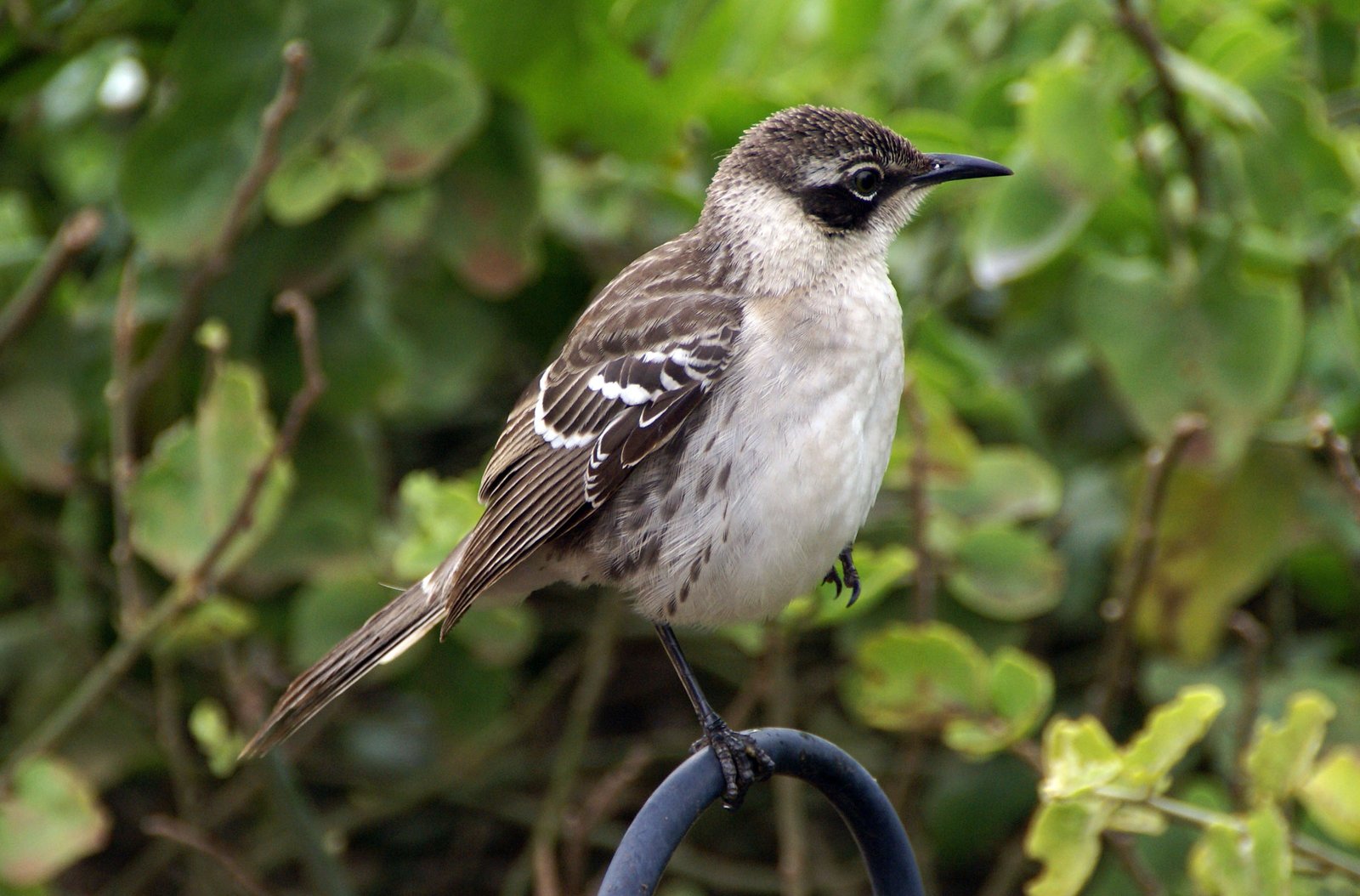
The Galapagos Mockingbird is the most widespread of the four mockingbirds of the Galápagos. It is remarkably curious and tame, inspecting visitors, bags and water bottles at close range. The Galápagos mockingbirds, with a different form on each island, inspired Darwin's ideas on the origin of species.
Voice
The song is a varied series of whistled, scratchy and chattering notes, often given from a shrub or rock. The call is a harsh, hoarse rasp.
Recording: Corrado Zanini — CC BY-NC-SA 4.0 · xeno-canto
Identification
25–26 cm, a slender, long-tailed bird with long legs and a long, slightly decurved black bill. The upperparts are grey-brown with dark streaking, the underparts dingy white with some streaking on the flanks. A dark patch through and behind the eye forms a mask. The wings are dark with two narrow white wing bars, and the tail is dark with white tips to the outer feathers. The sexes are alike; juveniles are browner and more streaked.
Confusion species
Only one mockingbird occurs on each island of the Galápagos. San Cristobal Mockingbird Mimus melanotis lives on San Cristóbal, Espanola Mockingbird Mimus macdonaldi, with a longer, more decurved bill, on Española, and Floreana Mockingbird Mimus trifasciatus on two islets off Floreana. On the mainland, Long-tailed Mockingbird Mimus longicaudatus is larger and longer-tailed, with a bolder head pattern.
Habitat
Mainly the arid lowland zone with shrubs and cacti, and the coast and lava fields; in smaller numbers also higher on the islands and in villages. It eats almost anything: insects, spiders, fruit, Opuntia nectar, eggs and young of other birds, and carrion. It lives in groups that defend a territory together; group members help raise the young.
Where the bird is most at home, classified by the vegetation units of the Andes and the west coast.


Range and movements
Endemic to the Galápagos, on most islands, including Santa Cruz, Isabela, Fernandina, Santiago, Santa Fe, Genovesa, Marchena and Pinta. Absent from San Cristóbal, Española and Floreana, where other mockingbirds live. Absent from mainland Colombia, Ecuador, Peru and Bolivia.
- Resident
How and when to look
On almost every visitor trail in the arid zone, such as on Santa Cruz, North Seymour and Genovesa; the birds often approach visitors of their own accord.
Conservation status
Least Concern. The species is widespread and common; introduced cats and rats and the parasitic fly Philornis downsi are a local threat.
Scientific name
Mimus parvulus | (Gould, 1837)
Gould described the species in 1837 as Orpheus parvulus; because it was later moved to another genus, the author and year stand in brackets. The genus Mimus was introduced in 1826 by Boie. The genus name is Latin mimus, 'mimic', after the imitation of other sounds. The species name is Latin parvulus, 'very small'. The specimen the first description was based on came from Isla Isabela, Galápagos.