All species › Waterfowl › Ducks, swans and geese › Eurasian Teal
Eurasian Teal | Anas crecca
Wintertaling | Cerceta común | Marreca-eurasiática
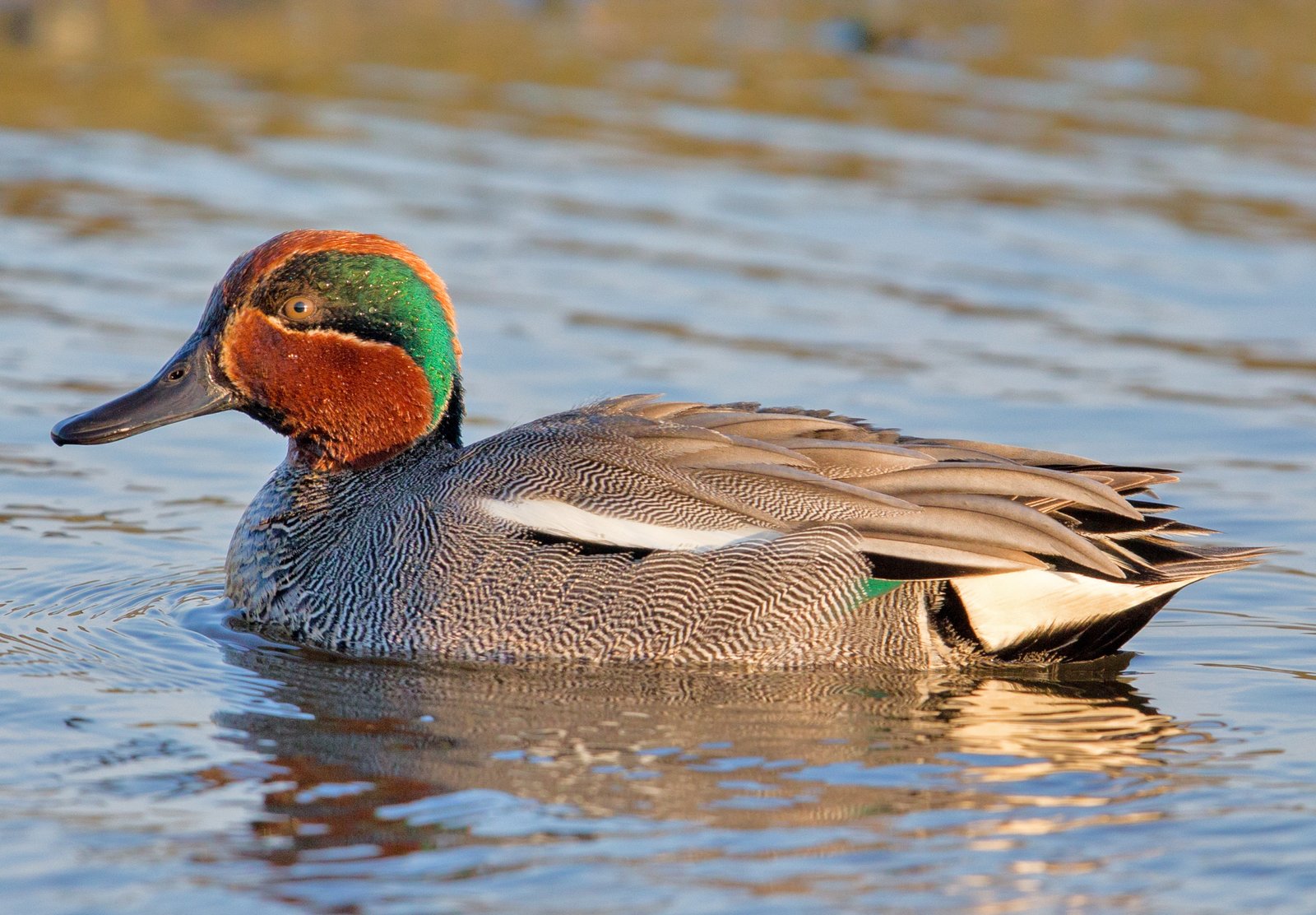
The Eurasian Teal is the smallest dabbling duck of the northern hemisphere, fast and agile in flight. In the guide area it is a rare winter visitor from North America. The birds that occur here belong to the American form carolinensis (Green-winged Teal), which some authors treat as a separate species.
Voice
The male gives a clear, short, whistled krick; the female a high, nasal quack. Fairly quiet in winter.
Recording: Stanislas Wroza — CC BY-NC-SA 4.0 · xeno-canto
Identification
34–38 cm, small and compact, with a short neck and a small, dark bill. The male has a chestnut head with a broad, glossy green band from the eye to the nape, a grey body and a yellowish patch at the side of the undertail. In the American form a vertical white stripe runs down the side of the breast and the horizontal white stripe above the wing is lacking. The female is mottled brown, with a dark eye-stripe and a pale patch at the side of the undertail. The speculum is green with a pale leading edge.
Confusion species
Female Blue-winged Teal Spatula discors is slightly larger, with a longer bill, a pale spot at the base of the bill, a broken white eye-ring and pale blue forewings. Andean Teal Anas andium is larger, with a grey, finely speckled head without an eye-stripe. Yellow-billed Teal Anas flavirostris has a yellow bill.
Habitat
In the guide area shallow lakes, pools and marshes with vegetated margins, in the lowlands and in the Andes. It dabbles in shallow water and on muddy shores for seeds and small invertebrates. It does not breed in the guide area.
Where the bird is most at home, classified by the vegetation units of the Andes and the west coast.


Range and movements
In Colombia a rare winter visitor, mainly in the north and on Andean lakes. In Ecuador and Peru recorded only a few times; there are no regular records from Bolivia or the Galápagos. It breeds in northern North America, Europe and Asia; the American form winters mainly in the United States, Mexico and the Caribbean.
- Winter visitor (c. Oct–Mar)
- dark = core range, pale = thinly spread
How and when to look
Search among flocks of Blue-winged Teal on lakes and marshes in northern Colombia and on the Sabana de Bogotá, mainly from December to February. In the male look for the vertical white breast stripe.
Conservation status
No separate Red List assessment has been made for the species in this circumscription (Not Evaluated). Both the Eurasian and the American form have large and widespread populations.
Scientific name
Anas crecca | Linnaeus, 1758
Linnaeus described the species in 1758 and placed it straight away in the genus where it still stands. He introduced the genus Anas in that same work. The genus name comes from Latin anas, 'duck'. The species name comes from the Swedish name kricka, which imitates the drake's call. The specimen the first description was based on came from Sweden.