All species › Waterfowl › Ducks, swans and geese › Northern Pintail
Northern Pintail | Anas acuta
Pijlstaart | Ánade rabudo | Arrabio
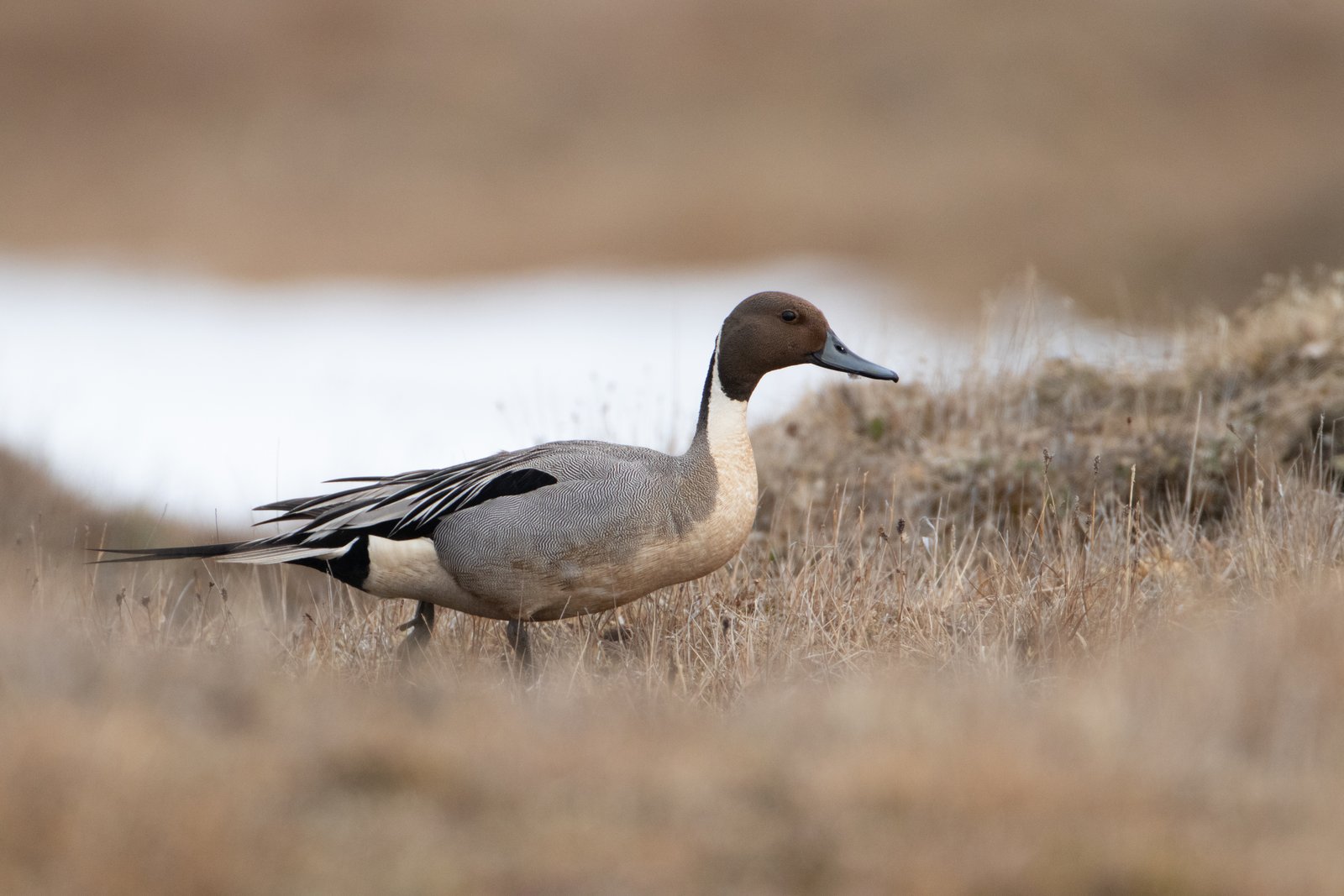
The Northern Pintail is a slender dabbling duck of the northern hemisphere, with a long neck and, in the male, long, needle-like central tail feathers. In the guide area it is a scarce winter visitor from North America that mainly reaches the north. Usually only a few birds occur among other ducks.
Voice
The male gives a soft, whistled proop-proop; the female a low, hoarse quack. Fairly quiet in winter.
Recording: Stanislas Wroza — CC BY-NC-SA 4.0 · xeno-canto
Identification
51–66 cm, the male including the long tail spike. The male has a chocolate-brown head, a white breast and foreneck with a white stripe running up the side of the neck, grey flanks, a creamy patch in front of the black undertail coverts and a speculum with a coppery gloss. The female is pale brown, finely scaled, with a plain, paler head, a pointed tail and a narrow white trailing edge to the brown speculum. The bill is blue-grey in both sexes. In the guide area birds in eclipse or transitional plumage are not unusual.
Confusion species
Yellow-billed Pintail Anas georgica resembles the female but has a yellow bill with a black culmen and a streaked head with a warm brown crown. White-cheeked Pintail Anas bahamensis has white cheeks and a red base to the bill. Female American Wigeon Mareca americana has a shorter neck, a small, grey head and a short bill.
Habitat
In the guide area shallow fresh and brackish lakes, marshes, flooded grassland and coastal lagoons, mainly in the lowlands but also on Andean lakes. It dabbles with its long neck for seeds, rhizomes and invertebrates. It does not breed in the guide area.
Where the bird is most at home, classified by the vegetation units of the Andes and the west coast.


Range and movements
In Colombia a scarce winter visitor in the north, on lakes and marshes in the Caribbean lowlands and on Andean lakes. In Ecuador, Peru and Bolivia very rare or recorded only a few times. Absent from the Galápagos. It breeds in northern North America, Europe and Asia and winters south to Central America, Africa and southern Asia.
- Winter visitor (c. Oct–Mar)
- dark = core range, pale = thinly spread
How and when to look
Search among flocks of Blue-winged Teal and other ducks on lakes and marshes in northern Colombia, mainly from November to February. Look for the slender build and long neck.
Conservation status
Least Concern. The world population is large but has declined in North America in recent decades, mainly through the conversion of grassland and wet hollows to cropland in the breeding range.
Scientific name
Anas acuta | Linnaeus, 1758
Linnaeus described the species in 1758 and placed it straight away in the genus where it still stands. He introduced the genus Anas in that same work. The genus name comes from Latin anas, 'duck'. The species name is Latin acutus, 'pointed', after the pointed tail. The specimen the first description was based on came from Sweden.