All species › Waterfowl › Ducks, swans and geese › Yellow-billed Pintail
Yellow-billed Pintail | Anas georgica
Zuid-Amerikaanse pijlstaart | Pato jergón | Marreca-parda
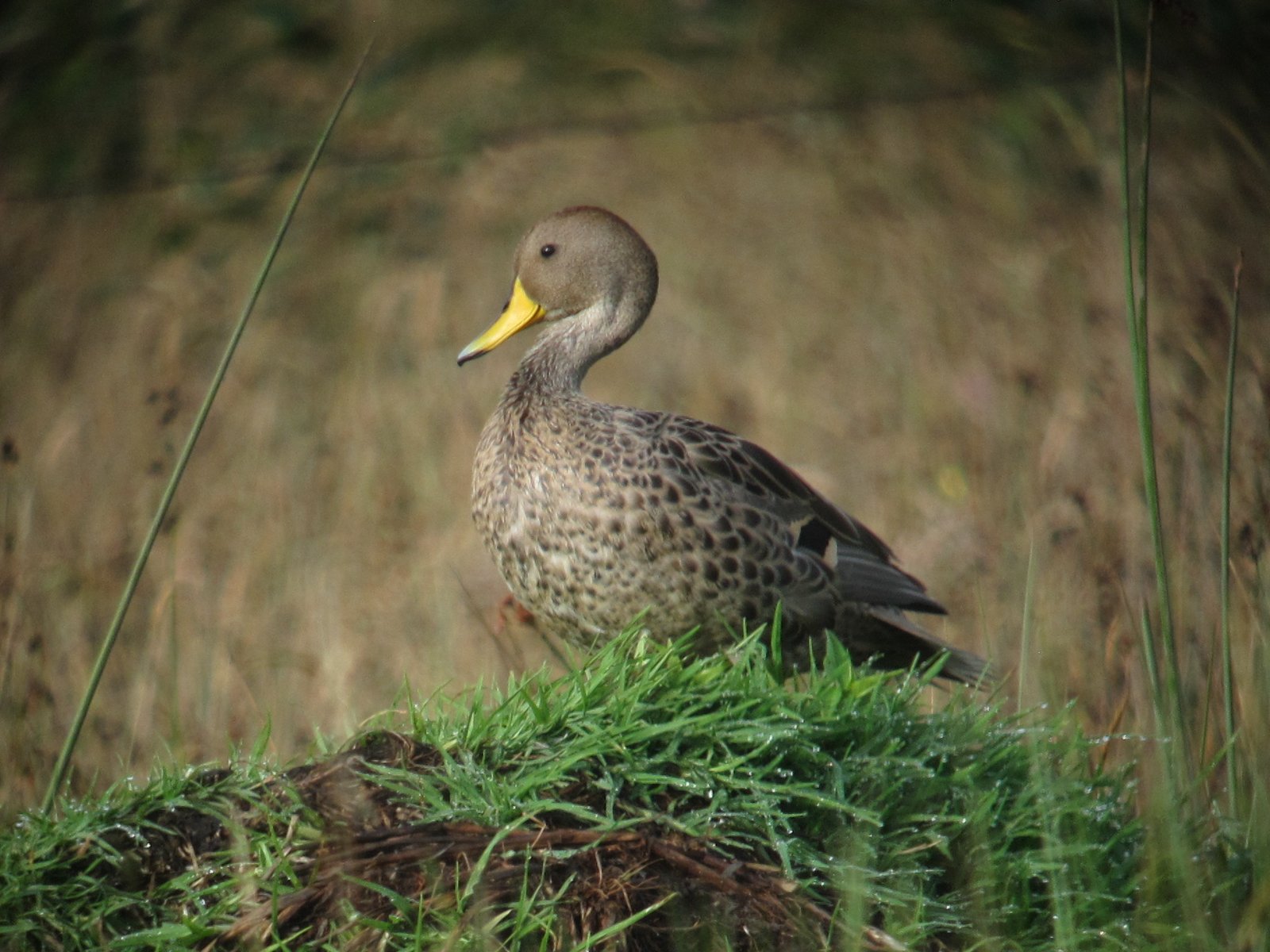
The Yellow-billed Pintail is a slender, brown dabbling duck with a yellow bill and a pointed tail. In the guide area it is one of the commonest ducks of the lakes and bogs of the high Andes, and it also occurs on the coastal lagoons of Peru. The sexes are nearly alike.
Voice
The male gives a soft, trilling whistle, mainly in display; the female a hoarse, descending quack.
Recording: Ignacio Escobar — CC BY-NC-SA 4.0 · xeno-canto
Identification
48–55 cm, with a long, thin neck, a small, rounded head and a long, pointed tail. The plumage is brown with dark spots on the breast and flanks; the head is finely streaked, with a warm brown crown. The bill is bright yellow with a black culmen and tip. The speculum is blackish with a green gloss, with broad buff borders. The female is slightly smaller and duller, with a shorter tail.
Confusion species
Yellow-billed Teal Anas flavirostris is smaller and stockier, with a shorter neck and tail, a greyer, speckled head and also a yellow bill. Female Northern Pintail Anas acuta has a grey bill and a greyer plumage. White-cheeked Pintail Anas bahamensis has white cheeks and a blue-grey bill with a red base. Puna Teal Spatula puna has a dark cap, white cheeks and a blue bill.
Habitat
Lakes, pools, bogs (bofedales) and wet grassland in the puna and the higher parts of the Andes, roughly between 2500 and 4600 m, and in Peru also coastal lagoons, estuaries and sewage ponds. It dabbles in shallow water and grazes on the shore, feeding on seeds, aquatic plants and invertebrates. It nests on the ground in dense vegetation, often some distance from water.
Where the bird is most at home, classified by the vegetation units of the Andes and the west coast.


Range and movements
In Colombia rare and local in the Andes of the south. In Ecuador local in the Andes, mainly in the centre and south. In Peru in the Andes throughout the country and along the Pacific coast. In Bolivia on the altiplano and in the Andes. Absent from the Galápagos. Outside the guide area in Chile and Argentina to Tierra del Fuego, and on South Georgia.
- Resident
- dark = core range, pale = thinly spread
How and when to look
Search lakes and bogs in the puna, for example around Lake Titicaca and in the Salinas y Aguada Blanca reserve near Arequipa and at Junín. On the coastal lagoons of Peru flocks often mix with other ducks.
Conservation status
Least Concern. Hunted locally; the South Georgia subspecies is small and vulnerable.
Scientific name
Anas georgica | Gmelin, 1789
Gmelin described the species in 1789 and placed it straight away in the genus where it still stands. The genus Anas was introduced in 1758 by Linnaeus. The genus name comes from Latin anas, 'duck'. The species name refers to South Georgia in the South Atlantic. The specimen the first description was based on came from South Georgia.