All species › Waterfowl › Ducks, swans and geese › White-cheeked Pintail
White-cheeked Pintail | Anas bahamensis
Bahamapijlstaart | Pato gargantillo | Marreca-toicinho
The White-cheeked Pintail is a medium-sized dabbling duck of brackish and saline waters, recognised by its white cheeks and the red patch at the base of the bill. In the guide area it lives mainly along the Pacific coast and on the Galápagos, where a distinct, smaller and duller subspecies occurs.
Voice
Fairly quiet. The male gives a soft, squeaky whistle, the female a series of weak, descending quacks.
Recording: Ignacio Escobar — CC BY-NC-SA 4.0 · xeno-canto
Identification
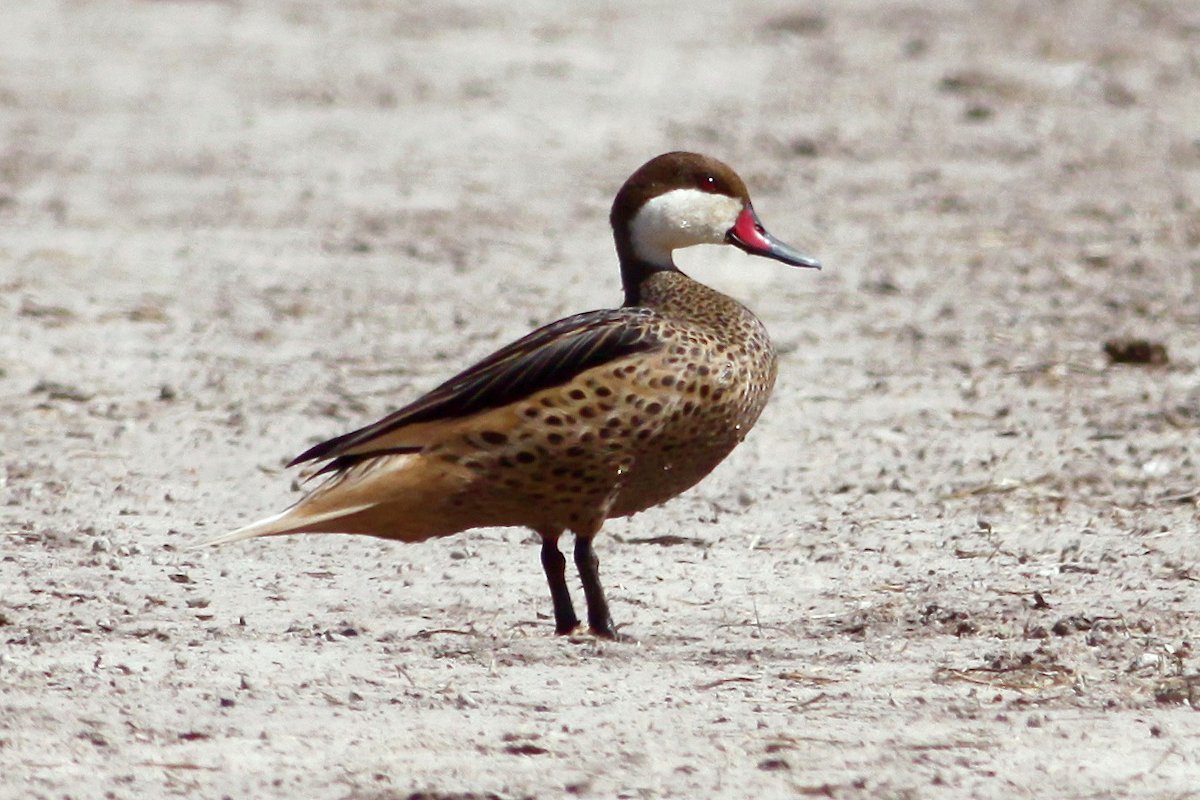
41–47 cm. The plumage is warm brown with dark spots, with a dark brown crown and hindneck and sharply defined white cheeks and throat. The bill is blue-grey with a red base at the sides. The pointed tail is pale buff. The speculum is green with broad buff borders. The female resembles the male but is duller, with a shorter tail and less red on the bill. Galápagos birds are smaller and duller, with less contrast in the head.
Confusion species
Yellow-billed Pintail Anas georgica has a yellow bill with a dark culmen and no white cheeks. Brazilian Teal Amazonetta brasiliensis has a pale grey patch on the side of the head, a red or dark bill without a red basal patch and a blue-green speculum with a white trailing edge. Blue-winged Teal Spatula discors is smaller, without white cheeks, with pale blue forewings.
Habitat
Brackish and saline lagoons, salt pans, estuaries, mangrove creeks, rice fields and shallow freshwater lakes, mainly in the lowlands and on the coast. On the Galápagos in brackish coastal lagoons and small freshwater pools in the highlands. It dabbles for seeds, aquatic plants and small invertebrates. It nests on the ground in dense vegetation near water.
Where the bird is most at home, classified by the vegetation units of the Andes and the west coast.


Range and movements
In Colombia on the Caribbean coast. In Ecuador in the lowlands of the south-western coast and on the Galápagos, on most of the larger islands. In Peru along the northern and central coast. In Bolivia scarce and local in the eastern lowlands. Outside the guide area in the Caribbean, northern and eastern South America and south to Argentina.
- Resident
- dark = core range, pale = thinly spread
How and when to look
Search the salt pans and lagoons near Santa Elena in Ecuador, the coastal lagoons of northern Peru, and on the Galápagos the lagoons of Puerto Villamil on Isabela.
Conservation status
Least Concern. Hunted locally and sensitive to the draining or conversion of coastal lagoons, among other things for shrimp farming.
Scientific name
Anas bahamensis | Linnaeus, 1758
Linnaeus described the species in 1758 and placed it straight away in the genus where it still stands. He introduced the genus Anas in that same work. The genus name comes from Latin anas, 'duck'. The species name refers to the Bahamas. The specimen the first description was based on came from Bahamas.