All species › Passerines › Manakins › Fiery-capped Manakin
Fiery-capped Manakin | Machaeropterus pyrocephalus
Vuurkapmanakin | Saltarín encendido | Uirapuru-cigarra
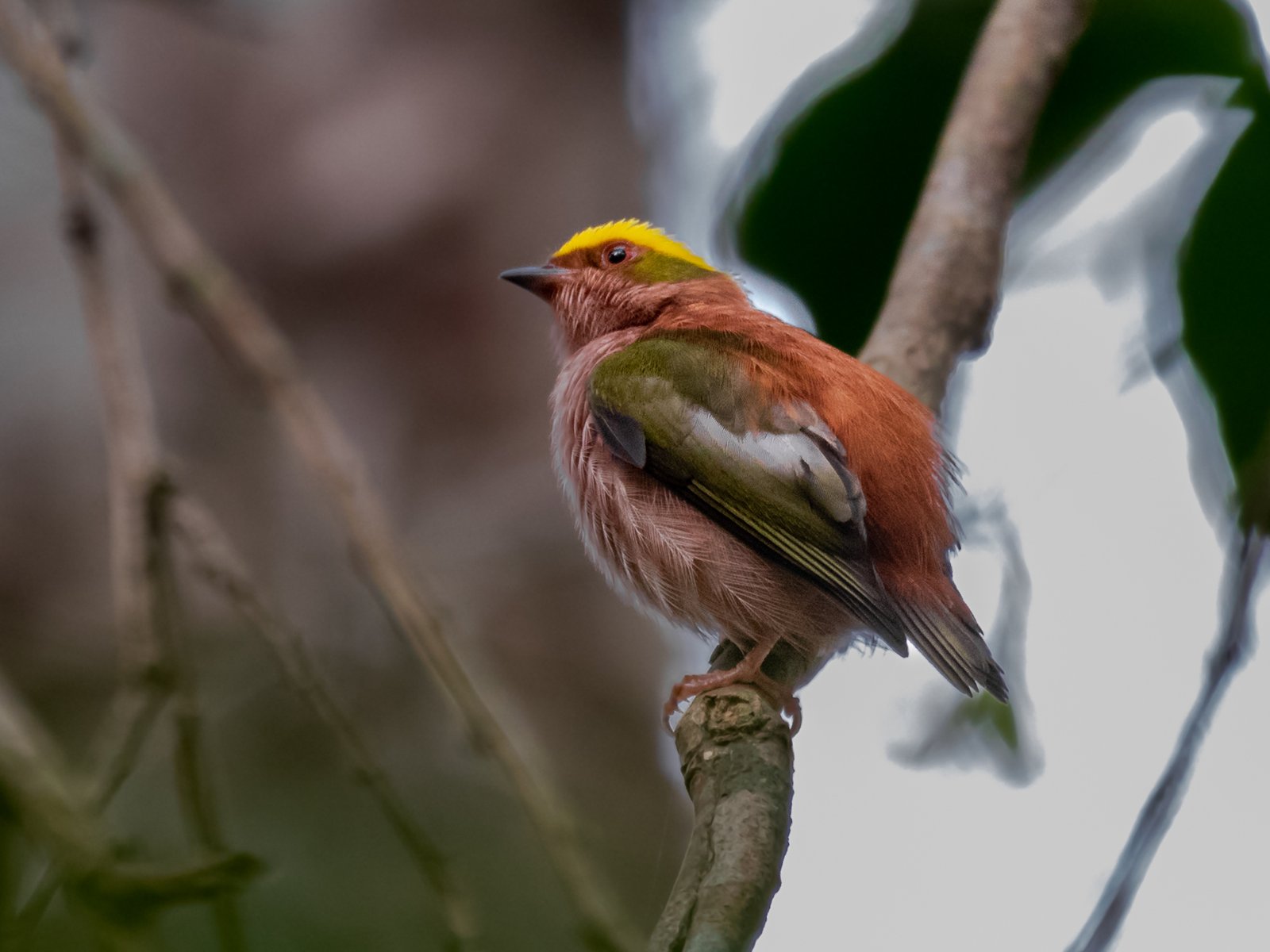
The Fiery-capped Manakin is a very small manakin of the midstorey of humid forest at the foot of the Andes and in the adjacent lowlands. The male has a yellow crown with a red central stripe and a pinkish-orange tinged back. In the guide area the species is local, with most records from Peru and northern Bolivia.
Voice
The male gives a high, short, somewhat ticking or buzzy note, repeated at intervals from a fixed perch. Also short, dry calls.
Recording: JAYRSON ARAUJO DE OLIVEIRA — CC BY-NC-SA 4.0 · xeno-canto
Identification
9 cm, with a short tail. The male has a golden-yellow crown with a narrow, fiery red central stripe. The upperparts are pinkish orange to cinnamon, the wings darker. The underparts are whitish, with fine pink streaks on the breast and flanks. The female is olive green, paler below, with a yellowish belly and faint streaks on the breast.
Confusion species
The male Striolated Manakin Machaeropterus striolatus has a red crown without yellow, an olive-green back and rufous streaks on the underparts. Painted Manakin Machaeropterus eckelberryi has a red crown in the male and is known only from a small area in the foothills of northern Peru. The females of these species are very similar; a male nearby helps with identification. Females of the Lepidothrix manakins are plain green, without streaks.
Habitat
The midstorey and lower levels of humid and semi-humid forest, forest edges, gallery forest and mature second growth, in the lowlands and in the foothills to roughly 1200 m. It feeds on small fruits and insects. Males display on thin branches in the midstorey. The nest is a small cup in a fork.
Where the bird is most at home, classified by the vegetation units of the Andes and the west coast.


Range and movements
In Peru locally along the eastern base of the Andes and in the adjacent lowlands, from the centre to the south-east of the country. In Bolivia in the north and centre, in the lowlands and foothills. Absent from Colombia, Ecuador and the Galápagos. Outside the guide area in Amazonian Brazil south of the Amazon, with a separate population in southern Venezuela.
- Resident
- dark = core range, pale = thinly spread
How and when to look
Search the midstorey of forest edges and open forest along the eastern base of the Andes; males often sit for long periods on the same thin branch. The high call gives the bird away sooner than its plumage.
Conservation status
Least Concern. Local in the guide area; loss of forest in the lowlands and foothills is the main threat.
Scientific name
Machaeropterus pyrocephalus | (Sclater, 1852)
Sclater described the species in 1852 as Pipra pyrocephala; because it was later moved to another genus, the author and year stand in brackets. The genus Machaeropterus was introduced in 1854 by Bonaparte. The genus name combines Greek makhaira, 'knife' or 'dagger', with -pteros, '-winged', after the thickened wing feathers of the males. The specific name comes from Greek pur, 'fire', and kephalē, 'head', after the fiery red crown. The specimen the first description was based on came from Ucayali, Peru.