All species › Passerines › Manakins › White-crowned Manakin
White-crowned Manakin | Pseudopipra pipra
Witkruinmanakin | Saltarín coroniblanco | Cabeça-branca
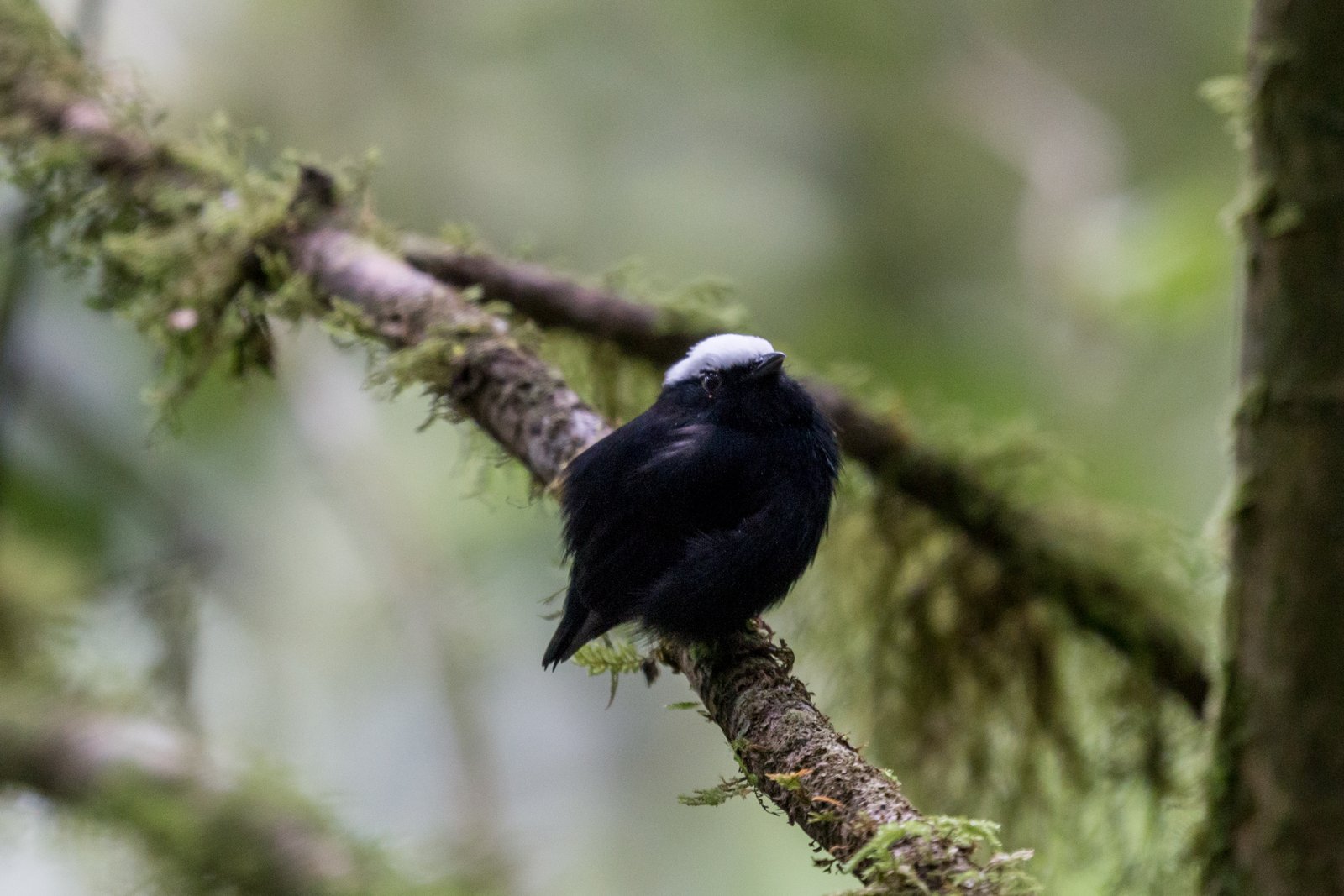
The White-crowned Manakin is a small, black manakin with a white crown, of the understorey of humid forest. It has one of the largest ranges in its family and is divided into a large number of subspecies, with differences in song and plumage; genetic studies suggest that several species may be involved. In the guide area it lives mainly in the foothills and on the lower slopes of the Andes.
Voice
A nasal, buzzy, slightly rising call, roughly dzeeeh, repeated from a fixed branch; the sound varies between subspecies. Also short, dry calls.
Recording: Mateus Gonçalves Santos — CC BY-NC-SA 4.0 · xeno-canto
Identification
9–10 cm, with a short tail. The male is glossy black with a white crown and nape; the iris is red or dark, depending on the subspecies. The female is olive green, with a grey head and a greyish throat and belly washed olive; the iris is reddish. Young males resemble the female, with the first black feathers and the start of a white crown.
Confusion species
The male Blue-rumped Manakin Lepidothrix isidorei is smaller, with a pale blue rump as well as the white crown. The male Snow-capped Manakin Lepidothrix nattereri is green, with a white crown and rump, and lives in the south-east of the guide area. Jet Manakin Chloropipo unicolor is entirely black, without a white crown, and lives higher in the mountains. The female Blue-capped Manakin Lepidothrix coronata is smaller and brighter green, without a grey head.
Habitat
The understorey of humid forest in the foothills and on the lower slopes of the Andes, roughly from 300 to 1500 m, locally higher, and scarcer in the adjacent lowlands. It feeds on small fruits and insects, taken in a short sally. Males display in loose groups, spread over a few fixed branches. The nest is a small cup low in a fork.
Where the bird is most at home, classified by the vegetation units of the Andes and the west coast.


Range and movements
In Colombia on the slopes of the Andes, both on the Pacific side and in the east, and locally in the eastern lowlands. In Ecuador on the eastern slope and in the adjacent lowlands. In Peru along the eastern slope of the Andes and in the adjacent lowlands, becoming scarcer to the south. Absent from Bolivia and the Galápagos. Outside the guide area in Costa Rica and Panama, Venezuela, the Guianas, Amazonian Brazil and the Atlantic Forest of eastern Brazil.
- Resident
- dark = core range, pale = thinly spread
How and when to look
Listen in the understorey of humid foothill forest for the buzzy call; males often sit on a fixed branch a few metres above the ground. Females often appear at shrubs with ripe fruit.
Conservation status
Least Concern. The range is very large; locally the species suffers from forest loss in the foothills.
Scientific name
Pseudopipra pipra | (Linnaeus, 1758) (GBIF: Pipra pipra)
Linnaeus described the species in 1758 as [Parus] Pipra; because it was later moved to another genus, the author and year stand in brackets. The genus Pseudopipra was introduced in 2016 by Kirwan, David, Gregory, Jobling, Steinheimer & Brito. The genus name comes from Greek pseudos, 'false', and the genus Pipra: a 'false Pipra'. The species name repeats Greek pipra, Aristotle's name for a small bird, which also gave the genus Pipra its name. The specimen the first description was based on came from Suriname.