All species › Passerines › Manakins › Red-capped Manakin
Red-capped Manakin | Ceratopipra mentalis
Geelbroekmanakin | Manaquín cabeza roja | Dançarino-de-boné-vermelho
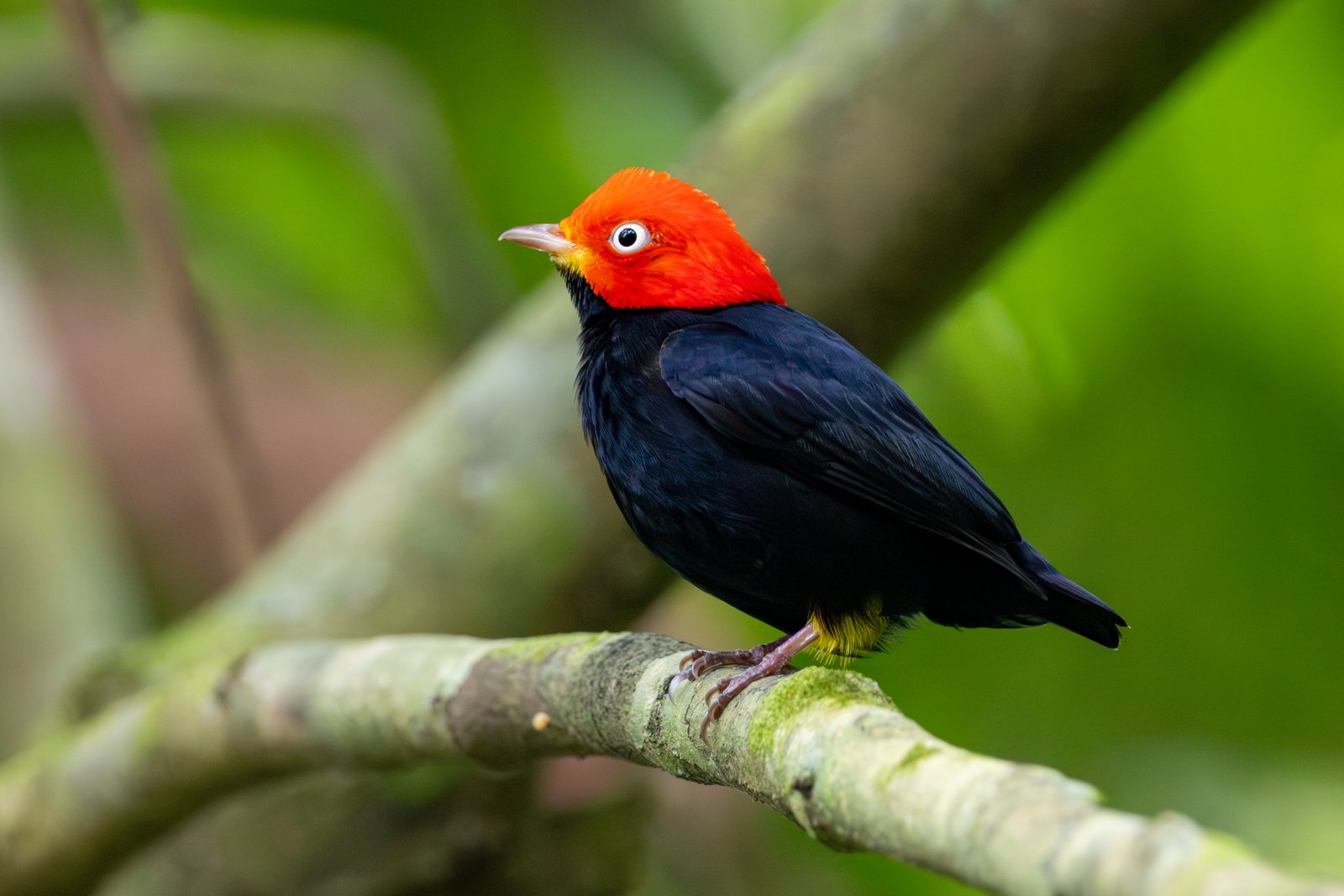
The Red-capped Manakin is a small, black manakin with a scarlet head and bright yellow thighs, of humid lowland forest west of the Andes. The male displays on a horizontal branch, sliding backwards with small, rapid steps, accompanied by snapping wing sounds. In the guide area it lives only in western Colombia and north-western Ecuador.
Voice
A sharp, dry psit and a buzzy, slightly descending call. During display snapping and buzzing wing sounds.
Recording: Nick Talbot — CC BY-NC-SA 4.0 · xeno-canto
Identification
10 cm, with a short tail. The male is velvety black, with a scarlet head and nape and bright yellow thighs, visible mainly during display. The iris is whitish, the bill pale. The female is olive green, paler and more yellowish olive below. Young males are green with the first red feathers on the head.
Confusion species
Golden-headed Manakin Ceratopipra erythrocephala has a golden-yellow head and red and white thighs, and lives east of the Andes and in northern Colombia. The female White-ruffed Manakin Corapipo altera is smaller, with a greyish throat. The female Golden-collared Manakin Manacus vitellinus has orange legs and a longer tail.
Habitat
The midstorey and lower levels of humid lowland forest and mature second growth, also forest edges, to roughly 1000 m in the foothills. It feeds mainly on small fruits, plucked in flight, and on insects. Males display in loose groups on horizontal branches in the midstorey. The nest is a small, shallow cup in a fork.
Where the bird is most at home, classified by the vegetation units of the Andes and the west coast.


Range and movements
In Colombia in the lowlands and foothills on the Pacific side and in the north-west. In Ecuador in the north-west, in the Chocó forests of Esmeraldas and adjacent provinces. Absent from Peru, Bolivia and the Galápagos. Outside the guide area from Panama north through Central America to southern Mexico.
- Resident
- dark = core range, pale = thinly spread
How and when to look
Search the midstorey of humid forest in the Chocó for displaying males on horizontal branches; the wing snaps carry some distance. Females also appear at trees with ripe fruit.
Conservation status
Least Concern. In the guide area the population depends on the remaining Chocó forest, which is shrinking through logging and agriculture.
Scientific name
Ceratopipra mentalis | (Sclater, 1857) (GBIF: Pipra mentalis)
Sclater described the species in 1857 as Pipra mentalis; because it was later moved to another genus, the author and year stand in brackets. The genus Ceratopipra was introduced in 1854 by Bonaparte. The genus name combines Greek keras, 'horn', with the genus name Pipra (manakins), after the horn-like head feathers of the type species. The species name comes from Modern Latin mentalis, 'of the chin', from Latin mentum, 'chin'. The specimen the first description was based on came from Córdoba, Veracruz, Mexico.