All species › Passerines › Cotingas › Fiery-throated Fruiteater
Fiery-throated Fruiteater | Pipreola chlorolepidota
Vuurkeelcotinga | Frutero golifuego | Anambé-de-garganta-de-fogo
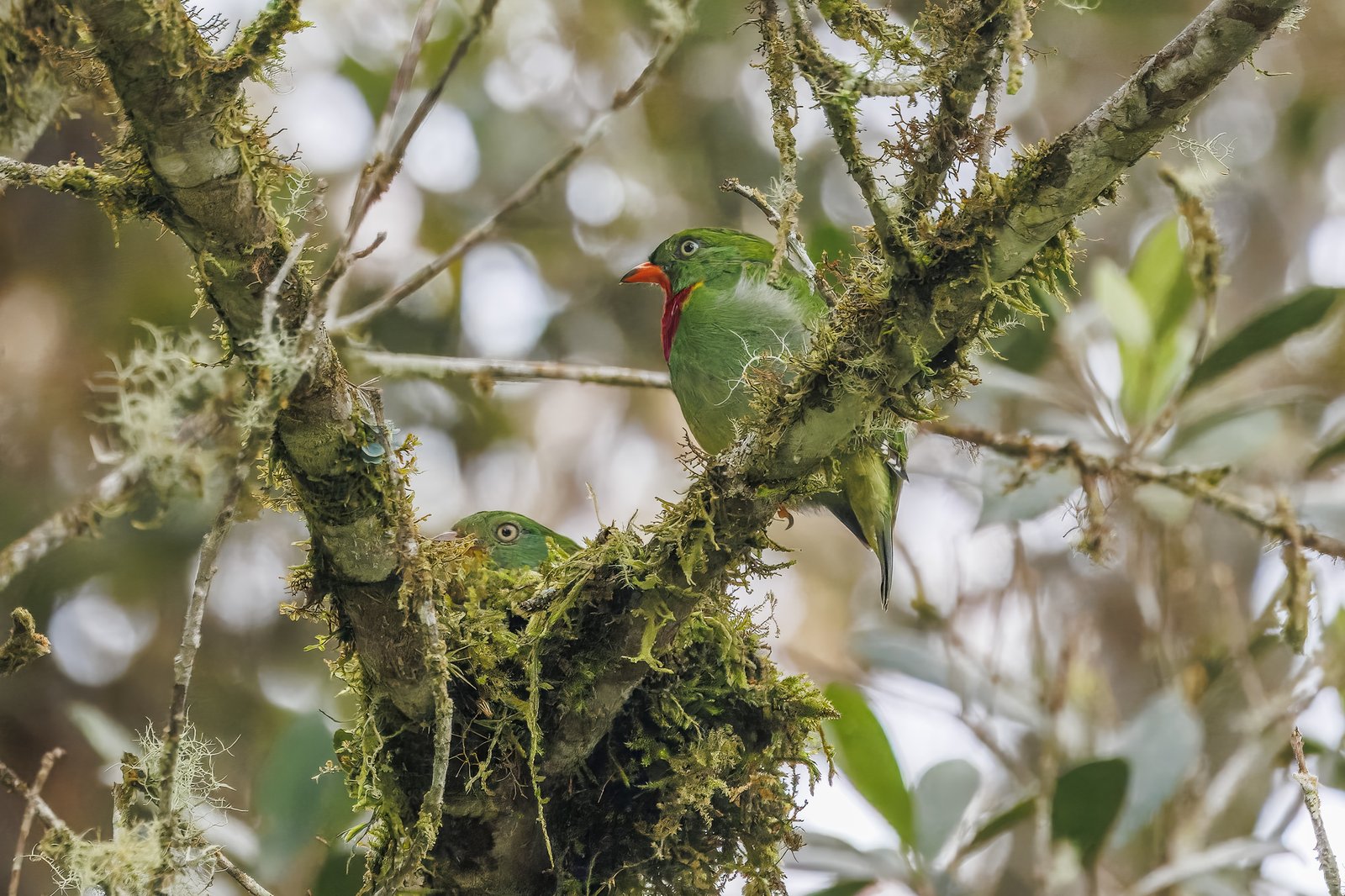
The Fiery-throated Fruiteater is the smallest member of the genus Pipreola, a stocky, grass-green fruit-eater of foothill forest on the east slope of the Andes. The male has a fiery orange-red throat and upper breast. Birds often sit still for long periods in the middle storey and sometimes join mixed flocks.
Voice
A very high, thin, hissing whistle, roughly tseeeee, which recalls an insect.
Recording: Scott Olmstead — CC BY-NC-SA 3.0 · xeno-canto
Identification
12 cm, a small, plump bird with a short tail; the bill and legs are orange-red. The male is bright grass-green above, with an orange-red to scarlet throat and upper breast; the rest of the underparts is green, becoming yellower towards the belly. The female lacks the red throat and is densely barred green and yellow below. Young birds resemble the female.
Confusion species
Scarlet-breasted Fruiteater Pipreola frontalis is larger; the male has a scarlet breast and a yellow belly, and the species usually lives somewhat higher. Masked Fruiteater Pipreola pulchra has a black mask in the male and lives higher, in cloud forest in Peru. Scaled Fruiteater Ampelioides tschudii is larger and scaled black and yellow above. Females of the various Pipreola species differ mainly in size, the pattern of the underparts and the elevation at which they live.
Habitat
Humid foothill forest and lower montane forest, also forest edges, roughly between 600 and 1200 m, locally somewhat higher. It stays in the middle storey and feeds mainly on small fruits and berries, also on insects. Little is known about the nest.
Where the bird is most at home, classified by the vegetation units of the Andes and the west coast.


Range and movements
In Colombia only on the east slope of the Andes in the south, in Caquetá and Putumayo. In Ecuador on the east slope. In Peru on the east slope and on outlying ridges, south to about the centre of the country. Absent from Bolivia and the Galápagos. Does not occur outside the guide area.
- Resident
- dark = core range, pale = thinly spread
How and when to look
Search foothill forest on the east slope, along roads and forest edges between about 700 and 1200 m, for example in the foothills of Ecuador. Listen for the high, hissing whistle, then scan the middle storey for a motionless green bird.
Conservation status
Least Concern. The species is tied to a narrow elevational band, where foothill forest is being lost locally to clearing and road building.
Scientific name
Pipreola chlorolepidota | Swainson, 1838
Swainson described the species in 1838 and placed it straight away in the genus where it still stands. He introduced the genus Pipreola in that same work. The genus name is a Latin diminutive of the genus Pipra (manakins). The species name comes from Greek khlōros, 'green', and lepidōtos, 'scaly', after the green scaled plumage. The specimen the first description was based on came from Moyobamba, Peru.