All species › Passerines › Cotingas › Scarlet-breasted Fruiteater
Scarlet-breasted Fruiteater | Pipreola frontalis
Geelkeelcotinga | Frutero pechiescarlata | Anambé-de-peito-escarlate
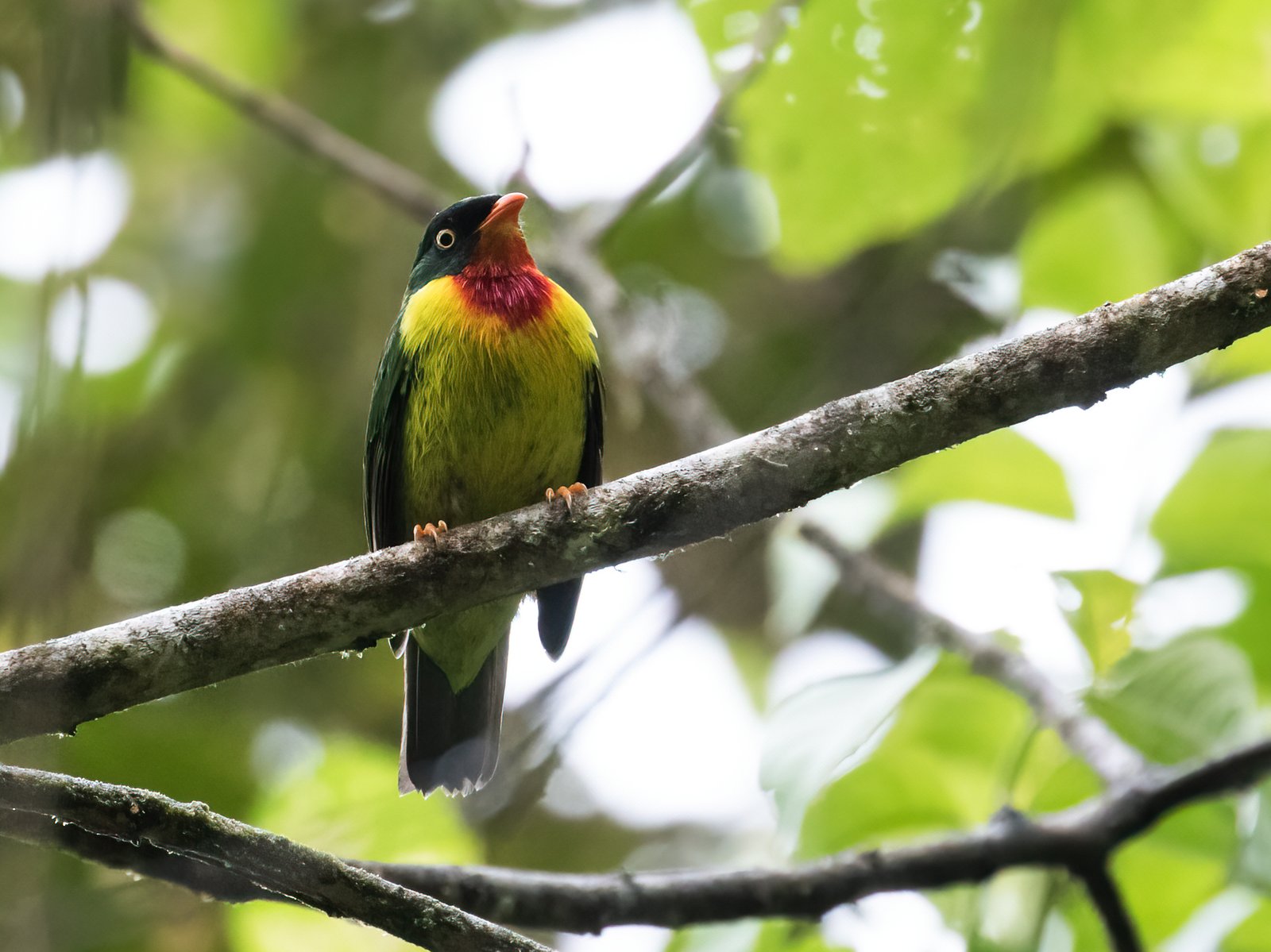
The Scarlet-breasted Fruiteater is a small fruit-eater of lower montane and foothill forest on the eastern slope of the Andes, from Ecuador to Bolivia. The male has a red to orange patch on the throat and breast on otherwise green and yellow plumage. On average it lives lower than most other Pipreola species.
Voice
Very high, thin tseeee notes, sometimes in a short, rising series.
Recording: Jonas Nilsson — CC BY-NC-SA 4.0 · xeno-canto
Identification
16–17 cm, with a short tail, a red bill and a pale iris. The male is green above, with a yellowish forehead; the throat and breast are orange-red to scarlet, grading into yellow at the sides. The belly is yellow, the flanks green. Birds from Ecuador and northern Peru have a more scaled breast. The female is green above and has yellow underparts densely scaled green, without red.
Confusion species
The male Fiery-throated Fruiteater Pipreola chlorolepidota is clearly smaller, has only a fiery orange throat and lives lower, in foothill forest. The male Masked Fruiteater Pipreola pulchra has a black mask and lives higher up. The male Black-chested Fruiteater Pipreola lubomirskii has a black head and breast.
Habitat
Humid foothill forest and lower montane forest on the eastern slope, also forest edges, at roughly 900 to 2000 m. It eats mainly fruit and berries, and also insects. It often sits quietly in the middle storey and canopy and joins mixed flocks.
Where the bird is most at home, classified by the vegetation units of the Andes and the west coast.


Range and movements
In Ecuador on the eastern slope of the Andes, mainly in the centre and south. In Peru on the eastern slope from north to south. In Bolivia in the Yungas of La Paz, Cochabamba and Santa Cruz. Absent from Colombia and the Galápagos. Does not occur outside the guide area.
- Resident
- dark = core range, pale = thinly spread
How and when to look
In lower montane forest on the eastern slope, such as along the road to Manú in Peru, in mixed flocks in the canopy and at fruiting trees. Listen for the high call.
Conservation status
Not Evaluated in its current circumscription. Earlier assessments considered the species Least Concern. The range is large and forest on the eastern slope is still largely intact.
Scientific name
Pipreola frontalis | (Sclater, 1859)
Sclater described the species in 1859 as Euchlornis frontalis; because it was later moved to another genus, the author and year stand in brackets. The genus Pipreola was introduced in 1838 by Swainson. The genus name is a Latin diminutive of the genus Pipra (manakins). The species name is Latin frontalis, 'of the forehead', after the forehead markings. The specimen the first description was based on came from Samaipata, Santa Cruz, Bolivia.