All species › Passerines › Tyrant flycatchers and allies › Foothill Elaenia
Foothill Elaenia | Myiopagis olallai
Heuvellandelenia | Elenita tropandina | Guaracava-do-sopé
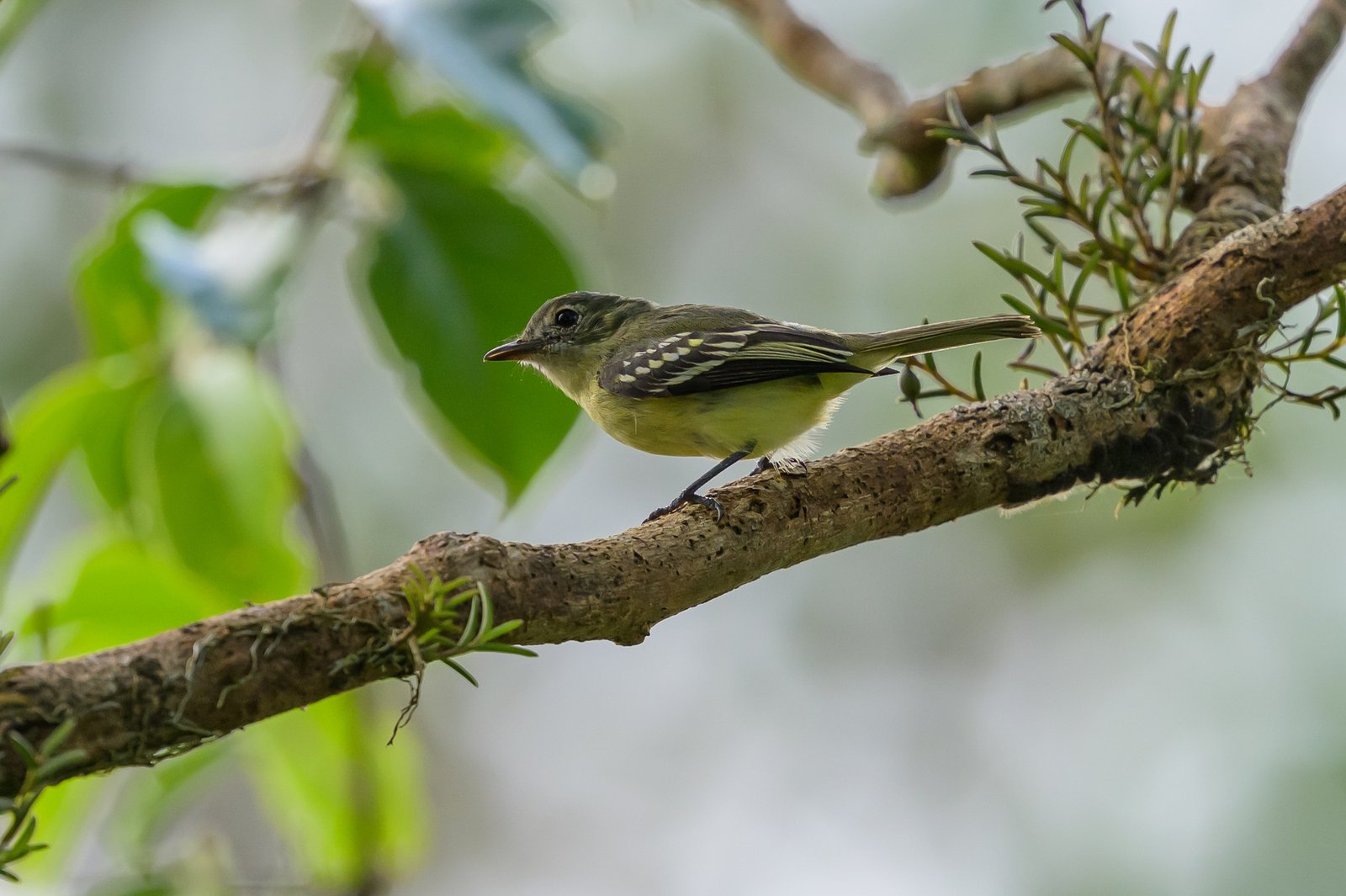
The Foothill Elaenia was described only in 2000, based on birds from Ecuador. It lives in the canopy of foothill forest on the slopes of the Andes and closely resembles Forest Elaenia, but has a different voice. Little is yet known about its habits.
Voice
A series of high, rather shrill notes, different in rhythm from the call of Forest Elaenia, repeated at intervals.
Recording: Iván Lau — CC BY-NC-SA 4.0 · xeno-canto
Identification
12.5 cm, with a rather short, dark bill. The crown is dark grey, with a yellow, partly hidden crown patch; there is a short pale eyebrow and a dark eye-stripe. The upperparts are dark olive-green. The wings are dark, with two narrow yellowish wing bars. The throat is greyish, the breast olive-grey with faint streaks, the belly pale yellow. The sexes are alike.
Confusion species
Forest Elaenia Myiopagis gaimardii is very similar, but has a paler head with a whitish crown patch and usually lives lower, in the lowlands; voice gives the clearest distinction. Greenish Elaenia Myiopagis viridicata lacks distinct wing bars. The female Grey-headed Elaenia Myiopagis caniceps has blacker wings with sharper wing bars.
Habitat
The canopy of humid foothill forest and lower montane forest, roughly between 900 and 1500 m. It gleans insects from foliage, often in mixed flocks. The nest has not been described.
Where the bird is most at home, classified by the vegetation units of the Andes and the west coast.


Range and movements
Colombia: locally, including Putumayo on the east slope and Antioquia at the north end of the Central Andes. Ecuador: on the east slope, including Napo around Sumaco and Zamora-Chinchipe. Peru: very locally on the east slope, in Pasco, Junín and Ucayali. Not known from Bolivia or the Galápagos. Does not occur outside the guide area.
- Resident
- dark = core range, pale = thinly spread
How and when to look
In Ecuador search along the roads near Sumaco (Napo) and around Zamora in the canopy of foothill forest, follow mixed flocks in the treetops and listen for the voice.
Conservation status
Least Concern according to the current assessment. Its habitat is a narrow, fragmented belt at elevations where much forest is being cleared.
Scientific name
Myiopagis olallai | Coopmans & Krabbe, 2000
Coopmans & Krabbe described the species in 2000 and placed it straight away in the genus where it still stands. The genus Myiopagis was introduced in 1888 by Salvin & Godman. The genus name comes from Greek muia, 'fly', and pagis, 'trap, snare'. The species name honours Alfonso María Olalla (1899–1971), an Ecuadorian professional collector in Amazonia. The specimen the first description was based on came from Río Bombuscaro near Zamora, Zamora-Chinchipe, Ecuador.