All species › Passerines › Tyrant flycatchers and allies › Grey-headed Elaenia
Grey-headed Elaenia | Myiopagis caniceps
Grijze elenia | Elenita gris | Guaracava-cinzenta
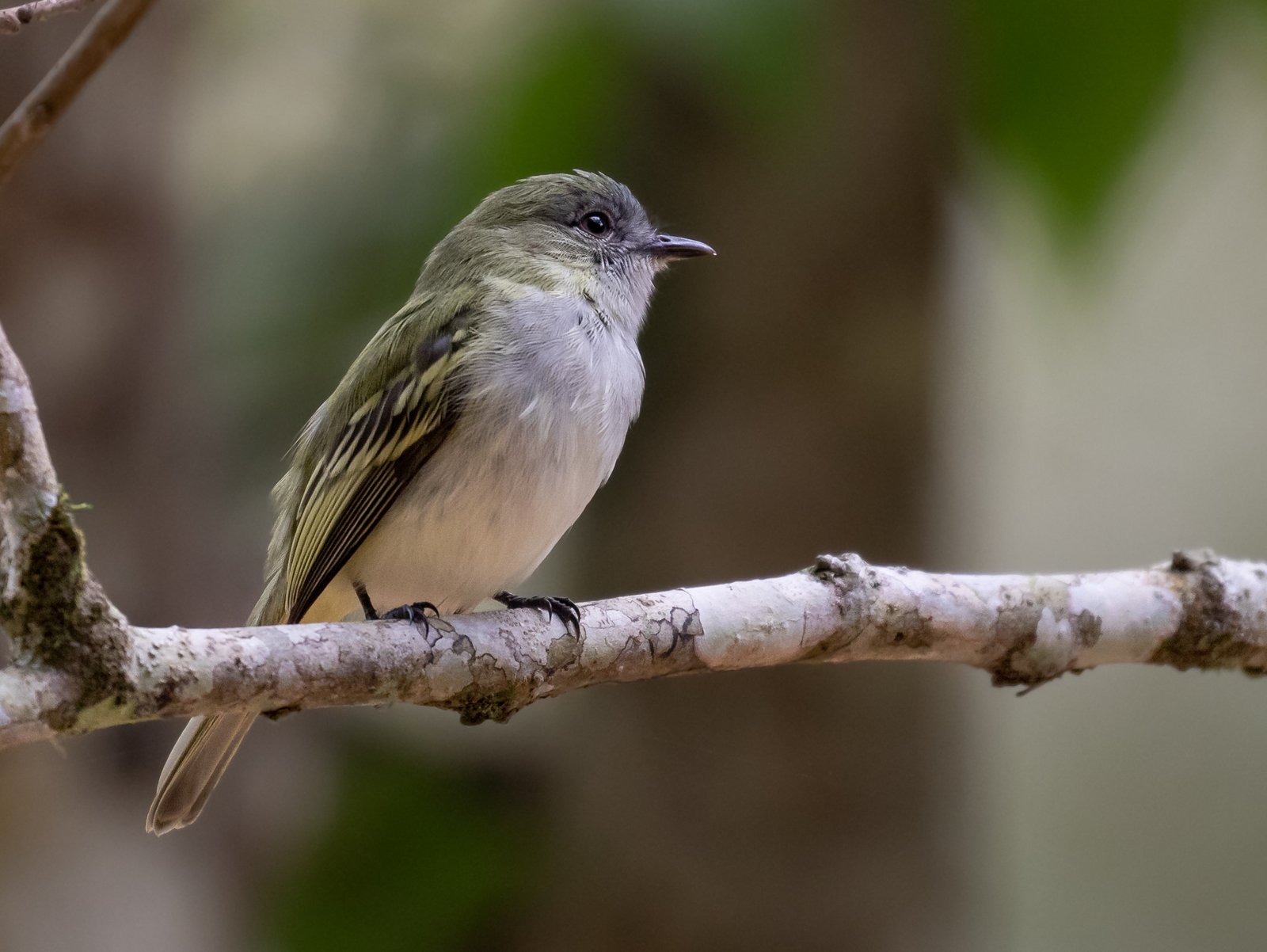
The Grey-headed Elaenia is a small canopy tyrant in which male and female differ clearly: the male is grey and white with black-and-white wings, the female olive-green and yellow. It lives high in the trees of humid lowland and foothill forest and often joins mixed flocks.
Voice
A high, accelerating, rather twittering trill, roughly tsee-tsee-tsi-tsi-ti-ti-ti, often from the treetops.
Recording: JAYRSON ARAUJO DE OLIVEIRA — CC BY-NC-SA 4.0 · xeno-canto
Identification
12 cm, with a small dark bill. Male: head and upperparts grey, with a white, partly hidden crown patch; wings black with two broad white wing bars and white edges to the secondaries; underparts greyish white, whiter on the belly. Female: head greyish with a yellow or whitish crown patch, upperparts olive-green; wings black with yellow wing bars and edges; breast greyish olive, belly pale yellow. Young birds resemble the female.
Confusion species
Forest Elaenia Myiopagis gaimardii resembles the female, but has browner-black wings with less contrasting wing bars. Foothill Elaenia Myiopagis olallai also has less contrasting wings. White-lored Tyrannulet Ornithion inerme is smaller, with a short tail, a white eyebrow and wing bars made of white spots.
Habitat
The canopy of humid lowland and foothill forest, also flooded forest and tall forest edges, up to roughly 1300 m. It gleans insects from high foliage, mostly in mixed flocks. The nest is a small cup high in a tree.
Where the bird is most at home, classified by the vegetation units of the Andes and the west coast.


Range and movements
Colombia: in the Pacific lowlands and foothills in the west, from Chocó to Nariño, in the Western Andes and in the Amazonian lowlands in the south and east. Ecuador: in the north-west and in the Amazonian lowlands. Peru: in the Amazonian lowlands and at the foot of the Andes. Bolivia: locally in the north and east. Absent from the Galápagos. Outside the guide area from eastern Panama and Venezuela to Brazil, Paraguay and north-eastern Argentina; the southernmost birds are partly migratory.
- Resident
- dark = core range, pale = thinly spread
How and when to look
Follow mixed flocks in the canopy, for example from canopy towers in the Amazonian lowlands or along roads in the foothills of north-western Ecuador, and look for a small grey bird with white wing bars high in the trees.
Conservation status
Least Concern. The species depends on tall forest, but is widespread.
Scientific name
Myiopagis caniceps | (Swainson, 1835)
Swainson described the species in 1835 as Tyrannula caniceps; because it was later moved to another genus, the author and year stand in brackets. The genus Myiopagis was introduced in 1888 by Salvin & Godman. The genus name comes from Greek muia, 'fly', and pagis, 'trap, snare'. The species name comes from Latin canus, 'grey', and -ceps, '-headed'. The specimen the first description was based on came from Santo Amaro, Bahia, Brazil.