All species › Passerines › Tyrant flycatchers and allies › Pacific Elaenia
Pacific Elaenia | Myiopagis subplacens
Ecuadoraanse elenia | Elenita del Pacífico | Guaracava-do-pacífico
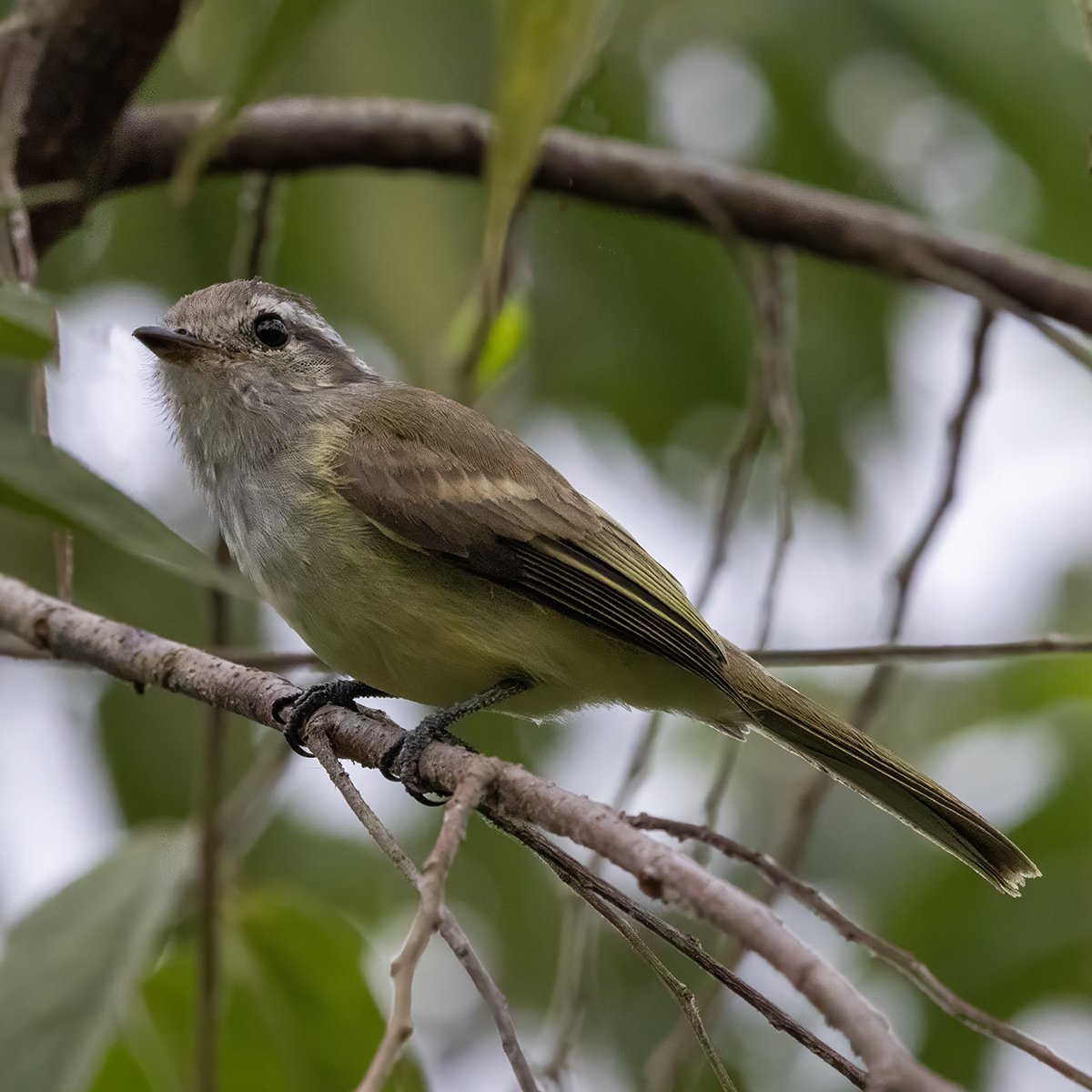
The Pacific Elaenia is the largest of the Myiopagis elaenias and occurs only in western Ecuador and north-western Peru. It lives in dry and semi-humid forest of the Tumbesian region, of which it is one of the characteristic species. A distinctive feature is the dark ear patch with a pale border.
Voice
A loud, rather hoarse, rolling call, often repeated, and a series of whistled notes.
Recording: Jerome Fischer — CC BY-NC-SA 4.0 · xeno-canto
Identification
14 cm, with a rather long tail and a dark bill with a pale base to the lower mandible. The crown is greyish olive, with a yellow, usually hidden crown patch. There is a pale eyebrow and a dark ear patch, bordered behind by a pale crescent. The upperparts are olive-green. The wings are dark with olive edges, with no or only faint wing bars. The throat is greyish, the breast olive-grey, the belly pale yellow. The sexes are alike.
Confusion species
Greenish Elaenia Myiopagis viridicata, which occurs in the same area, is smaller, with a greyer head and a less marked face pattern. Yellow-bellied Elaenia Elaenia flavogaster has a crest, white wing bars and a pale eye-ring. Grey-and-white Tyrannulet Pseudelaenia leucospodia is grey and white without yellow and lives in sparse scrub.
Habitat
Dry deciduous forest, semi-humid forest, forest edges and wooded scrub, from sea level to roughly 1700 m. It lives in the midstorey and canopy and eats insects and small fruits. The nest has been little described.
Where the bird is most at home, classified by the vegetation units of the Andes and the west coast.


Range and movements
Ecuador: in the west, from Esmeraldas and Pichincha south to El Oro and Loja. Peru: in the north-west, in Tumbes, Piura, Lambayeque and western Cajamarca. Absent from Colombia, Bolivia and the Galápagos. Does not occur outside the guide area.
- Resident
- dark = core range, pale = thinly spread
How and when to look
Search dry forest in south-western Ecuador, for example in the provinces of Loja and El Oro, or in the Cerros de Amotape in Tumbes, and listen in the midstorey for the rolling call.
Conservation status
Least Concern, but the dry forest it inhabits is heavily fragmented by logging and grazing.
Scientific name
Myiopagis subplacens | (Sclater, 1862)
Sclater described the species in 1862 as Elainea subplacens; because it was later moved to another genus, the author and year stand in brackets. The genus Myiopagis was introduced in 1888 by Salvin & Godman. The genus name comes from Greek muia, 'fly', and pagis, 'trap, snare'. The species name comes from Latin sub, 'near to', and the specific name of Elainia placens Sclater, 1859 (now a subspecies of Myiopagis viridicata): 'close to placens'. The specimen the first description was based on came from Pallatanga, Chimborazo, Ecuador.