All species › Passerines › Tyrant flycatchers and allies › Yellow-crowned Elaenia
Yellow-crowned Elaenia | Myiopagis flavivertex
Geelkruinelenia | Elenita coroniamarilla | Guaracava-de-penacho-amarelo
The Yellow-crowned Elaenia is an olive-green elaenia of flooded forest in Amazonia. Unlike most Myiopagis species it lives mainly in the understorey and midstorey of várzea and swamp forest. Its loud call is often the first sign of its presence.
Voice
A loud, rather hoarse series, roughly chek-chek-cheewee, and a sharp single call.
Recording: Iván Lau — CC BY-NC-SA 4.0 · xeno-canto
Identification
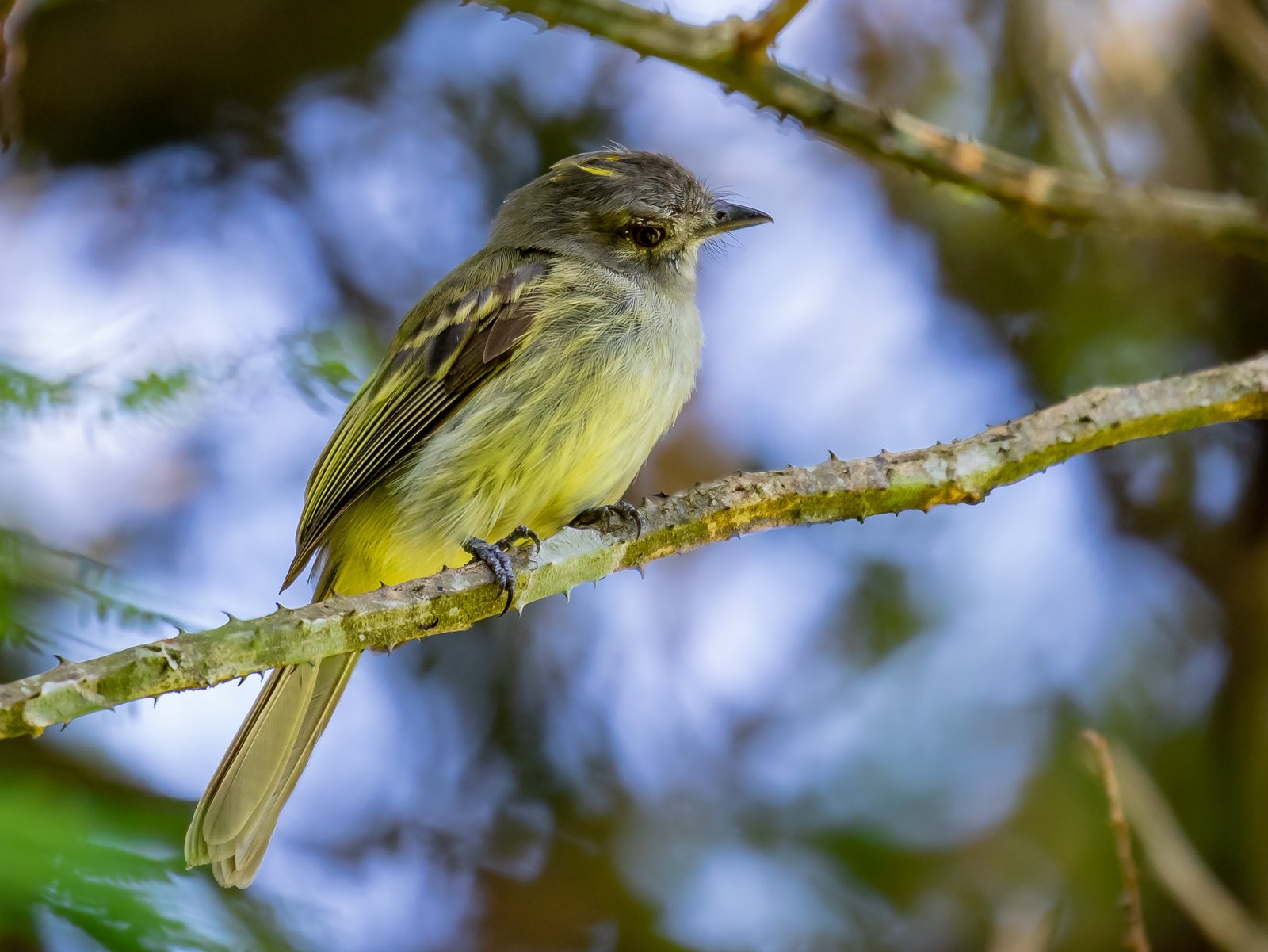
13 cm, with a rather long bill. The crown is dark olive, with a yellow, partly hidden crown patch; a pale eyebrow is barely present. The upperparts are olive-green. The wings are dark, with two distinct yellowish wing bars and yellow edges to the secondaries. The throat is greyish, the breast olive with faint streaks, the belly pale yellow. The sexes are alike.
Confusion species
Forest Elaenia Myiopagis gaimardii has a greyer head with a whitish crown patch and lives higher in the canopy. Yellow-crowned Tyrannulet Tyrannulus elatus is much smaller, with a stubby bill and a grey face. Small-billed Elaenia Elaenia parvirostris and other Elaenia species are larger, with a crest and a white eye-ring, and live in more open country.
Habitat
The understorey and midstorey of seasonally flooded forest (várzea and igapó), swamp forest and forest on river islands, in the Amazonian lowlands up to roughly 400 m. It eats insects, alone or in pairs. The nest has been little described.
Where the bird is most at home, classified by the vegetation units of the Andes and the west coast.


Range and movements
Colombia: in the Amazonian lowlands in the south and east. Ecuador: in the Amazonian lowlands, mainly in the east along the Napo and Aguarico. Peru: in the north-east, mainly in Loreto, locally into Ucayali. Not known from Bolivia and absent from the Galápagos. Outside the guide area in southern Venezuela, the Guianas and Amazonian Brazil.
- Resident
- dark = core range, pale = thinly spread
How and when to look
Search by canoe or along trails through flooded forest at lodges on the Napo and in the Iquitos area, and listen for the loud call in the midstorey.
Conservation status
Least Concern. Flooded forest still covers large areas along the major rivers.
Scientific name
Myiopagis flavivertex | (Sclater, 1887)
Sclater described the species in 1887 as Elainea flavivertex; because it was later moved to another genus, the author and year stand in brackets. The genus Myiopagis was introduced in 1888 by Salvin & Godman. The genus name comes from Greek muia, 'fly', and pagis, 'trap, snare'. The species name comes from Latin flavus, 'yellow', and vertex, 'crown'. The specimen the first description was based on came from Upper Ucayali (near Cashiboya), Peru.