All species › Passerines › Tyrant flycatchers and allies › Greenish Elaenia
Greenish Elaenia | Myiopagis viridicata
Groene elenia | Elenia verdosa | Guaracava-de-crista-alaranjada
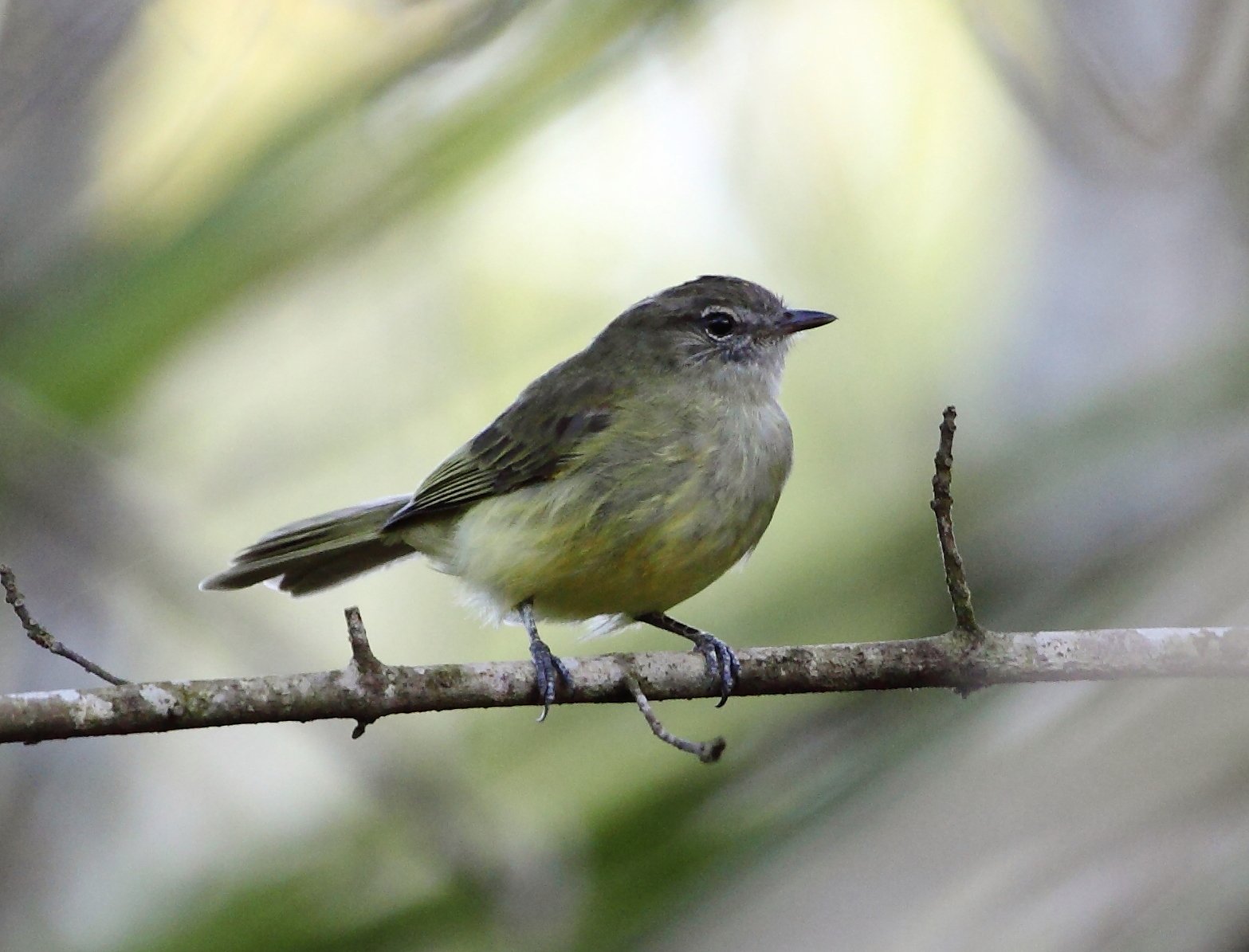
The Greenish Elaenia is a widespread elaenia occurring from Mexico to Argentina. In the guide area it lives mainly in dry and semi-humid forest west of the Andes and in eastern Bolivia; southern birds move to the Amazonian lowlands in the austral winter. Unlike most of its relatives it has no distinct wing bars.
Voice
A hoarse, buzzy call, roughly zhree-eep or chreep, repeated at intervals.
Recording: Marcos E. Sosa — CC BY-NC-SA 4.0 · xeno-canto
Identification
13.5 cm, with a rather long tail and a slender dark bill. The head is grey, with a yellow, usually hidden crown patch; a short whitish supraloral stripe and a narrow broken eye-ring. The upperparts are olive-green. The wings are dark, with olive-yellow edges and at most faint wing bars. The throat is pale grey, the breast greyish olive, the belly pale yellow. The sexes are alike.
Confusion species
Forest Elaenia Myiopagis gaimardii has distinct yellowish wing bars and a whitish crown patch. Pacific Elaenia Myiopagis subplacens is larger, with a dark ear patch bordered behind by a pale crescent. Yellow-olive Flatbill Tolmomyias sulphurescens has a broad, flat bill, a pale iris and distinct yellow wing edges.
Habitat
Dry deciduous forest, semi-humid forest, riparian woodland, forest edges and tall scrub, from sea level to roughly 1800 m. It gleans insects in the midstorey and canopy, often in mixed flocks, and also eats small fruits. The nest is a shallow cup in a tree fork. Migrants winter in humid lowland forest and forest edges.
Where the bird is most at home, classified by the vegetation units of the Andes and the west coast.


Range and movements
Colombia: in the Caribbean lowlands, the Magdalena and Cauca valleys and locally at the foot of the Andes. Ecuador: in the west, from Esmeraldas and Pichincha to El Oro and Loja. Peru: in the north-west (Tumbes) and in the eastern lowlands and the valleys of San Martín, where at least some birds are migrants from the south. Bolivia: breeds in the east and south, in dry forest and the Chaco; in the austral winter also further north. Absent from the Galápagos. Outside the guide area from Mexico through Central America to Venezuela, and in the south in Brazil, Paraguay and Argentina.
- Resident
- dark = core range, pale = thinly spread
How and when to look
Search dry and semi-humid forest in western Ecuador, for example in the provinces of Guayas, Manabí and El Oro, in mixed flocks in the midstorey, and listen for the hoarse call.
Conservation status
Least Concern. The species also occurs in forest edges and secondary forest.
Scientific name
Myiopagis viridicata | (Vieillot, 1817)
Vieillot described the species in 1817 as Sylvia viridicata; because it was later moved to another genus, the author and year stand in brackets. The genus Myiopagis was introduced in 1888 by Salvin & Godman. The genus name comes from Greek muia, 'fly', and pagis, 'trap, snare'. The species name comes from Latin viridicatus, 'greenish'. The specimen the first description was based on came from Paraguay.