All species › Passerines › Tyrant flycatchers and allies › Plain-crested Elaenia
Plain-crested Elaenia | Elaenia cristata
Kapelenia | Fiofío crestado | Guaracava-de-topete-uniforme
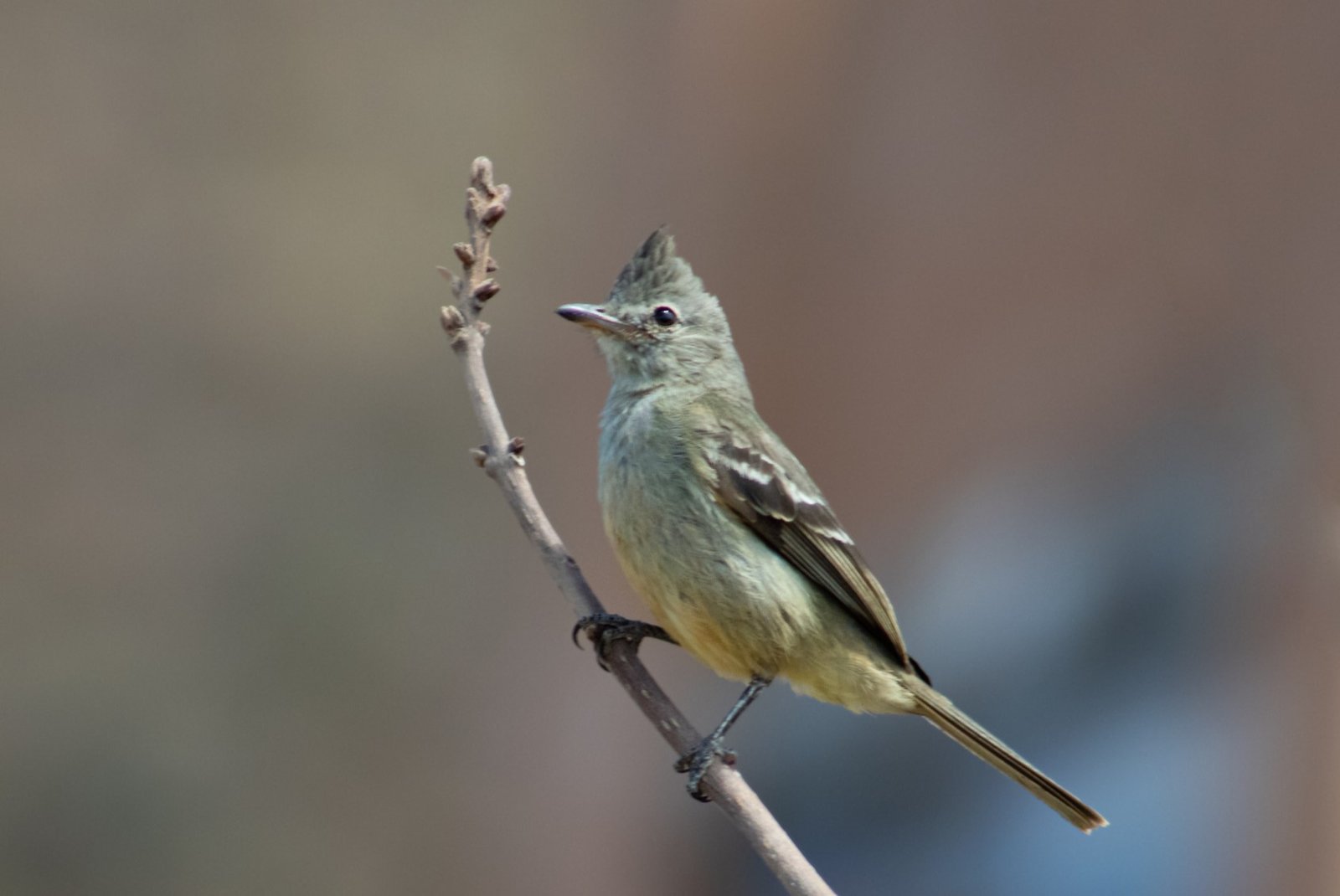
The Plain-crested Elaenia is an elaenia of open savanna with scattered shrubs and low trees. It has an erect, shaggy crest which, unlike in many other elaenias, shows no white crown patch. In the guide area it is restricted to savannas in eastern Colombia, south-eastern Peru and northern and eastern Bolivia.
Voice
A rapid, hoarse, chattering series, roughly cheb-e-cheb-e-chew, and a rasping single call.
Recording: JAYRSON ARAUJO DE OLIVEIRA — CC BY-NC-SA 4.0 · xeno-canto
Identification
14.5 cm, with a short bill with a pale base to the lower mandible. The crown feathers are long and usually raised into a shaggy crest, uniformly greyish brown without a white patch. There is a narrow whitish eye-ring. The upperparts are greyish olive. The wings are dark, with two distinct whitish wing bars. The throat and breast are greyish, the belly pale yellow. The sexes are alike.
Confusion species
Yellow-bellied Elaenia Elaenia flavogaster has a crest parted in the middle by a white crown patch, and lives more in farmland and gardens. Lesser Elaenia Elaenia chiriquensis is smaller, with a rounder head and a white crown patch. Large Elaenia Elaenia spectabilis is larger, with a white crown patch and a greyer breast. Suiriri Flycatcher Suiriri suiriri lacks a crest and has a greyer head.
Habitat
Open savanna and cerrado with scattered shrubs and low trees, also on white-sand soils, in the lowlands up to roughly 1000 m. It eats insects and many berries. The nest is a cup in a shrub or small tree.
Where the bird is most at home, classified by the vegetation units of the Andes and the west coast.


Range and movements
Colombia: in the savannas of the east, mainly in Guainía, Vichada and Vaupés, locally in Meta and Casanare. Peru: only in the south-east, in the savannas of Madre de Dios (Pampas del Heath) and locally in Cusco. Bolivia: in the savannas of Beni, Pando and northern La Paz, and in the cerrado of Santa Cruz. Absent from Ecuador and the Galápagos. Outside the guide area in Venezuela, the Guianas and the savannas and cerrado of Brazil.
- Resident
- dark = core range, pale = thinly spread
How and when to look
Search open savanna with scattered shrubs, for example the Beni savannas in Bolivia or the Pampas del Heath in Peru, in the tops of shrubs and low trees, and look for the shaggy crest without a white patch.
Conservation status
Least Concern. Savannas are locally converted to pasture and fields, but the species is widespread.
Scientific name
Elaenia cristata | Pelzeln, 1868
Pelzeln described the species in 1868 and placed it straight away in the genus where it still stands. The genus Elaenia was introduced in 1836 by Sundevall. The genus name comes from Ancient Greek elaineos, 'of olive oil' or 'oleaginous'. Latin cristatus, 'crested', after the crest. The specimen the first description was based on came from Goiás (city), Brazil.