All species › Passerines › Antbirds › Foothill Stipplethroat
Foothill Stipplethroat | Epinecrophylla spodionota
Heuvelmiersluiper | Hormiguerito submontano | Choquinha-do-sopé
The Foothill Stipplethroat is the Epinecrophylla of the foothills on the eastern slope of the Andes. It lives higher than its lowland relatives, in the understorey of humid forest on the slopes. Like them, it forages in hanging dead leaves.
Voice
The song is a series of high, thin notes falling slightly in pitch. The call is a short, sharp chek.
Recording: Paul Driver — CC BY-NC-SA 4.0 · xeno-canto
Identification
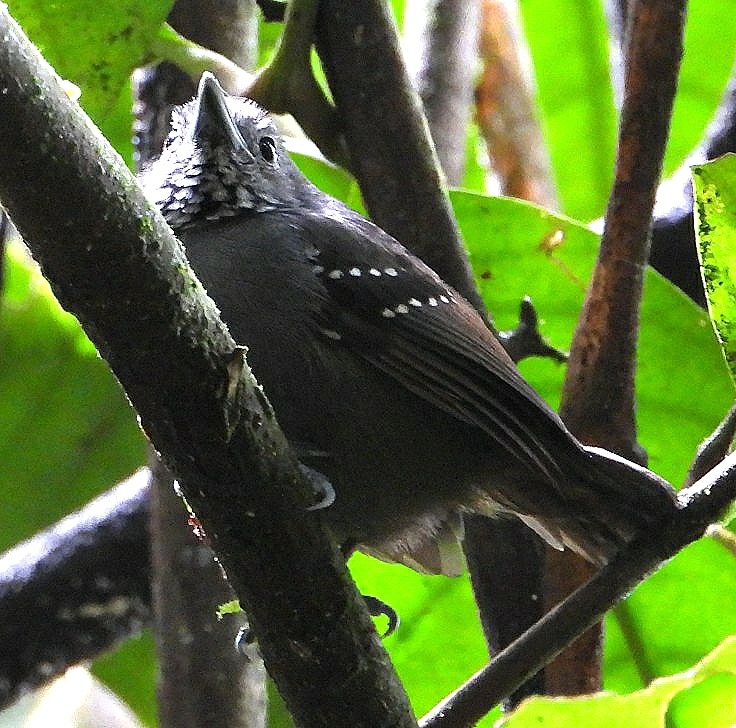
11 cm. The male is olive-brown above, with blackish wing coverts with buff spots. The throat is black with white stippling, the breast and belly grey and the flanks olive-brown. The female has a plain buff to ochre throat and breast. The tail is brown.
Confusion species
Rufous-backed Stipplethroat Epinecrophylla haematonota lives lower, in the lowlands, and has a rufous back. Ornate Stipplethroat Epinecrophylla ornata has a grey head, a rufous (lower) back and white wing spots, and usually lives lower. Rufous-tailed Stipplethroat Epinecrophylla erythrura has a rufous back and tail.
Habitat
Understorey of humid foothill forest and lower montane forest on the eastern slope of the Andes, roughly between 600 and 1400 m. It travels in pairs with mixed flocks, searching hanging dead leaves for insects and spiders. The nest is poorly described; probably a ball of dead leaves as in its relatives.
Where the bird is most at home, classified by the vegetation units of the Andes and the west coast.


Range and movements
Colombia: on the eastern slope of the Andes, mainly in the south. Ecuador: along the entire eastern slope of the Andes. Peru: along the eastern slope south to the centre of the country. Absent from Bolivia and the Galápagos. Does not occur outside the guide area.
- Resident
- dark = core range, pale = thinly spread
How and when to look
Follow understorey mixed flocks in foothill forest along roads and trails on the eastern slope, for example in northeastern or southeastern Ecuador, at about 700–1300 m.
Conservation status
Least Concern. The species has a narrow elevational range and is sensitive to deforestation of the foothills.
Scientific name
Epinecrophylla spodionota | (Sclater & Salvin, 1880)
Sclater & Salvin described the species in 1880 as Myrmotherula spodionota; because it was later moved to another genus, the author and year stand in brackets. The genus Epinecrophylla was introduced in 2006 by Isler & Brumfield. The genus name combines Greek epi, 'on', nekros, 'dead', and phullon, 'leaf', for the habit of foraging in hanging dead leaves. The species name comes from Greek spodios, 'ash-grey', and nōtos, 'back', for the grey back. The specimen the first description was based on came from Sarayacu, Pastaza, Ecuador.