All species › Passerines › Antbirds › Ornate Stipplethroat
Ornate Stipplethroat | Epinecrophylla ornata
Zwartkeelmiersluiper | Hormiguerito adornado | Choquinha-ornada
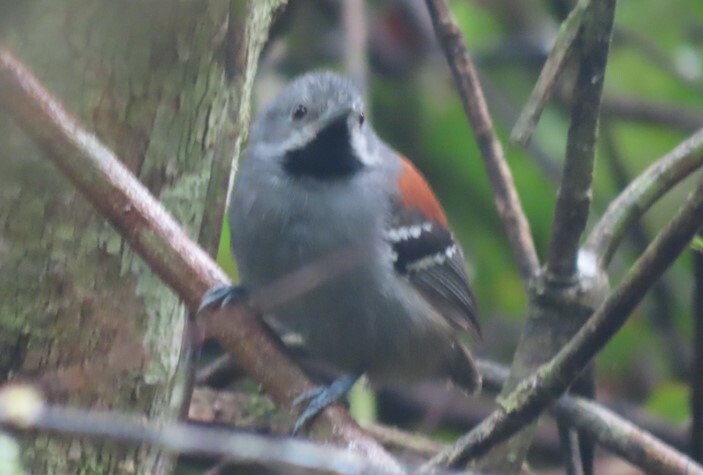
The Ornate Stipplethroat is an antwren of the western Amazon and the foothills, with a grey head and underparts and a rufous back. It searches dead leaves and vine tangles, often in mixed flocks. Northern and southern forms differ in the colour of the back.
Voice
The song is a series of high, thin whistles that fall and speed up slightly. The call is a sharp cheep.
Recording: Juan Freile — CC BY-NC-SA 4.0 · xeno-canto
Identification
11 cm. The male has a grey head and underparts, a black throat with white stippling and black wing coverts with white spots. The back is grey with a rufous lower back in the north, largely rufous in the south. The female has a rufous head and underparts, a blackish, white-stippled throat and also a rufous back.
Confusion species
Rufous-backed Stipplethroat Epinecrophylla haematonota has an olive-brown head and buff wing spots; the female has a plain ochre throat. White-eyed Stipplethroat Epinecrophylla leucophthalma has a brown head and a pale iris; the female lacks the black throat. White-flanked Antwren Myrmotherula axillaris is blackish with white flanks and has no rufous back.
Habitat
Understorey and mid-storey of humid lowland and foothill forest, especially in vine tangles, forest edges, gaps and locally bamboo, up to about 1200 m. It forages in pairs with mixed flocks for arthropods in dead leaves. The nest is a ball of dead leaves low in the vegetation.
Where the bird is most at home, classified by the vegetation units of the Andes and the west coast.


Range and movements
Colombia: along the base of the Andes in the east and in the southeast. Ecuador: in the eastern lowlands and foothills. Peru: over most of the Amazon lowlands. Bolivia: in the north. Absent from the Galápagos. Outside the guide area in western Amazonian Brazil.
- Resident
- dark = core range, pale = thinly spread
How and when to look
Search vine tangles and forest edges in the lowlands and foothills of Peru and Ecuador; in mixed flocks look for an antwren with grey underparts and a rufous back.
Conservation status
Not Evaluated. The species is widespread and locally fairly common, and tolerates forest edges and secondary forest.
Scientific name
Epinecrophylla ornata | (Sclater, 1853)
Sclater described the species in 1853 as Formicivora ornata; because it was later moved to another genus, the author and year stand in brackets. The genus Epinecrophylla was introduced in 2006 by Isler & Brumfield. The genus name combines Greek epi, 'on', nekros, 'dead', and phullon, 'leaf', for the habit of foraging in hanging dead leaves. The species name comes from Latin ornatus, 'adorned', for the varied pattern. The specimen the first description was based on came from Bogotá, Colombia.