All species › Parrots › African and New World parrots › Fuertes's Parrot
Fuertes's Parrot | Hapalopsittaca fuertesi
Fuertes' andespapegaai | Cotorra aliazul | Papagaio-de-fuertes
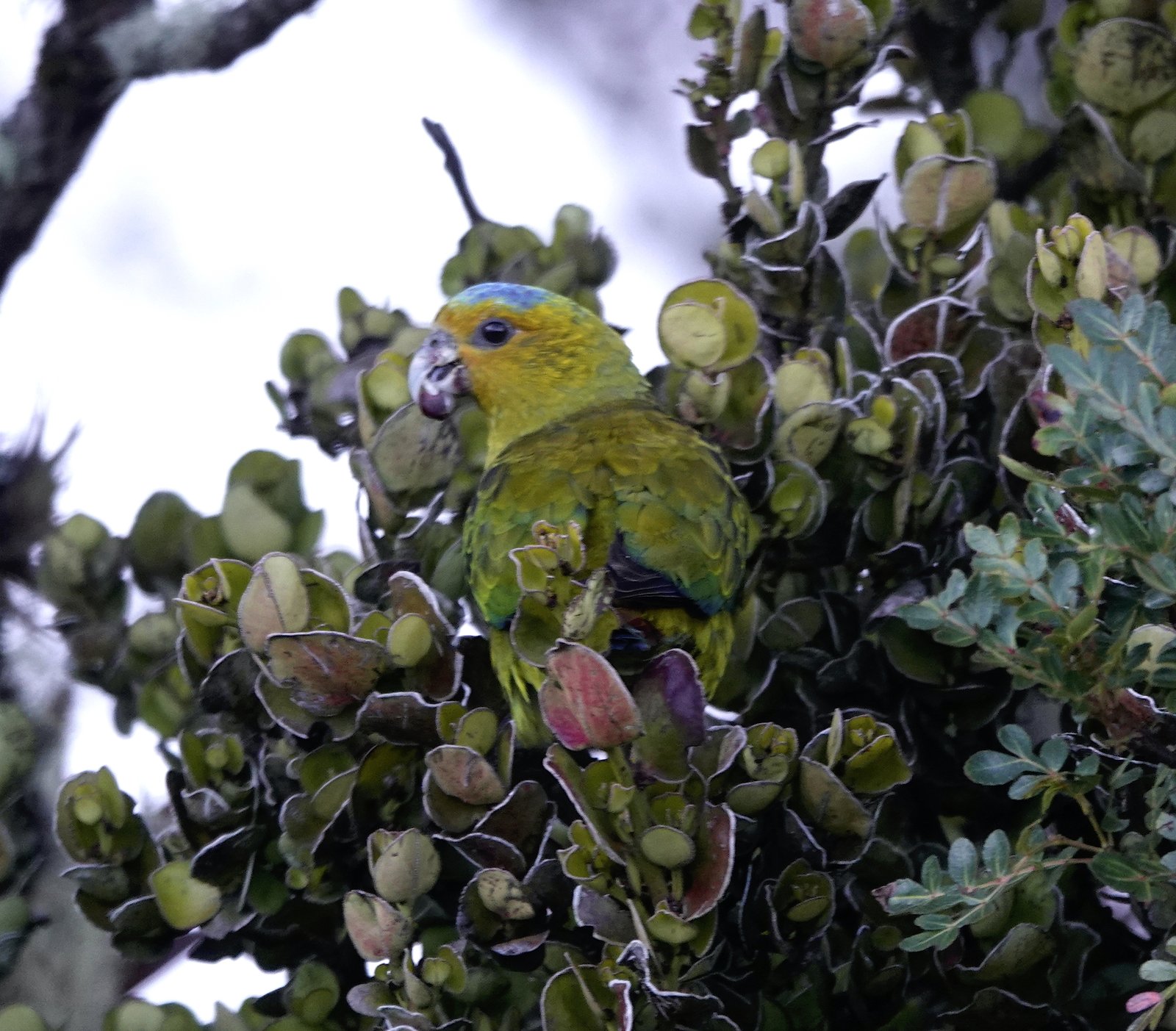
Fuertes's Parrot is a stocky parrot of high-elevation cloud forest in the Central Andes of Colombia. The species was collected in 1911 and then not seen with certainty for decades, until it was rediscovered in 2002. It has one of the smallest ranges of all parrots in the guide area.
Voice
High, shrill calls in flight, often repeated, and soft chatter from feeding groups.
Recording: Iván Lau — CC BY-NC-SA 4.0 · xeno-canto
Identification
24 cm, stocky, with a short tail and a pale bill. The plumage is green. There is a narrow red band on the forehead, the crown is blue and the face yellowish green. The shoulder is red, the flight feathers are blue and there is a red patch on the belly. The tail is reddish with a blue tip. The sexes are alike.
Confusion species
Rusty-faced Parrot Hapalopsittaca amazonina has a rusty red face and no blue crown, and lives mainly lower and in the Eastern Andes. Speckle-faced Parrot Pionus tumultuosus has a pale yellow bill, a plum-red, speckled head and red undertail coverts. Scaly-naped Amazon Amazona mercenarius is larger, with a longer tail and a scaly nape. Yellow-eared Parrot Ognorhynchus icterotis has a long, pointed tail, yellow cheeks and a heavy, dark bill.
Habitat
High cloud forest and forest edges up to just below the treeline, roughly between 2900 and 3800 m. It eats fruit and seeds, especially of mistletoes, and flowers. It breeds in tree cavities and also uses nest boxes.
Where the bird is most at home, classified by the vegetation units of the Andes and the west coast.


Range and movements
Endemic to Colombia, in the Central Andes in Caldas, Risaralda, Quindío and Tolima. Absent from Ecuador, Peru, Bolivia and the Galápagos.
- Resident
- dark = core range, pale = thinly spread
How and when to look
Visit protected high cloud forest in the Central Andes, around Los Nevados National Park. Small groups fly over the forest edges in the early morning and give themselves away by their calls.
Conservation status
Endangered. The range is very small and the population low; the high-elevation forest has largely been cleared for cattle ranching. Conservation measures, including nest boxes and forest restoration, have led to an increase in the population since its rediscovery.
Scientific name
Hapalopsittaca fuertesi | (Chapman, 1912)
Chapman described the species in 1912 as Pionopsitta fuertesi; because it was later moved to another genus, the author and year stand in brackets. The genus Hapalopsittaca was introduced in 1912 by Ridgway. The genus name comes from Greek hapalos, 'soft, gentle', and psittakē, 'parrot'. The species name honours Louis Agassiz Fuertes (1874–1927), American bird painter who took part in Chapman's expedition in Colombia. The specimen the first description was based on came from Laguneta, Colombia.