All species › Parrots › African and New World parrots › Red-faced Parrot
Red-faced Parrot | Hapalopsittaca pyrrhops
Vuuroogandespapegaai | Loro carirrojo | Papagaio-de-face-vermelha
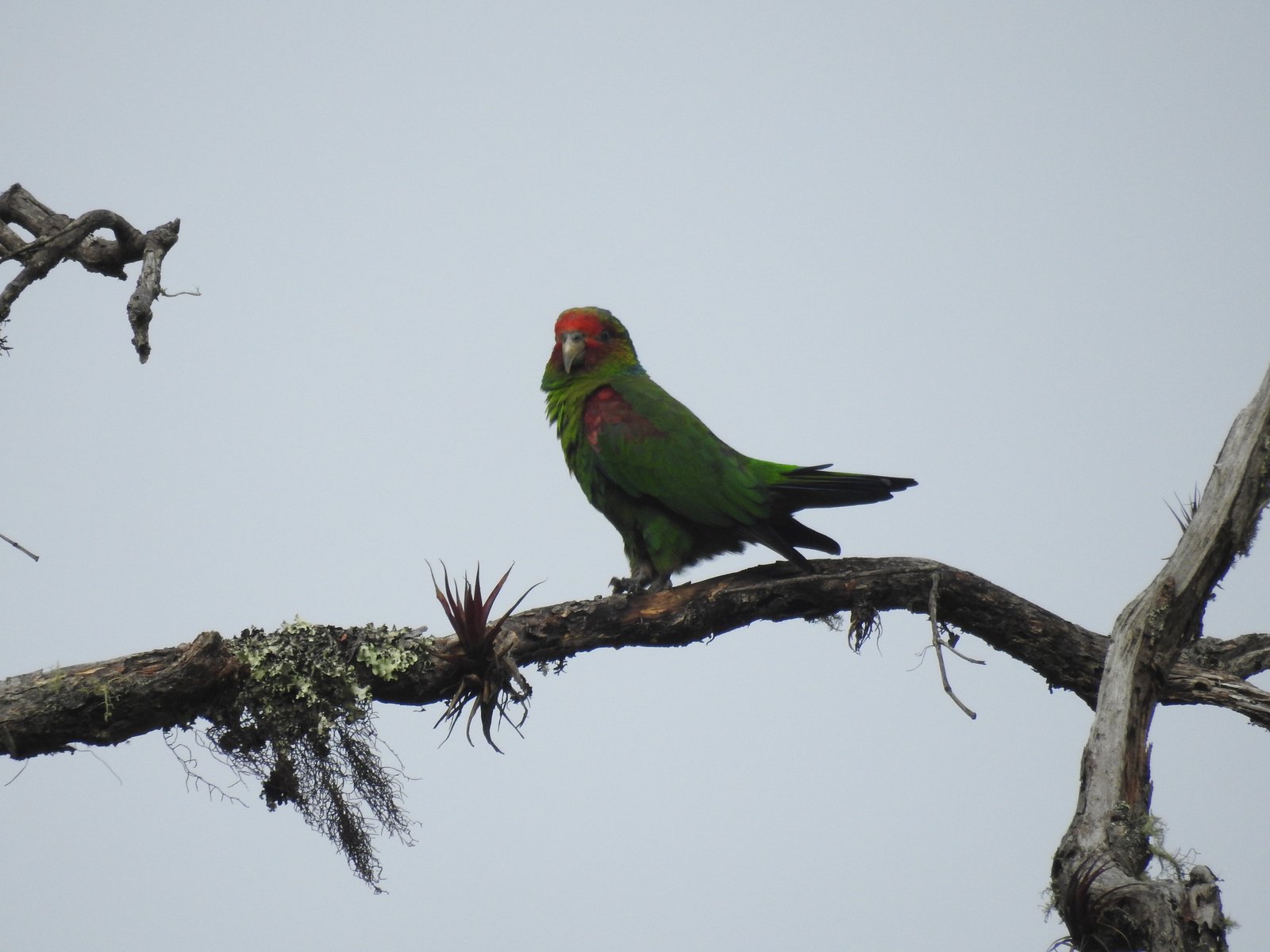
The Red-faced Parrot is a small, stocky parrot of high montane forest in southern Ecuador and the far north of Peru. It lives in pairs or small groups just below the treeline and sometimes enters the shrubbery of the páramo. Its red face distinguishes it from the other parrots of these highlands.
Voice
High, shrill and somewhat grating calls, mainly in flight, and soft chatter while feeding.
Recording: Paul Molina Abril — CC BY-NC-SA 4.0 · xeno-canto
Identification
23 cm, stocky, with a short tail and a pale, greyish bill. The plumage is green. The forehead, lores and the area around the eye are red, and the ear-coverts are yellowish green. The shoulder is red and the primaries are dark blue. The sexes are alike; juveniles have less red on the face.
Confusion species
Speckle-faced Parrot Pionus tumultuosus has a pale yellow bill, a greyish white or plum-red speckled head and red undertail coverts. Scaly-naped Amazon Amazona mercenarius is larger, with a longer tail, a scaly nape and red in the wing. Golden-plumed Parakeet Leptosittaca branickii has a long, pointed tail and a yellow streak behind the eye.
Habitat
High montane forest, elfin forest and scrub near the treeline and the transition to páramo, roughly between 2500 and 3500 m. It eats fruit, seeds and flowers, including those of mistletoes. The nest is in a tree cavity.
Where the bird is most at home, classified by the vegetation units of the Andes and the west coast.


Range and movements
In Ecuador in the south, in Azuay, Loja, Zamora-Chinchipe and southern Morona-Santiago. In Peru in the far north, in Piura and Cajamarca. Absent from Colombia, Bolivia and the Galápagos.
- Resident
- dark = core range, pale = thinly spread
How and when to look
In Podocarpus National Park in southern Ecuador, look along the upper forest edge for small groups flying low over the elfin forest. They often sit still in the trees and give themselves away by their calls.
Conservation status
Endangered. The population is small and fragmented; the high-elevation forest is being degraded by logging, fires and the spread of pasture.
Scientific name
Hapalopsittaca pyrrhops | (Salvin, 1876)
Salvin described the species in 1876 as Pionopsitta pyrrhops; because it was later moved to another genus, the author and year stand in brackets. The genus Hapalopsittaca was introduced in 1912 by Ridgway. The genus name comes from Greek hapalos, 'soft, gentle', and psittakē, 'parrot'. The species name comes from Greek purrhos, 'flame-red', and ōps, 'face', for the red face. The specimen the first description was based on came from Santa Rita and San Lucas, Ecuador.