All species › Passerines › Tanagers and allies › Fulvous-headed Tanager
Fulvous-headed Tanager | Thlypopsis fulviceps
Taankoptangare | Tangara cabecifulva | Saí-de-cabeça-fulva
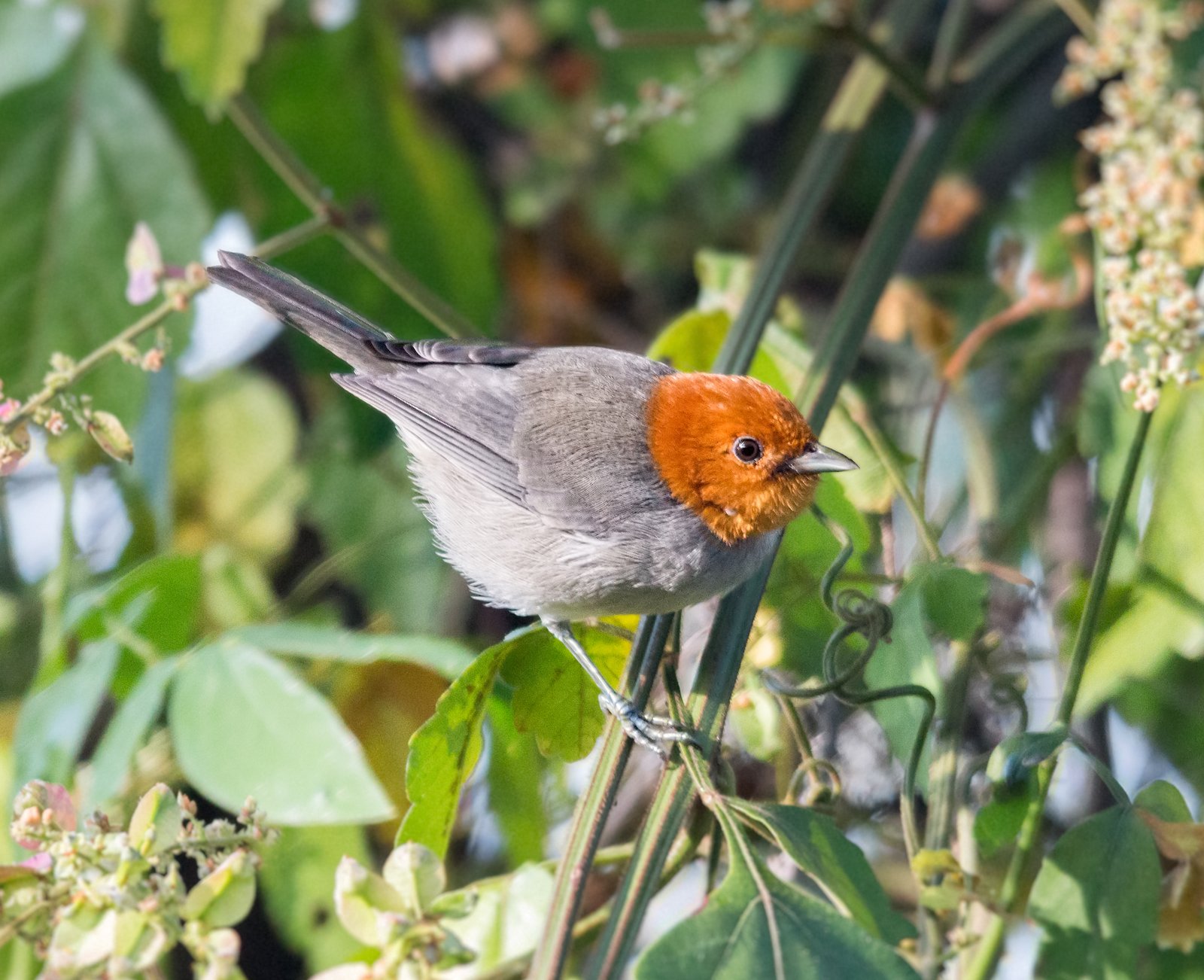
The Fulvous-headed Tanager is a small, grey tanager with a rufous head, found in the guide area only in north-eastern Colombia. The core of its range lies in the mountains of Venezuela. Pairs and small groups move through the middle and upper levels of forest edges, often in mixed flocks.
Voice
High, thin tsit calls. The song is a fast series of high, thin notes.
Recording: Nick Athanas — CC BY-NC-SA 3.0 · xeno-canto
Identification
12–13 cm, with a pointed, dark bill. The whole head is warm rufous to fulvous, sharply set off against the grey neck, back and wings. The underparts are grey, the centre of the belly whitish. The female resembles the male but has a paler, drab throat. Juveniles are greyer, with a faintly brown head.
Confusion species
Rufous-chested Tanager Thlypopsis ornata has an orange-rufous breast and a white belly, and lives further south. Grey-hooded Bush Tanager Cnemoscopus rubrirostris has a grey head, a pink bill and olive-yellow underparts. Orange-headed Tanager Thlypopsis sordida has an orange-yellow head, and lives in the lowlands.
Habitat
Humid montane forest, forest edges, open woodland and tall second growth, mainly in the middle and upper levels, roughly between 800 and 2400 m. It searches leaves and twigs for insects and also eats small fruits, often in mixed flocks. Little is known about the nest.
Where the bird is most at home, classified by the vegetation units of the Andes and the west coast.


Range and movements
In Colombia only in the north-east, in the Serranía de Perijá and on the northernmost part of the Eastern Andes. Absent from Ecuador, Peru, Bolivia and the Galápagos. Outside the guide area in the mountains of northern and western Venezuela.
- Resident
- dark = core range, pale = thinly spread
How and when to look
Search mixed flocks at forest edges in the mountains of Norte de Santander and the Serranía de Perijá. Watch for a small, grey tanager with a rufous head.
Conservation status
Least Concern. Forest loss in the mountains of north-eastern Colombia may affect the species locally.
Scientific name
Thlypopsis fulviceps | Cabanis, 1851
Cabanis described the species in 1851 and placed it straight away in the genus where it still stands. He introduced the genus Thlypopsis in that same work. The genus name combines Greek thlupis, an unknown small bird, with opsis, 'appearance'. The species name combines Latin fulvus, 'tawny', with -ceps, 'headed', for the tawny head. The specimen the first description was based on came from Caracas, Venezuela.