All species › Passerines › Tanagers and allies › Buff-bellied Tanager
Buff-bellied Tanager | Thlypopsis inornata
Taanbuiktangare | Tangara ventrianteada | Saí-de-barriga-ocre
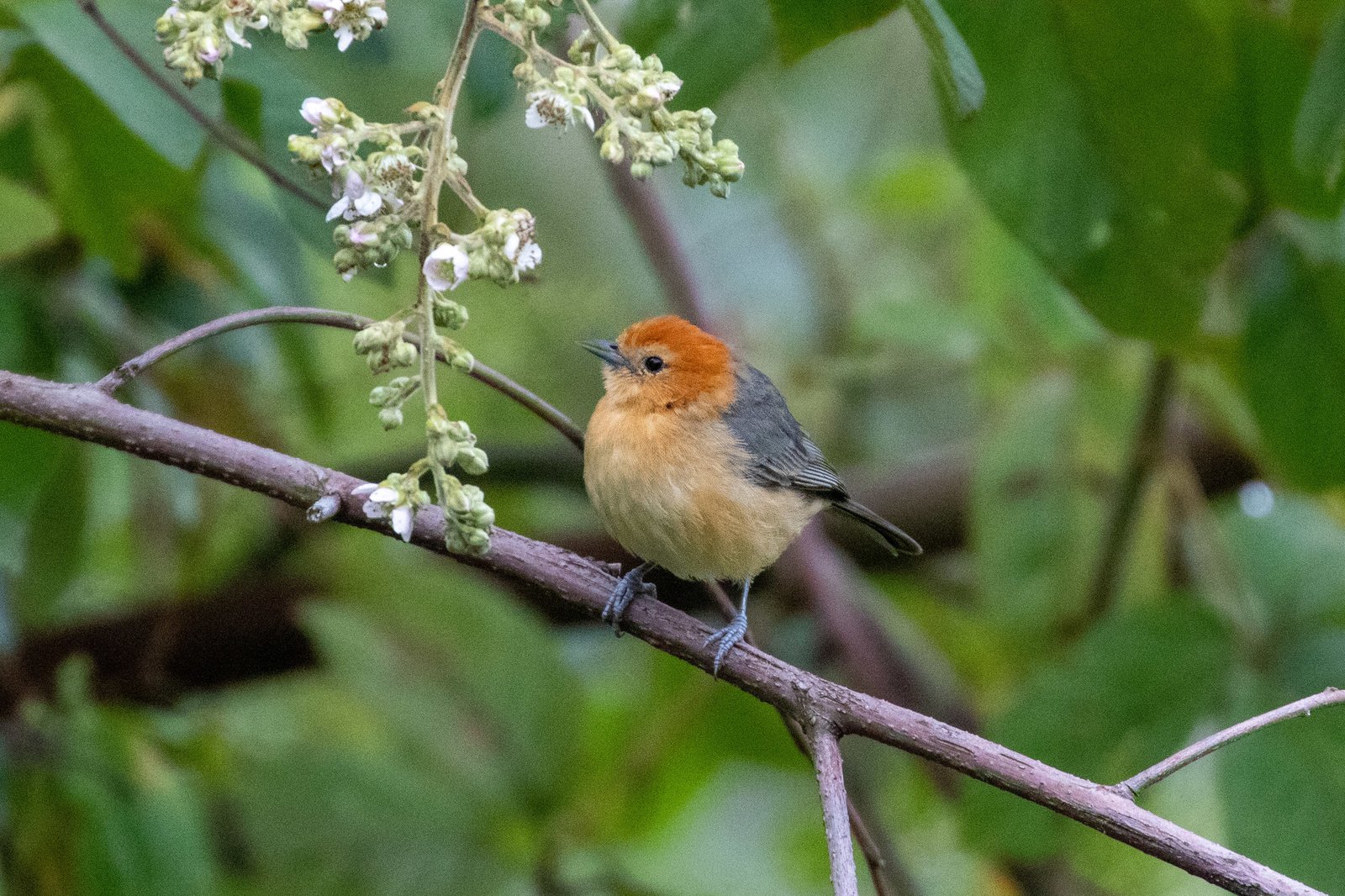
The Buff-bellied Tanager is a small tanager with a rufous head and buff underparts, almost restricted to the dry valley of the Marañón and its tributaries. It does not occur outside this valley and the adjacent far south of Ecuador. Pairs and small groups search the foliage for insects, often together with other species.
Voice
High, thin tsit and tsip calls. The song is a short series of high, rapidly repeated notes.
Recording: rudy gelis — CC BY-NC-SA 4.0 · xeno-canto
Identification
12–13 cm, with a pointed, dark bill. The crown and sides of the head are rufous to cinnamon, the upperparts grey. The throat, breast and belly are warm buff to pale ochre, the centre of the belly slightly paler. The sexes are nearly alike; the female is sometimes slightly duller. Juveniles are greyer, with a drab head.
Confusion species
Orange-headed Tanager Thlypopsis sordida has an orange-yellow head with a yellow throat and pale grey underparts, and lives in the Amazonian lowlands. Rufous-chested Tanager Thlypopsis ornata has a white belly and a more orange-rufous breast, and lives higher in wetter montane forest.
Habitat
Dry forest, riparian woodland, scrub and forest edges in the dry Marañón valley, also around fields and in coffee and fruit plantations, roughly between 500 and 2200 m. It searches leaves and twigs for insects in pairs or small groups, also in mixed flocks. Little is known about the nest.
Where the bird is most at home, classified by the vegetation units of the Andes and the west coast.


Range and movements
In Ecuador only in the far south, in the Chinchipe valley. In Peru in the dry valley of the Marañón and its tributaries in the north of the country. Absent from Colombia, Bolivia and the Galápagos. Does not occur outside the guide area.
- Resident
- dark = core range, pale = thinly spread
How and when to look
Search riparian woodland and scrub along the Marañón and its side valleys, for example around Jaén and Bagua. Watch for small, grey tanagers with a rufous head in mixed flocks.
Conservation status
Least Concern. The range is small, but the species tolerates open farmland with scrub and forest remnants.
Scientific name
Thlypopsis inornata | (Taczanowski, 1879)
Taczanowski described the species in 1879 as Nemosia inornata; because it was later moved to another genus, the author and year stand in brackets. The genus Thlypopsis was introduced in 1851 by Cabanis. The genus name combines Greek thlupis, an unknown small bird, with opsis, 'appearance'. The species name is Latin inornatus, 'unadorned, plain', for the plain plumage. The specimen the first description was based on came from Tambillo, Cajamarca, Peru.