All species › Passerines › Tanagers and allies › Orange-headed Tanager
Orange-headed Tanager | Thlypopsis sordida
Oranjekoptangare | Tangara cabecinaranja | Saí-canário
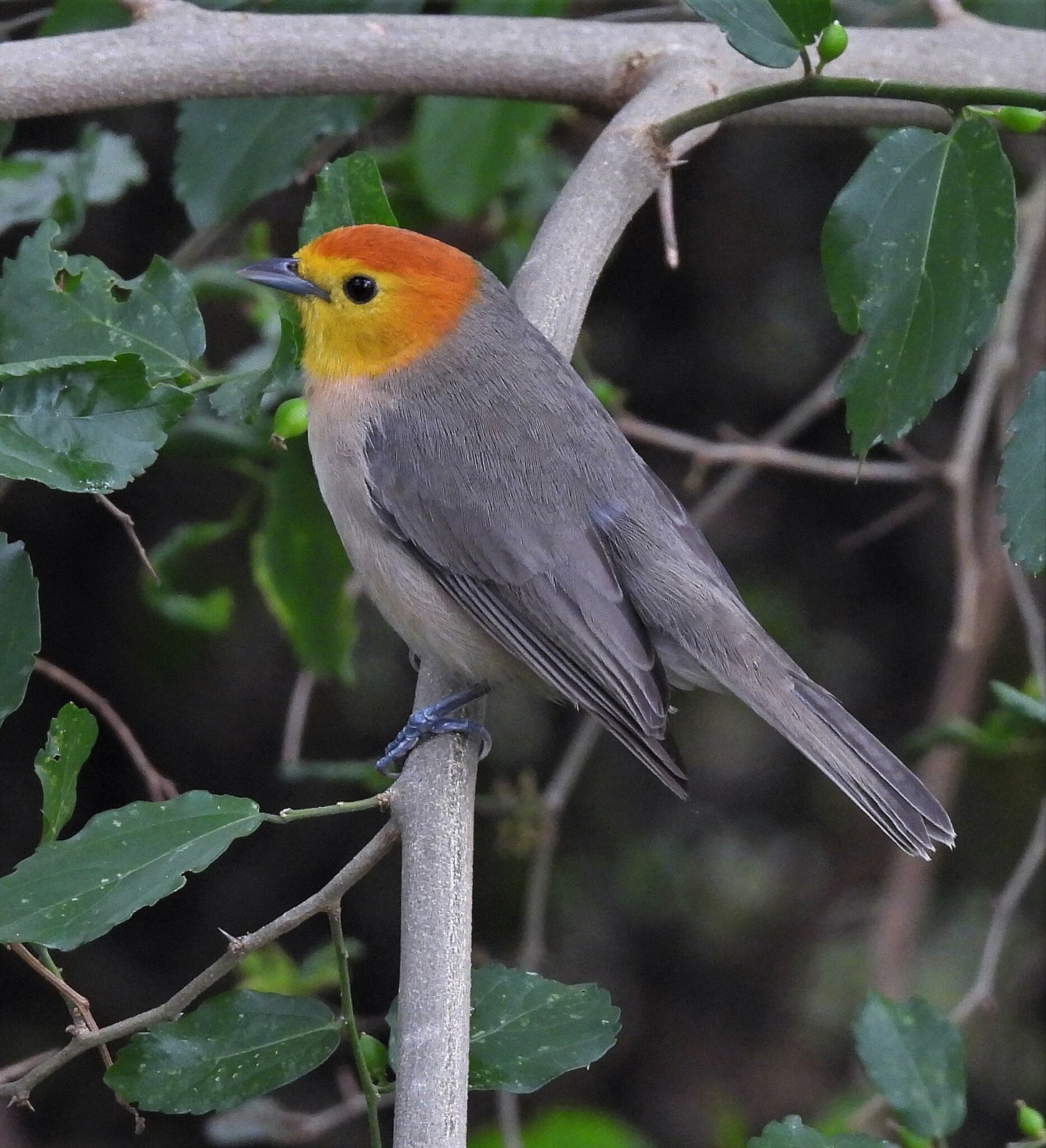
The Orange-headed Tanager is a small, grey tanager with an orange-yellow head, living mainly in scrub and young woodland along rivers in the lowlands east of the Andes. It searches the foliage for insects in pairs or small groups, often in mixed flocks. It is the most widespread member of the genus Thlypopsis and the only one found mainly in the lowlands.
Voice
High, thin tsit calls. The song is a short, fast series of high, squeaky notes.
Recording: Guilherme Melo — CC BY-NC-SA 4.0 · xeno-canto
Identification
13–14 cm, with a pointed, dark bill. The male has a warm orange-yellow crown and yellow lores, throat and eye-ring; the upperparts are grey and the underparts pale grey to dull white, with an ochre wash on the flanks and undertail coverts. The female is duller, with a yellower, less orange head. Juveniles are greyer, with a faintly yellow head.
Confusion species
Buff-bellied Tanager Thlypopsis inornata has a rufous head and buff underparts, and lives in the dry Marañón valley. Rust-and-yellow Tanager Thlypopsis ruficeps has yellow underparts and an olive back, and lives higher in the mountains. The female Guira Tanager Hemithraupis guira is olive-green with yellow underparts, and lives in the forest canopy.
Habitat
Scrub and young woodland on river islands and banks, forest edges, gardens and second growth, in the south also dry forest and savanna with groves; mostly below 1000 m, in Bolivia locally to roughly 2000 m in dry valleys. It searches leaves and twigs for insects and also eats small fruits. The nest is an open cup in a shrub.
Where the bird is most at home, classified by the vegetation units of the Andes and the west coast.


Range and movements
In Colombia in the eastern lowlands, especially along large rivers. In Ecuador in the east, especially on river islands of the Napo and other rivers. In Peru in the eastern lowlands and in the lower valleys at the foot of the Andes. In Bolivia widespread in the lowlands and in valleys of the eastern slope. Absent from the Galápagos. Outside the guide area in Venezuela, Brazil, Paraguay and northern Argentina.
- Resident
- dark = core range, pale = thinly spread
How and when to look
Search the scrub on river islands and along banks in the Amazonian lowlands, for example from a boat. Watch for pairs with an orange-yellow head moving with mixed flocks.
Conservation status
Least Concern. The species tolerates second growth and locally benefits from open, shrubby terrain.
Scientific name
Thlypopsis sordida | (d'Orbigny, ACVMD & de Lafresnaye, 1837)
D'Orbigny, ACVMD & de Lafresnaye described the species in 1837 as N[emosia] sordida; because it was later moved to another genus, the author and year stand in brackets. The genus Thlypopsis was introduced in 1851 by Cabanis. The genus name combines Greek thlupis, an unknown small bird, with opsis, 'appearance'. The species name is Latin sordidus, 'dirty, dull', for the drab body plumage. The specimen the first description was based on came from Yuracarés, Cochabamba, Bolivia.