All species › Passerines › Tanagers and allies › Black-faced Grassquit
Black-faced Grassquit | Melanospiza bicolor
Maskergrondvink | Semillero bicolor | Tiziu-de-cara-preta
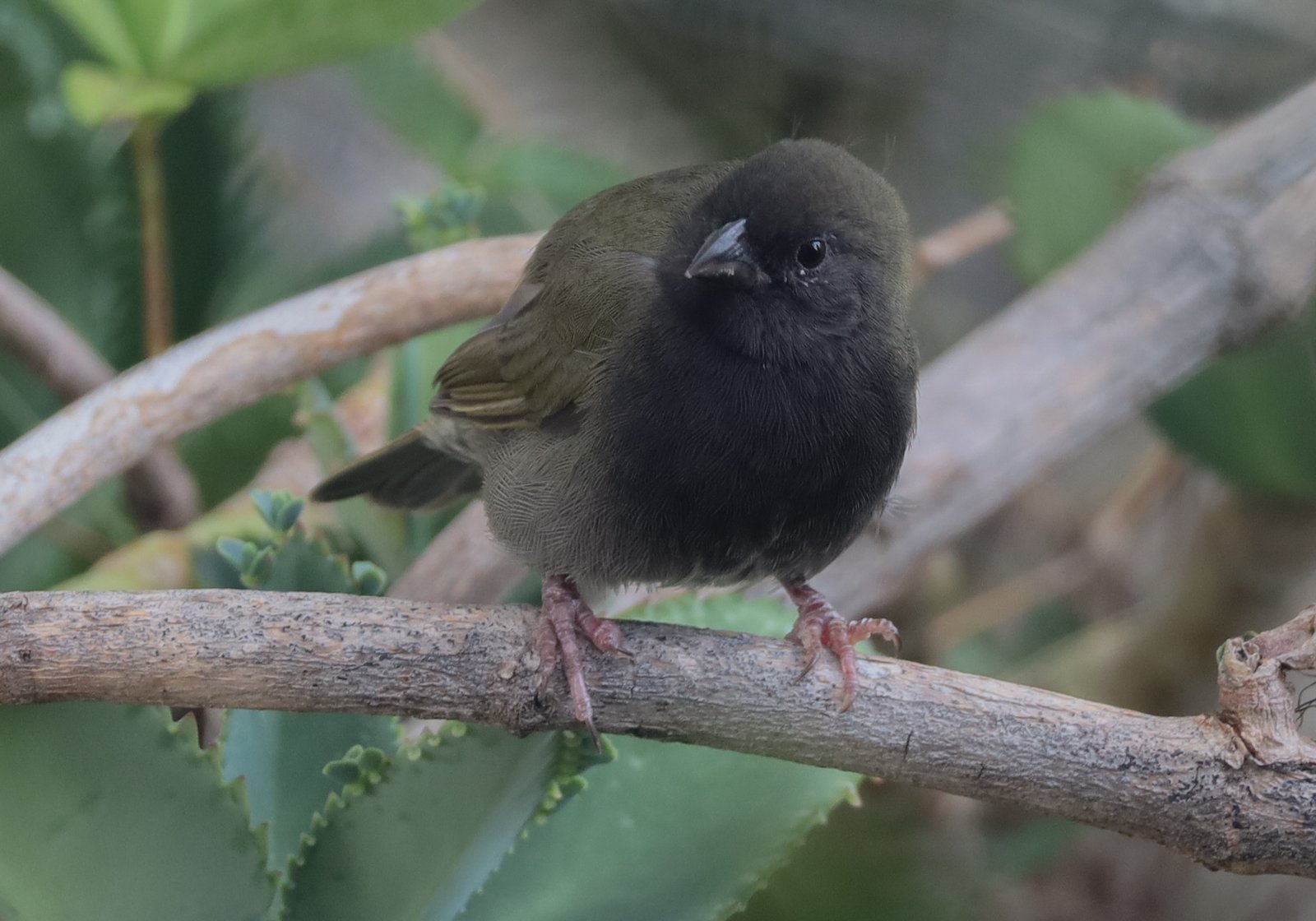
The Black-faced Grassquit is a small, dark finch of dry, open lowlands. The male has a black head and underparts and an olive back; the female is plain greyish olive. In the guide area it occurs only in northern Colombia, along the Caribbean coast.
Voice
The song is a short, buzzy and hissing tsi-dzzzt, often given during a short display flight in which the male flutters upward with quivering wings. The call is a soft tsip.
Recording: Francisco contreras — CC BY-NC-SA 4.0 · xeno-canto
Identification
10 cm, with a small, conical, blackish bill. The male has a black head, throat and breast grading into a dark grey to blackish belly; the back, wings and tail are duller olive. The female and juveniles are plain greyish olive, paler and greyer below, without markings, with a slightly paler bill. The sexes therefore differ.
Confusion species
Yellow-faced Grassquit Tiaris olivaceus shows yellow on the face in both sexes and lives higher on the mountain slopes. The male Sooty Grassquit Asemospiza fuliginosa is uniformly sooty black, including the back, and lives near humid montane forest. Female Blue-black Grassquits Volatinia jacarina are browner with a streaked breast, and female seedeaters Sporophila have a thicker, more rounded bill.
Habitat
Dry scrub, grassy clearings, roadsides, field edges, gardens and villages in the lowlands, from sea level to about 1000 m. It feeds on grass seeds and small seeds of herbs, taken on the ground or low in the grass, often in pairs or small groups. The nest is a globular structure with a side entrance, low in a shrub.
Where the bird is most at home, classified by the vegetation units of the Andes and the west coast.


Range and movements
In Colombia only in the north, in the dry Caribbean lowlands of La Guajira, Magdalena and Atlántico, around the Sierra Nevada de Santa Marta and locally in the lower Magdalena valley. Absent from Ecuador, Peru, Bolivia and the Galápagos. Outside the guide area in northern Venezuela, on Trinidad and Tobago, the islands off the Venezuelan coast and in the Caribbean.
- Resident
- dark = core range, pale = thinly spread
How and when to look
Along the Caribbean coast of Colombia, for example around Santa Marta and in La Guajira, in dry scrub and grassy verges; males draw attention with their short display flights.
Conservation status
Least Concern. The species lives in open, human-made landscapes and is common within its range.
Scientific name
Melanospiza bicolor | (Linnaeus, 1766)
Linnaeus described the species in 1766 as Fringilla bicolor; because it was later moved to another genus, the author and year stand in brackets. The genus Melanospiza was introduced in 1897 by Ridgway. The genus name comes from Greek melas, 'black', and spiza, 'finch'. The species name comes from Latin bicolor, 'two-coloured', after the male's black and olive plumage. The specimen the first description was based on came from Bahamas.