All species › Passerines › Tanagers and allies › Yellow-faced Grassquit
Yellow-faced Grassquit | Tiaris olivaceus
Grote cubavink | Tomeguín de la tierra | Tiziu-de-cara-amarela
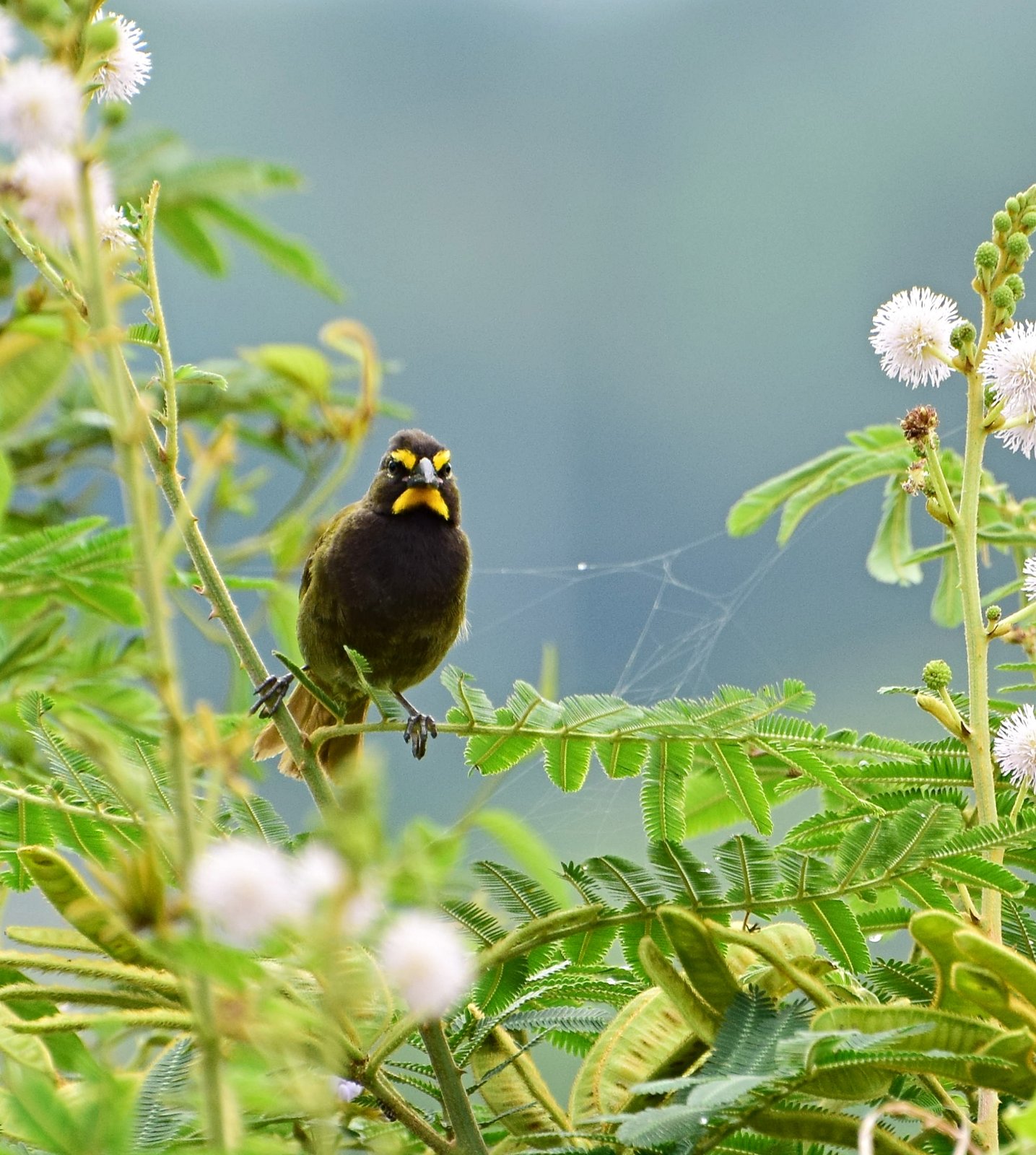
The Yellow-faced Grassquit is a small, olive-green finch; the male has a bright yellow supercilium and throat against a black face and breast. It lives in grassy clearings and pastures on the mountain slopes. In the guide area it occurs mainly in Colombia and reaches north-western Ecuador.
Voice
The song is a thin, dry, insect-like trill, such as tititititi, often given from a grass stem or small shrub. The call is a soft, high tsip.
Recording: Stephan Risch — CC BY-NC-SA 4.0 · xeno-canto
Identification
10 cm, with a small, pointed, conical black bill. The male is olive-green above, with a yellow supercilium, a yellow spot below the eye and a yellow throat; the forehead, lores, cheek and breast are black, and the belly is greyish olive. The extent of black varies. The female is plain olive-grey, paler below, with a faint yellowish supercilium and throat. Juveniles resemble the female and are even duller.
Confusion species
Black-faced Grassquit Melanospiza bicolor lacks yellow on the face; the male has a black head and underparts, and it lives in dry lowlands on the Caribbean coast. Dull-colored Grassquit Asemospiza obscura is browner, without yellow, with a pale lower mandible. Female Blue-black Grassquits Volatinia jacarina are brown with a streaked breast. Female seedeaters such as Yellow-bellied Seedeater Sporophila nigricollis have a thicker, more rounded bill.
Habitat
Grassy forest edges and clearings, pastures with shrubs, roadsides, abandoned fields and coffee plantations, mainly between about 1000 and 2300 m, locally lower. It feeds mainly on grass seeds, taken low in the grass or on the ground, often in pairs or small groups. The nest is a globular structure with a side entrance, low in a shrub or grass tussock.
Where the bird is most at home, classified by the vegetation units of the Andes and the west coast.


Range and movements
In Colombia in the Andes and the inter-Andean valleys, in the Sierra Nevada de Santa Marta and locally elsewhere. In Ecuador only locally in the north-west, near the Colombian border. Absent from Peru, Bolivia and the Galápagos. Outside the guide area from Mexico to Panama, in the Greater Antilles and in Venezuela.
- Resident
- dark = core range, pale = thinly spread
How and when to look
In Colombia, search grassy roadsides and pastures with shrubs at middle elevations; males sing from a grass stem or low shrub, mainly in the morning.
Conservation status
Least Concern. The species benefits from deforestation and the creation of grassy clearings.
Scientific name
Tiaris olivaceus | (Linnaeus, 1766)
Linnaeus described the species in 1766 as Emberiza olivacea; because it was later moved to another genus, the author and year stand in brackets. The genus Tiaris was introduced in 1827 by Swainson. The genus name comes from Greek tiaris, from tiara, 'tiara, headdress'. The species name is New Latin olivaceus, 'olive-green'. The specimen the first description was based on came from Hispaniola.