All species › Passerines › Tanagers and allies › Genovesa Cactus Finch
Genovesa Cactus Finch | Geospiza propinqua
Genovesacactusgrondvink | Pinzón cactero de Genovesa | Tentilhão-dos-cactos-de-genovesa
The Genovesa Cactus Finch is a large Darwin's finch found only on the north-eastern island of Genovesa. It was formerly included in Espanola Cactus Finch. On Genovesa, long-term research has shown how males with different song types and bill shapes forage differently at the Opuntia cacti.
Voice
The song is a short, simple phrase, often repeated. Two clearly different song types occur on Genovesa; each male sings one of them.
No recording with a suitable Creative Commons licence is available for this species yet.
Identification
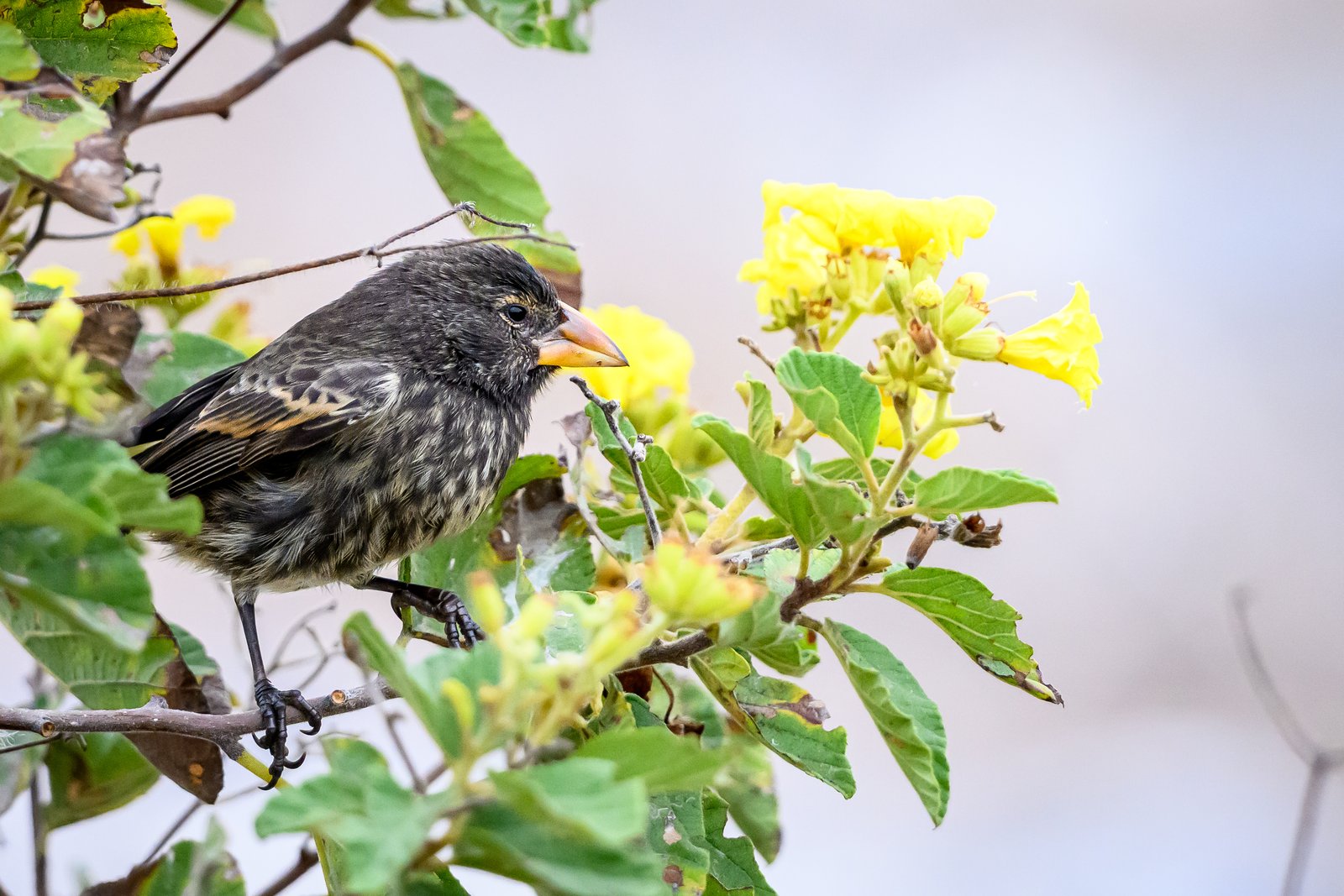
14 cm, with a long, deep, pointed bill, longer and less deep than in Espanola Cactus Finch. Adult males are entirely black, with whitish edges to the undertail coverts; younger males are partly black. Females and young birds are greyish brown above and heavily streaked dark below, with a paler bill. The bill is black in the breeding season, horn-coloured outside it.
Confusion species
Large Ground Finch Geospiza magnirostris, which also lives on Genovesa, is larger, with a much deeper, blunter bill. Genovesa Ground Finch Geospiza acutirostris is much smaller, with a small, pointed bill. Grey Warbler-Finch Certhidea fusca is small and greyish brown, with a thin bill. Common Cactus Finch Geospiza scandens is very similar but does not occur on Genovesa.
Habitat
The arid zone of the low, flat island, with shrubs, small trees and the low Opuntia helleri cacti, down to near the coast and the seabird colonies. It eats nectar, pollen, fruit and seeds of Opuntia, as well as seeds from the ground and insects from under bark and in rotting cactus wood. The nest is usually built in an Opuntia or shrub.
Where the bird is most at home, classified by the vegetation units of the Andes and the west coast.


Range and movements
Endemic to the Galápagos, only on Genovesa. Absent from the other islands and from mainland Colombia, Ecuador, Peru and Bolivia.
- Resident
How and when to look
Seen at the visitor sites on Genovesa, such as Prince Philip's Steps and Darwin Bay, among the cacti and shrubs of the arid zone. The birds are tame.
Conservation status
Vulnerable, because of its very small range on a single island. Numbers fluctuate strongly with dry years and El Niño. Introduced species and the introduced parasitic fly Philornis downsi are threats.
Scientific name
Geospiza propinqua | Ridgway, 1894
Ridgway described the species in 1894 and placed it straight away in the genus where it still stands. The genus Geospiza was introduced in 1837 by Gould. The genus name comes from Greek gē, 'earth, ground', and spiza, 'finch': a ground finch. The species name comes from Latin propinquus, 'near, related', after its close relationship to other cactus finches. The specimen the first description was based on came from Genovesa Island, Galápagos.