All species › Passerines › Tanagers and allies › Red Pileated Finch
Red Pileated Finch | Coryphospingus cucullatus
Rode kroongors | Brasita de fuego | Tico-tico-rei
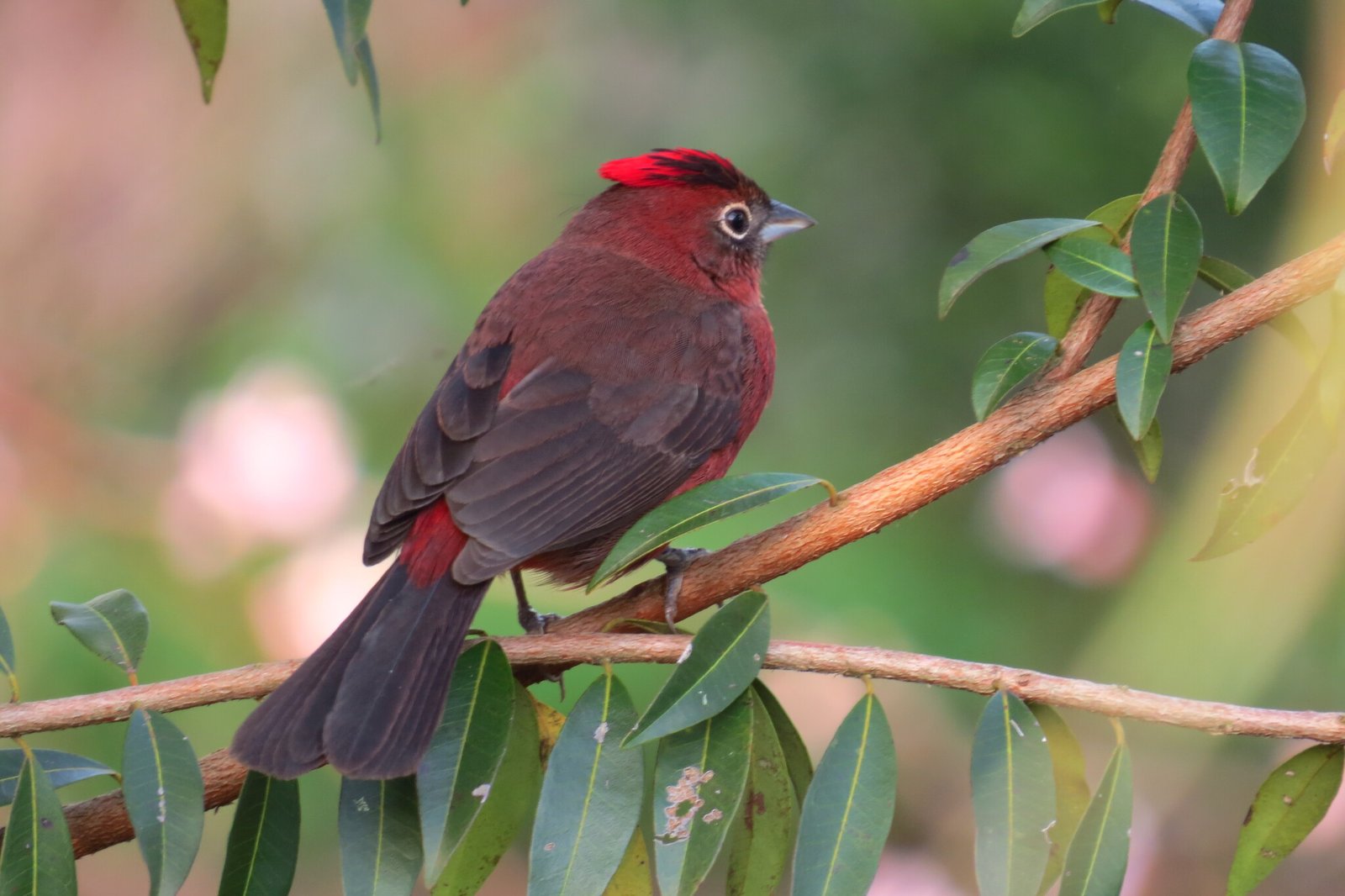
The Red Pileated Finch is a small, reddish tanager with a short conical bill, of dry woodland, scrub and semi-open country. The male has a scarlet crown stripe with a black border, which it raises when excited. In the guide area it is mainly a bird of Bolivia and of a few dry valleys on the eastern slope in Peru.
Voice
A short, dry chip call; the song is a short series of high, clear notes, often from an exposed branch.
Recording: Faustino Hollmann — CC BY-NC-SA 4.0 · xeno-canto
Identification
13–14 cm, with a short, pointed conical bill and a narrow white eye-ring. The male is dark reddish brown above, with a crimson rump and wine-red to crimson underparts; the crown has a scarlet central stripe, bordered black on both sides, that usually lies flat. The female is brown above with a reddish rump, and pinkish buff below, with no red on the crown. Young males resemble the female.
Confusion species
Grey Pileated Finch Coryphospingus pileatus is grey instead of red and lives in northern Colombia; the two species do not meet in the guide area. Crimson-breasted Finch Rhodospingus cruentus is smaller, black above, and lives only west of the Andes. Females resemble female seedeaters Sporophila and Blue-black Grassquit Volatinia jacarina, but have a white eye-ring, a more pointed bill and a reddish rump.
Habitat
Dry woodland, scrub, forest edges, overgrown fields and semi-open country with bushes, in the lowlands and in dry valleys up to about 2000 m. It forages on or just above the ground, often in pairs or small groups, feeding mainly on seeds and also on insects. The nest is a small open cup in a shrub.
Where the bird is most at home, classified by the vegetation units of the Andes and the west coast.


Range and movements
In Ecuador only locally in the far south, in the dry valley around Zumba. In Peru locally in dry and semi-open valleys on the eastern slope of the Andes, including the Marañón drainage and the south-east. In Bolivia widespread in the lowlands and dry Andean valleys of the centre and south. Absent from Colombia and the Galápagos. Outside the guide area in the Guianas, much of Brazil, Paraguay, Uruguay and northern Argentina.
- Resident
- dark = core range, pale = thinly spread
How and when to look
In Bolivia along forest edges and scrub around Santa Cruz and in the dry Andean valleys; look for a small, reddish bird foraging low in bushes or on the ground.
Conservation status
Least Concern. The species locally benefits from open, disturbed land and is common in much of its range; it is also trapped as a cage bird.
Scientific name
Coryphospingus cucullatus | (Müller, 1776)
Müller described the species in 1776 as Fringilla cucullata; because it was later moved to another genus, the author and year stand in brackets. The genus Coryphospingus was introduced in 1851 by Cabanis. The genus name combines Greek koruphē, 'crown of the head', and spingos, 'finch'. The species name is Latin cucullatus, 'hooded'. The specimen the first description was based on came from Cayenne, French Guiana.