All species › Passerines › Tanagers and allies › Grey Pileated Finch
Grey Pileated Finch | Coryphospingus pileatus
Grijze kroongors | Soldadito capirotado | Tico-tico-rei-cinza
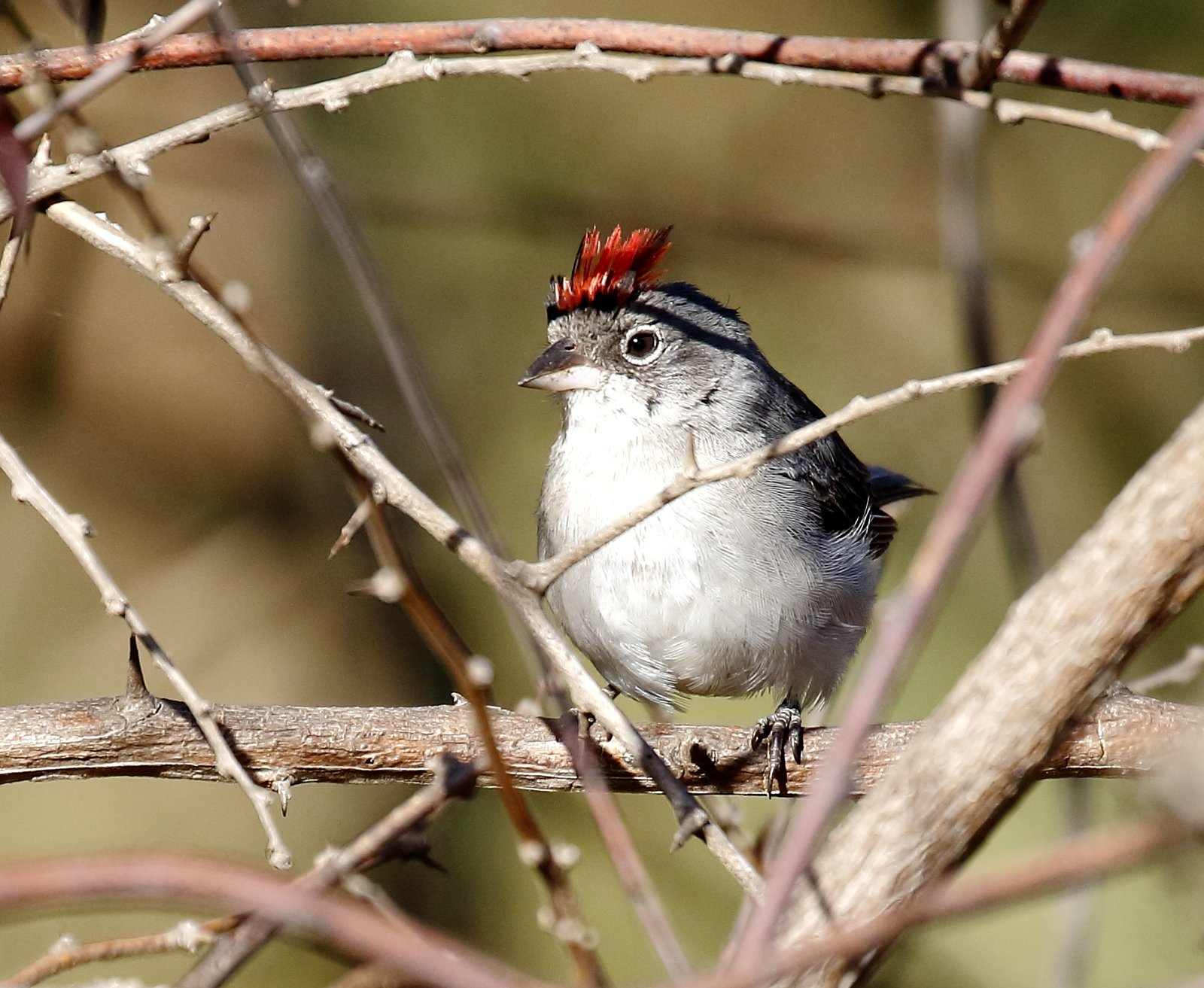
The Grey Pileated Finch is a small, grey tanager with a short conical bill and a red crown stripe, of dry scrub and thorn woodland in northern Colombia. When excited the male raises a scarlet crest bordered black on both sides. It forages in pairs or small groups low in bushes and on the ground.
Voice
A dry, short chip call; the song is a rapid series of high, clear notes, often repeated.
Recording: Robson Silva e Silva — CC BY-NC-SA 4.0 · xeno-canto
Identification
13–14 cm, with a short, pointed conical bill and a distinct white eye-ring. The male is grey above and pale grey to whitish below; the crown is black with a scarlet central stripe that is usually mostly hidden. The female is brownish grey above and dull white below, with faint grey streaking on the breast, and has no red or black on the crown. Juveniles resemble the female.
Confusion species
Red Pileated Finch Coryphospingus cucullatus is reddish brown with a crimson rump and does not occur in Colombia. Females resemble female seedeaters Sporophila, but have a more pointed bill, a white eye-ring and a greyer tone. Bluish-grey Saltator Saltator coerulescens is much larger, with a white supercilium and a white throat.
Habitat
Dry thorn scrub, dry deciduous woodland, forest edges and bushy pastures in the lowlands and dry valleys, up to about 1500 m. It forages low in bushes and on the ground for seeds and insects. The nest is a small open cup in a shrub.
Where the bird is most at home, classified by the vegetation units of the Andes and the west coast.


Range and movements
In Colombia in the dry Caribbean lowlands, from La Guajira to Cesar and Magdalena, and locally in dry parts of the Magdalena valley. Absent from Ecuador, Peru, Bolivia and the Galápagos. Outside the guide area in northern Venezuela and, separately, in eastern Brazil.
- Resident
- dark = core range, pale = thinly spread
How and when to look
Search the dry scrub of La Guajira, for example around Riohacha, for pairs foraging low in thorn bushes and along sandy tracks.
Conservation status
Least Concern. The species tolerates disturbed, open land and is fairly common in dry scrub.
Scientific name
Coryphospingus pileatus | (Wied-Neuwied, 1821)
Wied-Neuwied described the species in 1821 as Fringilla pileata; because it was later moved to another genus, the author and year stand in brackets. The genus Coryphospingus was introduced in 1851 by Cabanis. The genus name combines Greek koruphē, 'crown of the head', and spingos, 'finch'. The species name is Latin pileatus, 'capped', after the crest. The specimen the first description was based on came from Rio Pardo, Bahia, Brazil.