All species › Passerines › Tanagers and allies › Grey-crested Finch
Grey-crested Finch | Lophospingus griseocristatus
Grijze kuifgors | Soldadito gris | Tico-tico-de-topete-cinza
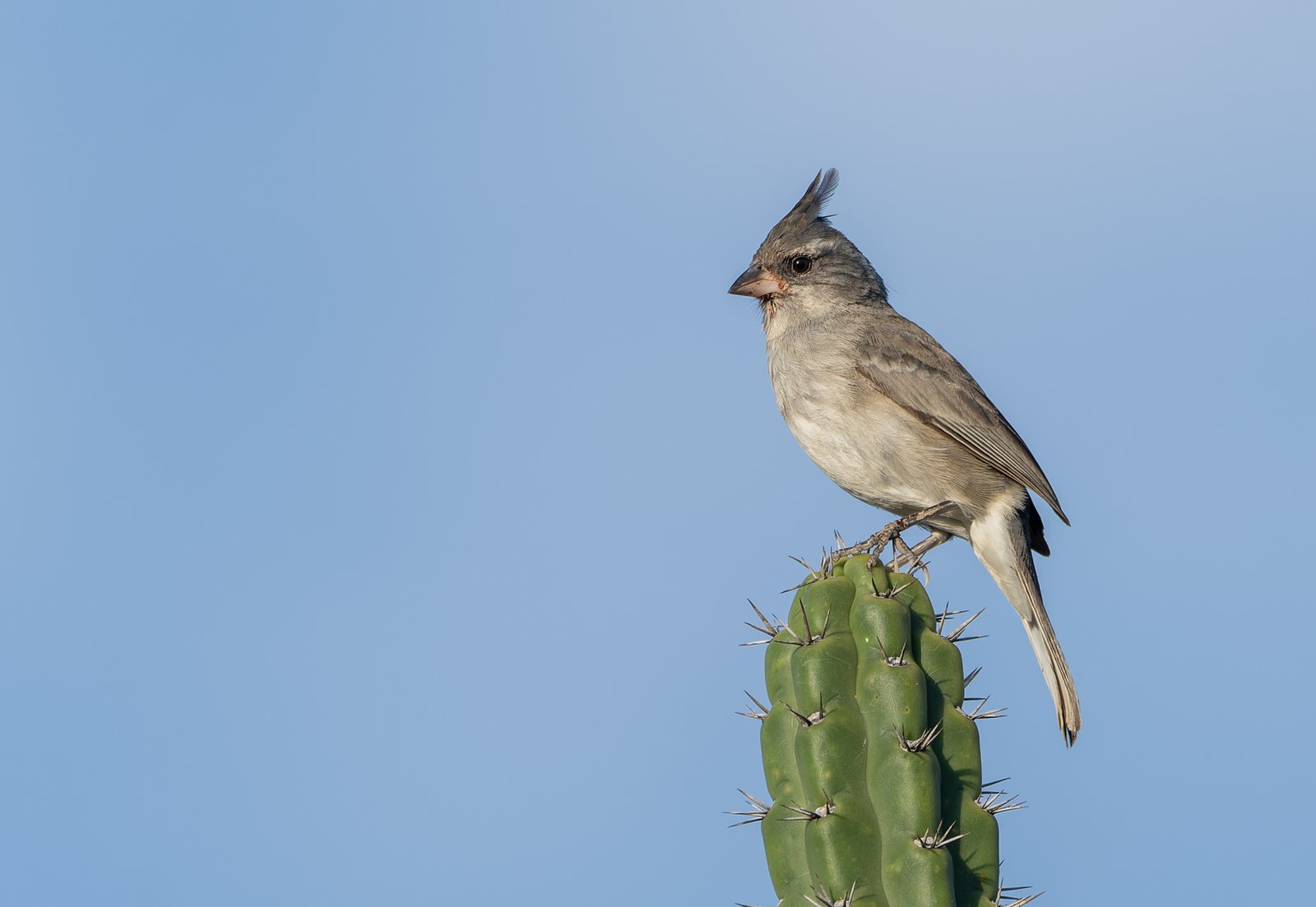
The Grey-crested Finch is a plain grey, finch-like tanager with a pointed crest, of the dry valleys in the Andes of Bolivia and northwestern Argentina. It lives in pairs or small groups in dry scrub and forages much on the ground.
Voice
Calls are soft tsip notes. The song is a short, clear series of whistles and trills, repeated from a shrub.
Recording: Dante Buzzetti — CC BY-NC-SA 4.0 · xeno-canto
Identification
14 cm, with a short, conical pink to horn-coloured bill. The plumage is almost plain slate-grey, with a pointed grey crest that is often raised. The belly is paler grey to whitish. The tail is blackish with broad white corners, visible mainly in flight. The sexes are almost alike. Juveniles are browner grey, with a shorter crest and faint streaking.
Confusion species
Black-crested Finch Lophospingus pusillus lives lower in the Chaco and has a black crest, a white supercilium and (in the male) a black throat. Mourning Sierra Finch Rhopospina fruticeti is larger, darker grey with a yellow bill and no crest. Red Pileated Finch Coryphospingus cucullatus is reddish-brown with a red crown.
Habitat
Dry scrub and thorn woodland with cacti in inter-Andean valleys, shrubby slopes, riparian scrub, hedgerows and field edges, mostly from about 1100 to 3000 m. It forages in pairs or small groups on the ground and low in shrubs for seeds and insects. The nest is a cup in a shrub or cactus.
Where the bird is most at home, classified by the vegetation units of the Andes and the west coast.


Range and movements
Does not occur in Colombia, Ecuador, Peru or on the Galápagos. In Bolivia in the dry Andean valleys from La Paz and Cochabamba south through Chuquisaca and Potosí to Tarija and western Santa Cruz. Outside the guide area in northwestern Argentina.
- Resident
- dark = core range, pale = thinly spread
How and when to look
Search dry scrub in the valleys around Cochabamba, near Comarapa and Saipina in Santa Cruz and around Tarija; the birds forage on the ground along tracks and fly up into a shrub when disturbed, showing the white tail corners.
Conservation status
Least Concern. Fairly common in dry scrub; tolerates man-made, semi-open country.
Scientific name
Lophospingus griseocristatus | (d'Orbigny, ACVMD & de Lafresnaye, 1837)
D'Orbigny, ACVMD & de Lafresnaye described the species in 1837 as Emberiza griseo-cristata; because it was later moved to another genus, the author and year stand in brackets. The genus Lophospingus was introduced in 1878 by Cabanis. The genus name comes from Greek lophos, 'crest', and spingos, 'finch'. The species name comes from Medieval Latin griseus, 'grey', and Latin cristatus, 'crested', after the grey crest. The specimen the first description was based on came from Vallegrande, Santa Cruz, Bolivia.