All species › Passerines › Tanagers and allies › Black-crested Finch
Black-crested Finch | Lophospingus pusillus
Boliviaanse kuifgors | Soldadito común | Tico-tico-de-topete-preto
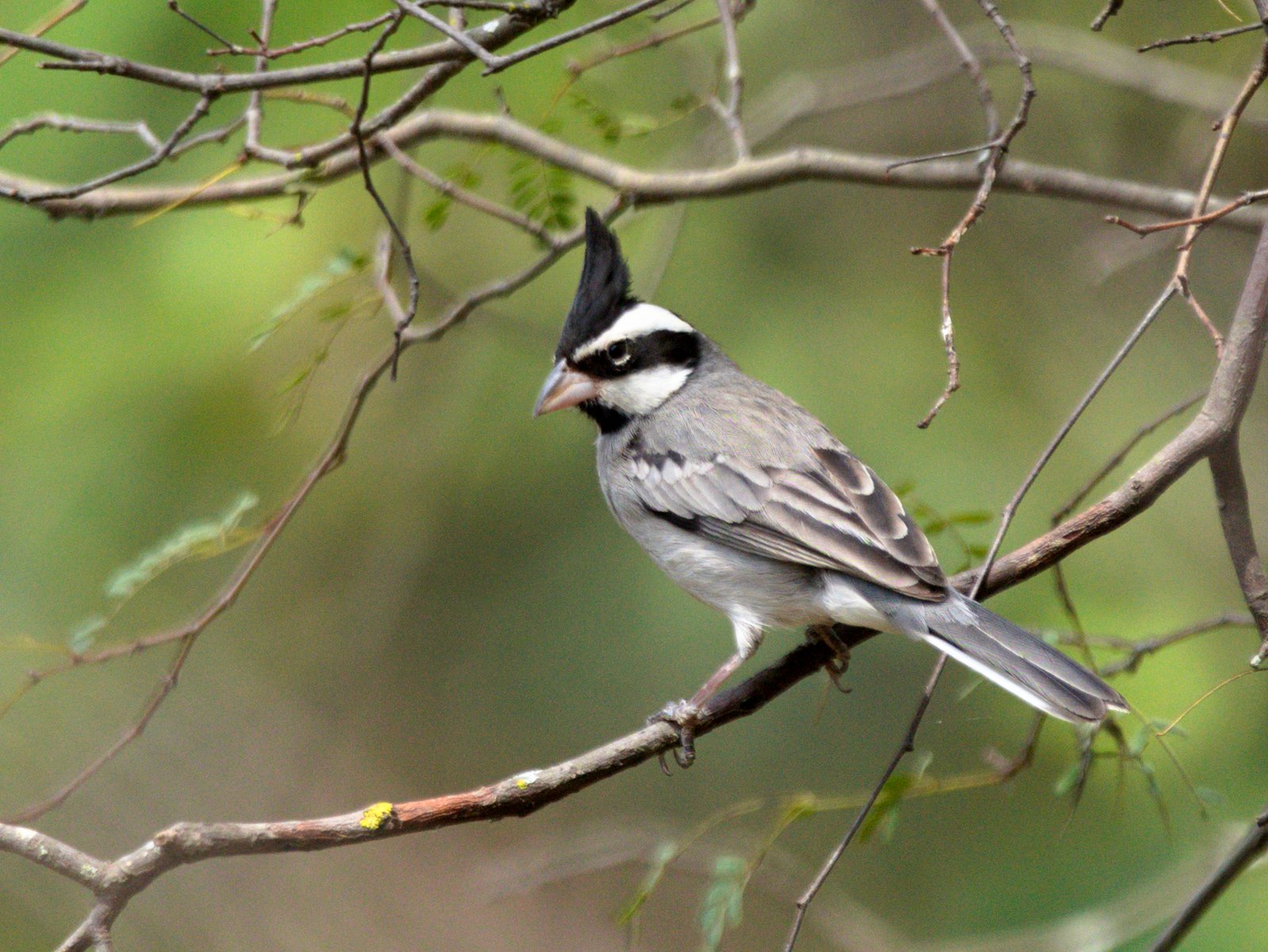
The Black-crested Finch is a small, finch-like tanager of dry Chaco woodland, with a black crest, a white supercilium and a black-and-white patterned head. In the guide area it occurs only in southeastern Bolivia.
Voice
Gives a soft tsip. The song is a short, varied series of clear notes and trills, from a shrub or low tree.
Recording: Carlos Ferrari — CC BY-NC-SA 4.0 · xeno-canto
Identification
13 cm, with a short, conical pink bill. The male has a black, pointed crest, a broad white supercilium, black ear coverts and a black throat bordered by a white malar stripe. The upperparts are grey, the underparts pale grey to white. The wings have two narrow white bars; the tail is blackish with white corners. The female has a greyer crest, a less sharply patterned head and a whitish throat. Juveniles are browner and streaked.
Confusion species
Grey-crested Finch Lophospingus griseocristatus lives higher in dry Andean valleys and is plain grey, without a black-and-white head pattern. Many-colored Chaco Finch Saltatricula multicolor has a black face, pinkish-orange flanks and a yellow bill and no crest. Grey Pileated Finch Coryphospingus pileatus does not occur in Bolivia; Red Pileated Finch Coryphospingus cucullatus is reddish-brown with a red crown.
Habitat
Dry Chaco woodland, thorn scrub and open, shrubby country with cacti, also edges of fields and pasture, from the lowlands up to about 1500 m, locally in the lower dry valleys. It forages in pairs or small groups on the ground and low in shrubs for seeds and insects. The nest is a cup in a thorny shrub.
Where the bird is most at home, classified by the vegetation units of the Andes and the west coast.


Range and movements
Does not occur in Colombia, Ecuador, Peru or on the Galápagos. In Bolivia in the Chaco of the southeast, in southern Santa Cruz, eastern Chuquisaca and eastern Tarija. Outside the guide area in western Paraguay and northern Argentina.
- Resident
- dark = core range, pale = thinly spread
How and when to look
Search Chaco scrub around Villamontes and Boyuibe; the birds forage on the ground along sandy tracks and fly up into a shrub, showing the white tail corners.
Conservation status
Least Concern. Fairly common in Chaco scrub; habitat is declining locally through clearing for agriculture and cattle ranching.
Scientific name
Lophospingus pusillus | (Burmeister, 1860)
Burmeister described the species in 1860 as Gubernatrix pusilla; because it was later moved to another genus, the author and year stand in brackets. The genus Lophospingus was introduced in 1878 by Cabanis. The genus name comes from Greek lophos, 'crest', and spingos, 'finch'. The species name comes from Latin pusillus, 'very small'. The specimen the first description was based on came from Tucumán, Argentina.