All species › Passerines › Tanagers and allies › Flame-rumped Tanager
Flame-rumped Tanager | Ramphocelus flammigerus
Vuurrugtangare | Tangara lomiflama | Pipira-de-uropígio-flamejante
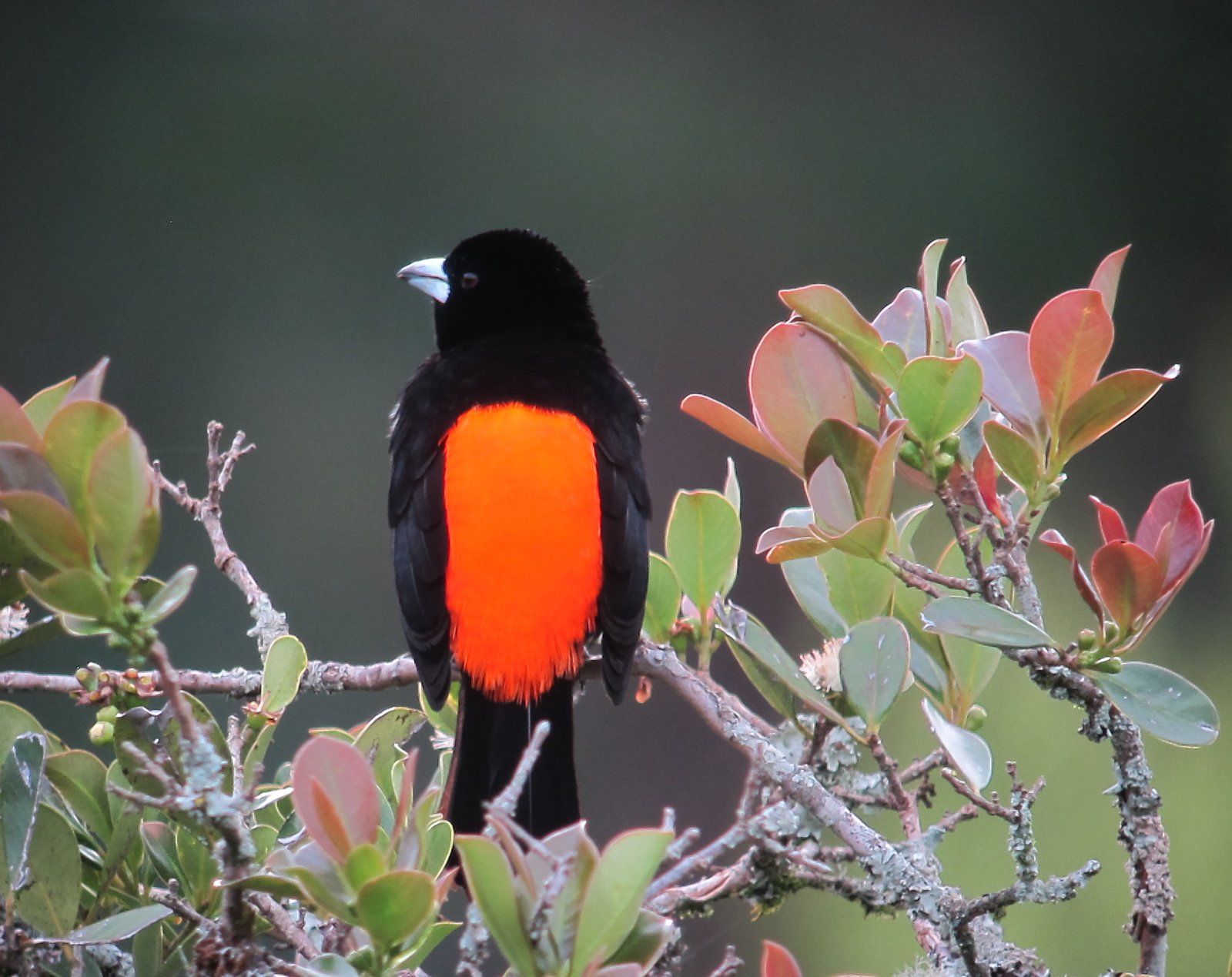
The Flame-rumped Tanager is a tanager of forest edges and scrub in western Colombia and Ecuador. The male is velvety black with a brightly coloured rump, which is flame red-orange or lemon yellow depending on the form. The yellow form is sometimes treated as a separate species, Lemon-rumped Tanager; where both forms meet, intermediates occur.
Voice
Flocks give constant sharp, metallic chek calls; the song is a simple, repeated series of whistled notes, often at dawn and dusk.
Recording: Johan Chaves — CC BY-NC-SA 4.0 · xeno-canto
Identification
18–19 cm, with a conspicuous, pale bluish-silver bill with a dark tip. The male is velvety black, with a large rump patch that is flame red to orange in the form of the Cauca Valley and lemon yellow in the form of the Pacific lowlands. The female is dark brownish-grey above, with an orange-yellow to yellow rump and yellow to orange-yellow underparts, and a paler throat. Juveniles resemble the female.
Confusion species
Crimson-backed Tanager Ramphocelus dimidiatus in northern Colombia has a dark maroon head and a red rump and belly. Scarlet-rumped Tanager Ramphocelus passerinii of Central America has a scarlet rump and is smaller. The female White-lined Tanager Tachyphonus rufus is uniform rufous, without yellow or orange underparts.
Habitat
Forest edges, clearings, scrub, riversides, plantations and gardens, from sea level to roughly 2000 m. It lives in noisy small flocks that move through shrubs and low trees and eat mainly fruit, also insects. The nest is a cup in a shrub or low tree.
Where the bird is most at home, classified by the vegetation units of the Andes and the west coast.


Range and movements
In Colombia on the Pacific side and in the western and central Andes, with the red form mainly in the Cauca Valley and adjacent slopes and the yellow form in the Pacific lowlands and foothills, also in the north-west. In Ecuador in the western lowlands and on the western slopes, south to about El Oro. Absent from Peru, Bolivia and the Galápagos. Outside the guide area in Panama.
- Resident
- dark = core range, pale = thinly spread
How and when to look
Along roadsides and in scrub in western Colombia and Ecuador you often see small flocks of black males with a yellow or orange-red rump flying back and forth between the shrubs.
Conservation status
Least Concern. The species is common and benefits from open, human-shaped landscapes.
Scientific name
Ramphocelus flammigerus | (Jardine & Selby, 1833)
Jardine & Selby described the species in 1833 as Ramphopis flammigerus; because it was later moved to another genus, the author and year stand in brackets. The genus Ramphocelus was introduced in 1805 by Desmarest, A-G. The genus name combines Greek rhamphos, 'bill', and koilos, 'hollow, concave'. The species name comes from Latin flammiger, 'flame-bearing' (flamma, 'flame', and gerere, 'to carry'), for the fiery rump. The specimen the first description was based on came from Antioquia, Colombia.