All species › Passerines › Tanagers and allies › Huallaga Tanager
Huallaga Tanager | Ramphocelus melanogaster
Zwartbuiktangare | Tangara del Huallaga | Pipira-do-huallaga
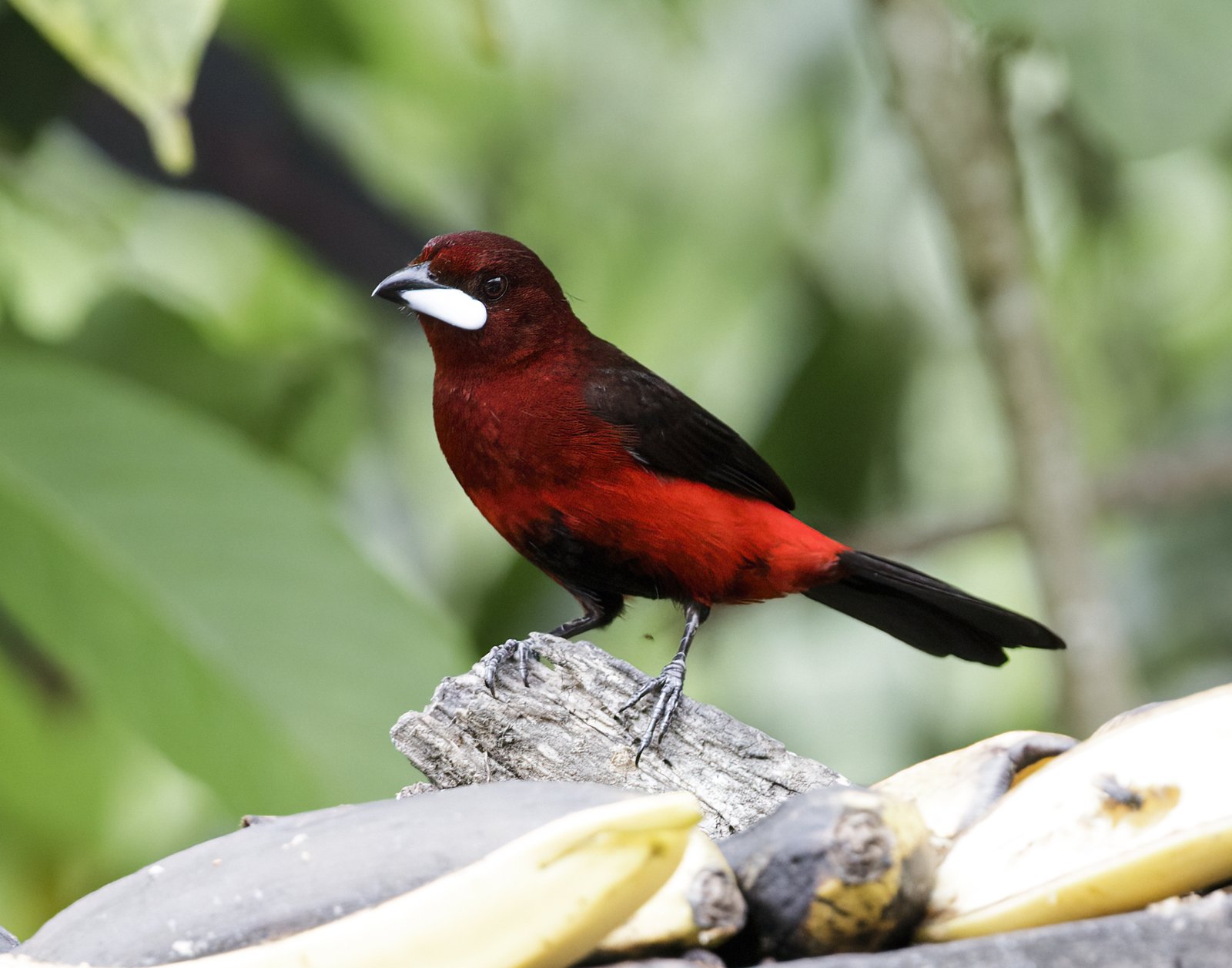
The Huallaga Tanager is a tanager found only in Peru, in the Huallaga Valley and adjacent valleys on the eastern side of the Andes. The male has a wine-red head, a crimson rump and underparts, and a black centre to the belly. The species is closely related to Silver-beaked Tanager, which lives in the surrounding lowlands.
Voice
Gives a sharp chek; the song is a simple, repeated series of whistled notes, often in the early morning.
Recording: Guilherme Melo Becher — CC BY-NC-SA 4.0 · xeno-canto
Identification
16–17 cm, with a black upper mandible and, in the male, a greatly expanded, silvery-white lower mandible. The male has a dark wine-red head and throat, a blackish mantle, black wings and tail, a crimson lower back and rump, crimson flanks and breast, and a black centre to the belly. The female is duller and browner, with a reddish-brown head, a reddish rump and belly and a less conspicuous lower mandible. Juveniles resemble the female.
Confusion species
The male Silver-beaked Tanager Ramphocelus carbo is mostly dark blackish-red, without a bright crimson rump and flanks; the female is more uniform reddish-brown. Masked Crimson Tanager Ramphocelus nigrogularis has a black mask and a crimson head, and lives along rivers and lakes in the Amazonian lowlands.
Habitat
Forest edges, scrub, second growth, plantations and gardens on the lower slopes and in the valleys on the eastern side of the Andes, roughly between 300 and 1500 m. It lives in small flocks that eat mainly fruit in shrubs and low trees, also insects. The nest is a cup in a shrub.
Where the bird is most at home, classified by the vegetation units of the Andes and the west coast.


Range and movements
Endemic to Peru: on the eastern side of the Andes in the Huallaga Valley and adjacent valleys, mainly in San Martín and Huánuco, with a separate form in the north of the range. Absent from Colombia, Ecuador, Bolivia and the Galápagos. Occurs nowhere outside the guide area.
- Resident
- dark = core range, pale = thinly spread
How and when to look
Along roads through the valleys of San Martín, for example around Tarapoto and Moyobamba, you regularly see the species in scrub and gardens; note the crimson rump and black belly centre of the male.
Conservation status
Least Concern. The species is locally common and tolerates heavily modified landscapes; its range is small, however.
Scientific name
Ramphocelus melanogaster | (Swainson, 1838)
Swainson described the species in 1838 as Rhamphopis melanogaster; because it was later moved to another genus, the author and year stand in brackets. The genus Ramphocelus was introduced in 1805 by Desmarest, A-G. The genus name combines Greek rhamphos, 'bill', and koilos, 'hollow, concave'. The species name combines Greek melas, 'black', and gastēr, 'belly'. The specimen the first description was based on came from Moyobamba, San Martín, Peru.