All species › Passerines › Tanagers and allies › Genovesa Ground Finch
Genovesa Ground Finch | Geospiza acutirostris
Genovesagrondvink | Pinzón terrestre de Genovesa | Tentilhão-terrestre-de-genovesa
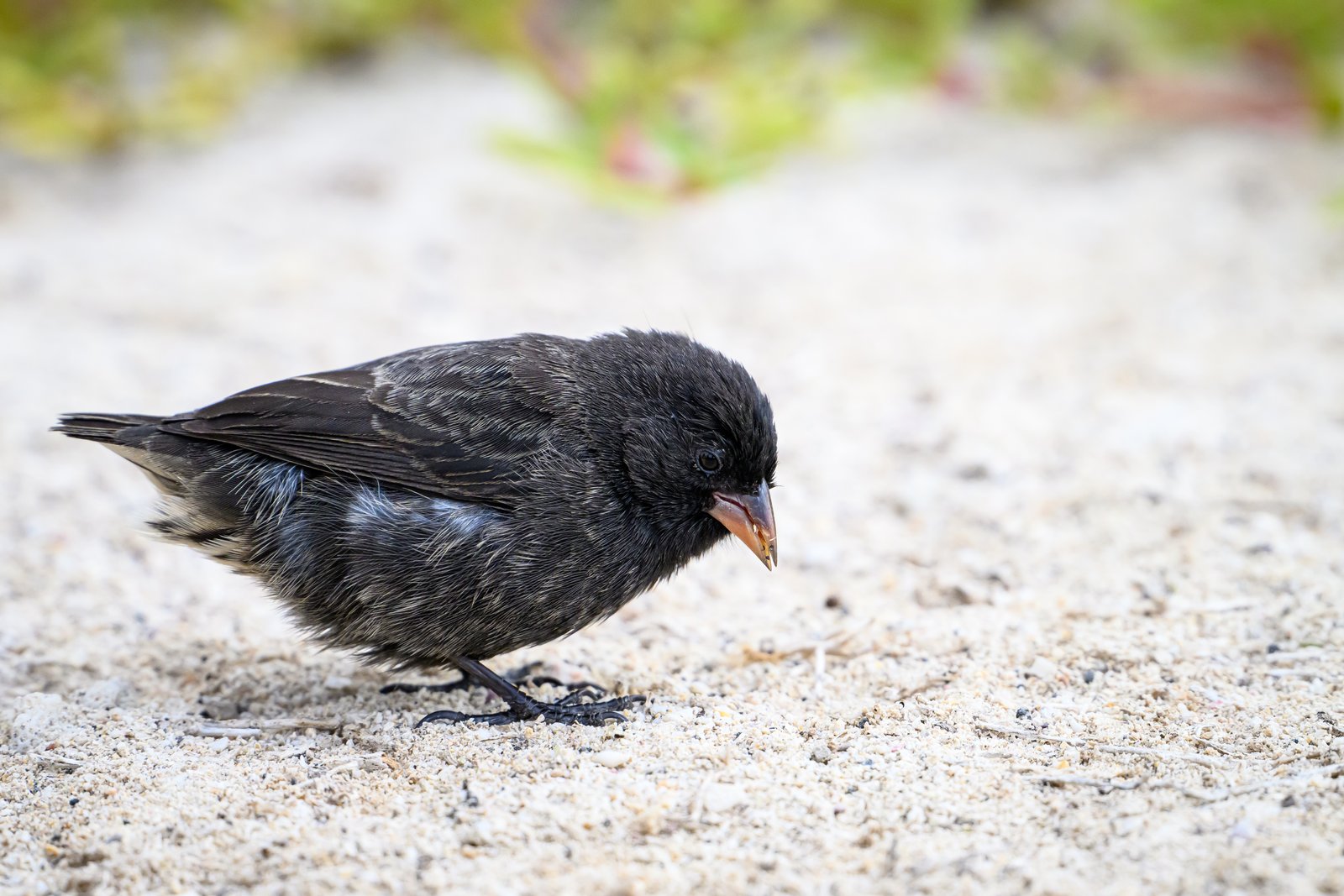
The Genovesa Ground Finch occurs only on Genovesa, in the north-east of the Galápagos. It was long treated as a subspecies of Sharp-beaked Ground Finch and has only recently been recognised as a separate species. On Genovesa it takes the place of Small Ground Finch, which is absent there.
Voice
The song is a short series of repeated chirping or buzzing notes, similar to that of other ground finches.
Recording: Barry Edmonston — CC BY-NC-SA 4.0 · xeno-canto
Identification
11–12 cm, with a fairly long, pointed, conical bill with a straight upper edge, longer and more pointed than that of Small Ground Finch. Adult males are entirely black, with a black bill in the breeding season. Females and young birds are greyish brown above and dingy white with dark streaking below, with a paler bill.
Confusion species
Three other Darwin's finches live on Genovesa. Large Ground Finch Geospiza magnirostris is much larger, with a very deep bill. Genovesa Cactus Finch Geospiza propinqua is larger, with a longer, thicker and slightly decurved bill. Grey Warbler-Finch Certhidea fusca is smaller and grey, with a thin bill. Small Ground Finch Geospiza fuliginosa does not occur on Genovesa.
Habitat
The arid zone of Genovesa, with low shrubs, Opuntia, Bursera and lava rocks, including around the seabird colonies. It eats seeds, insects and the nectar and pollen of Opuntia, mostly on or near the ground. The nest is a domed structure in a shrub or cactus.
Where the bird is most at home, classified by the vegetation units of the Andes and the west coast.


Range and movements
Endemic to Genovesa (Galápagos); it occurs on no other island. Absent from mainland Colombia, Ecuador, Peru and Bolivia.
- Resident
How and when to look
Along the visitor trails of Genovesa, at Darwin Bay and Prince Philip's Steps, where it forages together with Large Ground Finch and Genovesa Cactus Finch.
Conservation status
Vulnerable. The species occurs on only one small island, which makes it sensitive to introduced predators, diseases and the parasitic fly Philornis downsi, and to extreme drought. The population fluctuates strongly between dry and wet years (El Niño).
Scientific name
Geospiza acutirostris | Ridgway, 1894
Ridgway described the species in 1894 and placed it straight away in the genus where it still stands. The genus Geospiza was introduced in 1837 by Gould. The genus name comes from Greek gē, 'earth, ground', and spiza, 'finch': a ground finch. The species name comes from Latin acutus, 'sharp, pointed', and -rostris, 'billed': sharp-billed. The specimen the first description was based on came from Genovesa Island, Galápagos.