All species › Passerines › Tanagers and allies › Vampire Ground Finch
Vampire Ground Finch | Geospiza septentrionalis
Vampiergrondvink | Pinzón vampiro | Tentilhão-vampiro
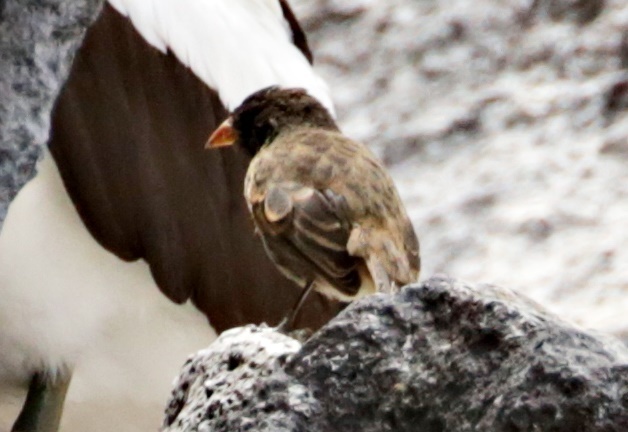
The Vampire Ground Finch lives only on the remote northern islands of Wolf and Darwin. It is known for its behaviour in the dry season: it pecks at the base of the feathers of nesting boobies, especially Nazca Booby, and drinks the blood. It also rolls seabird eggs against rocks to break them open.
Voice
The song is a short series of repeated chirping or buzzing notes, similar to that of other ground finches.
No recording with a suitable Creative Commons licence is available for this species yet.
Identification
12 cm, with a fairly long, pointed, conical bill with a straight upper edge. Adult males are entirely black, with a black bill. Females and young birds are greyish brown above and dingy white with dark streaking below, with a paler bill. Until recently the species was treated as a subspecies of Sharp-beaked Ground Finch Geospiza difficilis.
Confusion species
Few other finches live on Wolf and Darwin. Large Ground Finch Geospiza magnirostris is much larger, with a very deep bill. Common Cactus Finch Geospiza scandens and Small Ground Finch Geospiza fuliginosa do not occur there. Grey Warbler-Finch Certhidea fusca is smaller and grey, with a thin bill.
Habitat
The dry, rocky slopes and plateaus of Wolf and Darwin, with low shrubs, Opuntia and seabird colonies. In the wet season it eats seeds, insects and the nectar and pollen of Opuntia; in the dry season also blood of Nazca Boobies Sula granti and Red-footed Boobies Sula sula, and the contents of seabird eggs. The nest is a domed structure in a shrub or cactus.
Where the bird is most at home, classified by the vegetation units of the Andes and the west coast.


Range and movements
Endemic to the Galápagos: only on Wolf and Darwin in the far north-west of the archipelago. Absent from mainland Colombia, Ecuador, Peru and Bolivia.
- Resident
How and when to look
Wolf and Darwin are closed to visitors; landing is possible only with a research permit. Dive boats do pass the islands, but the finches are seldom seen from the water.
Conservation status
Vulnerable. The range is very small, on two small islands, which makes the species sensitive to introduced predators, diseases and the parasitic fly Philornis downsi, and to extreme drought.
Scientific name
Geospiza septentrionalis | Rothschild & Hartert, 1899
Rothschild & Hartert described the species in 1899 and placed it straight away in the genus where it still stands. The genus Geospiza was introduced in 1837 by Gould. The genus name comes from Greek gē, 'earth, ground', and spiza, 'finch': a ground finch. The species name comes from Latin septentrionalis, 'northern', after its occurrence on the northern islands of Wolf and Darwin. The specimen the first description was based on came from Wolf Island, Galápagos.