All species › Passerines › Tanagers and allies › Large Ground Finch
Large Ground Finch | Geospiza magnirostris
Grote grondvink | Pinzón terrestre grande | Tentilhão-terrestre-grande
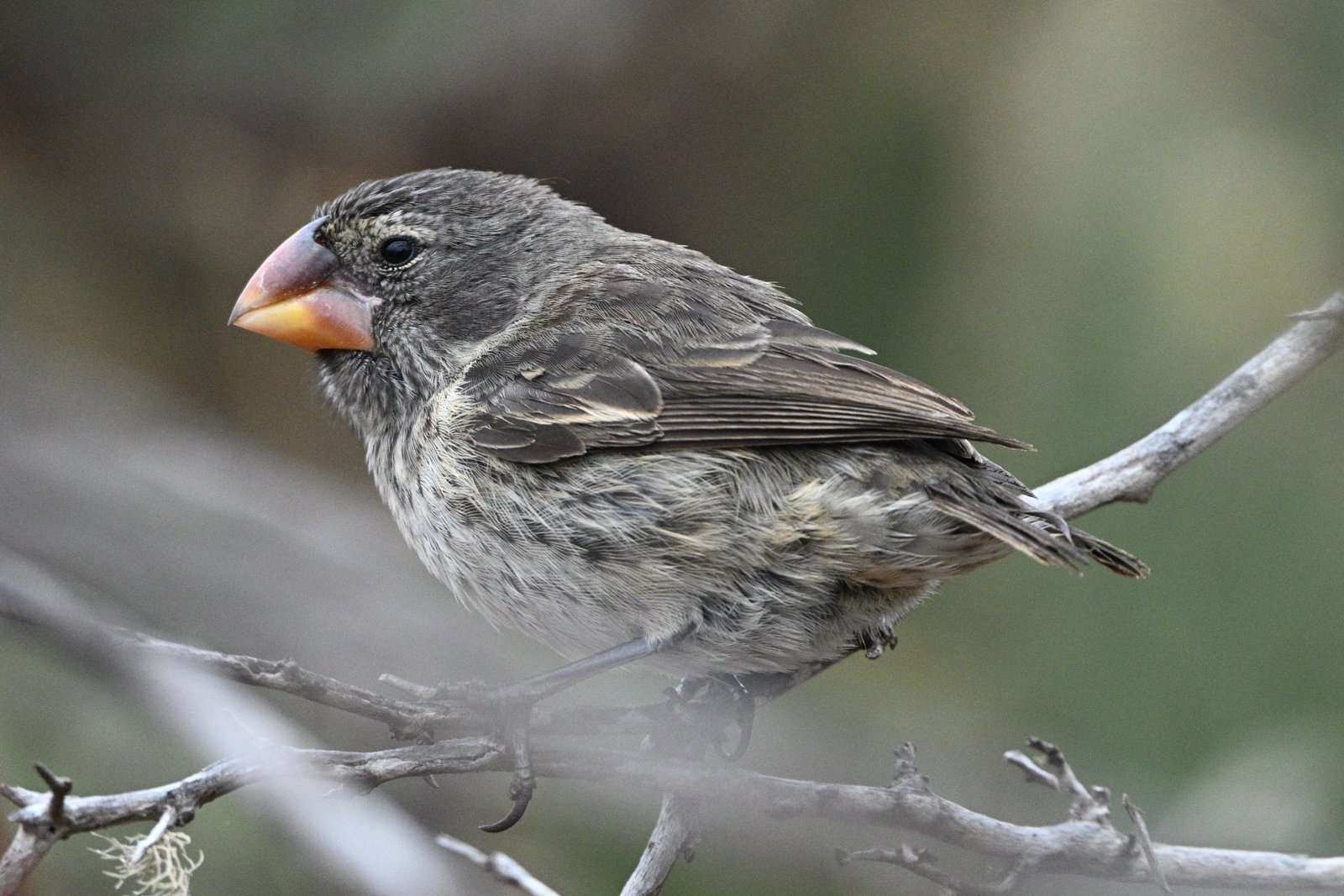
The Large Ground Finch has the heaviest bill of all Darwin's finches: deep, broad and conical. With it, it cracks hard seeds and fruits that other finches cannot open, such as the spiny fruits of Tribulus. In dry years, when soft seeds run out, this bill gives it an advantage.
Voice
The song is a short, low phrase of a few repeated, forceful notes, lower than in the smaller ground finches. The call is a low chirp.
Recording: Charlie Vogt — CC BY-NC-SA 4.0 · xeno-canto
Identification
16 cm, a bulky, short-tailed finch with a very large, deep, conical bill; the base of the bill is often wider than the forehead. Adult males are entirely black, with a black bill in the breeding season. Females and young birds are dark greyish brown above and heavily streaked dark below, with a paler, horn-coloured bill.
Confusion species
Medium Ground Finch Geospiza fortis is smaller, with a smaller bill; large individuals resemble small Large Ground Finches and cannot always be separated with certainty in the field. Small Ground Finch Geospiza fuliginosa is much smaller, with a short, pointed bill. Vegetarian Finch Platyspiza crassirostris also has a thick bill, but with a curved upper edge, and males have only a black head and breast.
Habitat
Mainly the arid lowland zone with shrubs, cacti and Bursera woodland, and the lava fields; in smaller numbers higher on the islands. It eats hard seeds and fruits, which it cracks with its bill, as well as softer seeds, insects and Opuntia nectar. The nest is a domed structure in a shrub, tree or cactus.
Where the bird is most at home, classified by the vegetation units of the Andes and the west coast.


Range and movements
Endemic to the Galápagos, including Genovesa, Marchena, Pinta, Santiago, Santa Cruz, Isabela, Fernandina, Wolf and Darwin, and breeding on Daphne Major since 1982. Extinct on Floreana and San Cristóbal. Absent from mainland Colombia, Ecuador, Peru and Bolivia.
- Resident
How and when to look
On Genovesa, along the trails at Darwin Bay and Prince Philip's Steps, where the species is numerous; also in the arid zone of Santa Cruz.
Conservation status
Least Concern. The species is widespread. Numbers fluctuate between dry and wet years (El Niño), and the parasitic fly Philornis downsi also affects this species.
Scientific name
Geospiza magnirostris | Gould, 1837
Gould described the species in 1837 and placed it straight away in the genus where it still stands. He introduced the genus Geospiza in that same work. The genus name comes from Greek gē, 'earth, ground', and spiza, 'finch': a ground finch. The species name comes from Latin magnus, 'large', and -rostris, 'billed': large-billed. The specimen the first description was based on came from Galápagos Islands, Ecuador.